Writing Clear, Measurable Learning Objectives for a Lesson Plan
A clear, measurable learning objective states what learners should be able to demonstrate by the end of a lesson. Write it as learner + observable action + content; add a condition or performance criterion only when it changes what successful performance means, and keep the scope realistic for the lesson.
Write the objective
Build a clear lesson learning objective
Combine the learner, an observable action, and the content of that action. Add a condition or performance criterion only when it materially defines the expected performance.
Enter the learner, observable action, and content to build the statement.
Check the result: the builder assembles the wording; it does not decide whether the learning level or lesson scope is realistic. Verify those against the intended learning and the lesson’s actual conditions.
The sections below explain how each part functions, how to choose observable wording, how to keep the scope workable, and how to check whether the finished objective can produce usable evidence of learning.
Table of Contents⌄
What a Clear Lesson Learning Objective Needs to Express
At minimum, a clear lesson learning objective identifies the learner, an observable action, and the content or object of that action. Add a condition when the performance context changes what is expected, and add a performance criterion when an acceptable standard must be explicit.
Within a lesson plan, the objective should communicate the expected performance without becoming a description of every other lesson-plan field.
Conditions are useful when the context, resources, prompts, or constraints affect how the learner is expected to perform, while performance criteria are useful when a particular standard of acceptable performance needs to be explicit.
They do not need to be added mechanically when they make no material difference to the meaning of the clear objective.
Within broader lesson plan objective fields, the wording should remain focused on learner performance and include only the information needed to make that performance sufficiently clear.
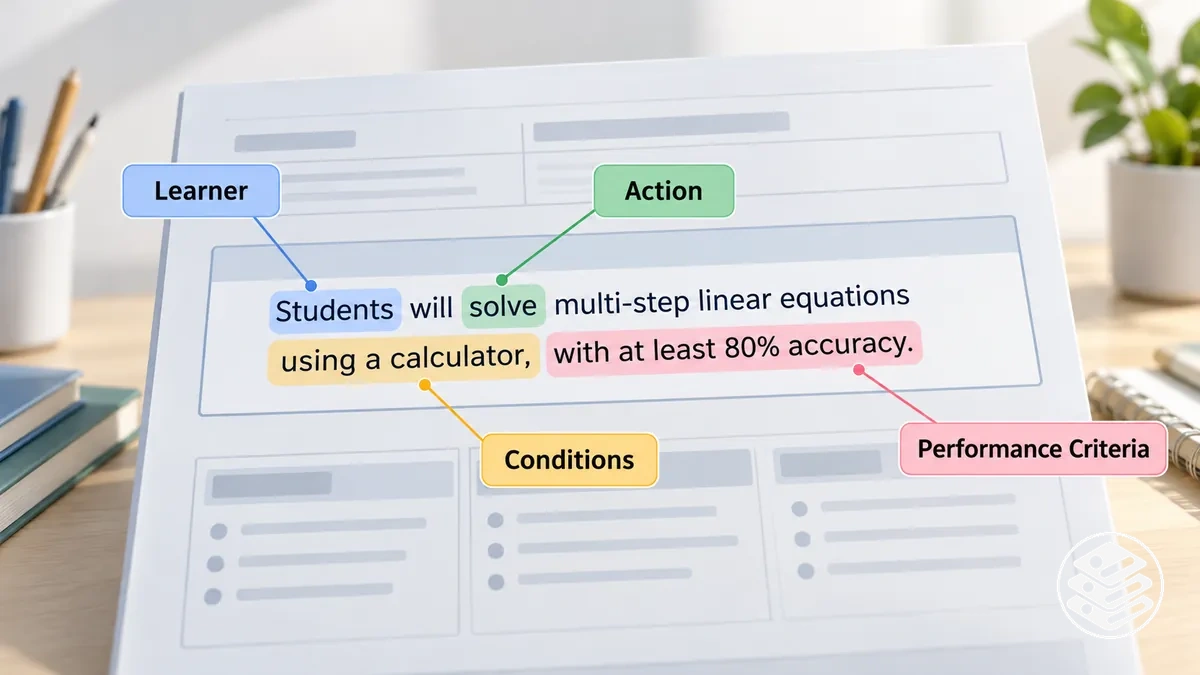
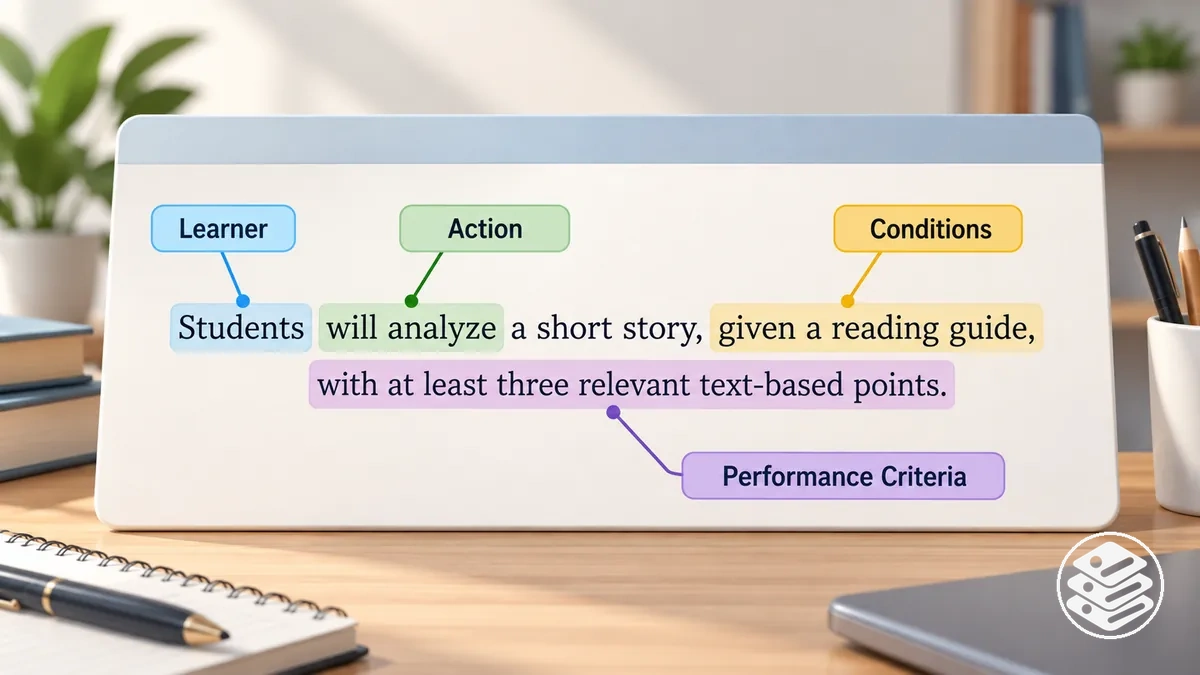
The annotated example shows how the objective field can make the learner performance and observable action clear while adding a condition or criterion only when it changes the meaning of successful performance.
Learner, Action, Conditions, and Performance Criteria
Learning objective components describe different functional parts of one objective: the learner identifies the performer, the action identifies the observable behaviour, conditions describe the performance context when it matters, and performance criteria specify an acceptable level when that standard needs to be explicit.
Component frameworks vary in naming and count, so these parts are best treated as functional elements rather than a universal formula.
The common ABCD formulation uses different labels for the same functions: Audience identifies the learner, Behaviour expresses the performance (including what the learner acts on), Condition defines relevant circumstances, and Degree states the acceptable performance standard.
The table maps each component to the question it answers, when it needs to be stated, and its practical implication.
Component
Question it answers
Include when
Practical implication
Learner
Who performs?
The performer needs to be identified explicitly.
Identifies who is expected to demonstrate the learner performance.
Action
What is demonstrated?
The expected performance needs to be expressed as observable behaviour.
Makes the intended performance identifiable through what the learner does.
Content or object
What does the learner act on?
The action would otherwise be too open-ended to define the intended knowledge, text, problem, procedure, skill, or other lesson content.
Closes the performance relation by specifying what the observable action applies to.
Conditions
Under what circumstances?
The situation, tools, prompts, resources, or constraints materially affect the expected performance.
Constrains the performance context so the circumstances of successful performance are clear.
Performance criteria
To what standard?
An acceptable level of performance needs to be explicit.
Specifies the standard used to distinguish acceptable performance.
Conditions and performance criteria are conditional parts: they add useful information when the performance context or acceptable level changes what successful performance means, rather than because every objective must state them.
The annotated example labels where the learner, observable action, condition, and performance criterion can appear within one sample objective without implying that every objective requires all four explicitly.
Distinguish the Learning Objective from the Learning Activity
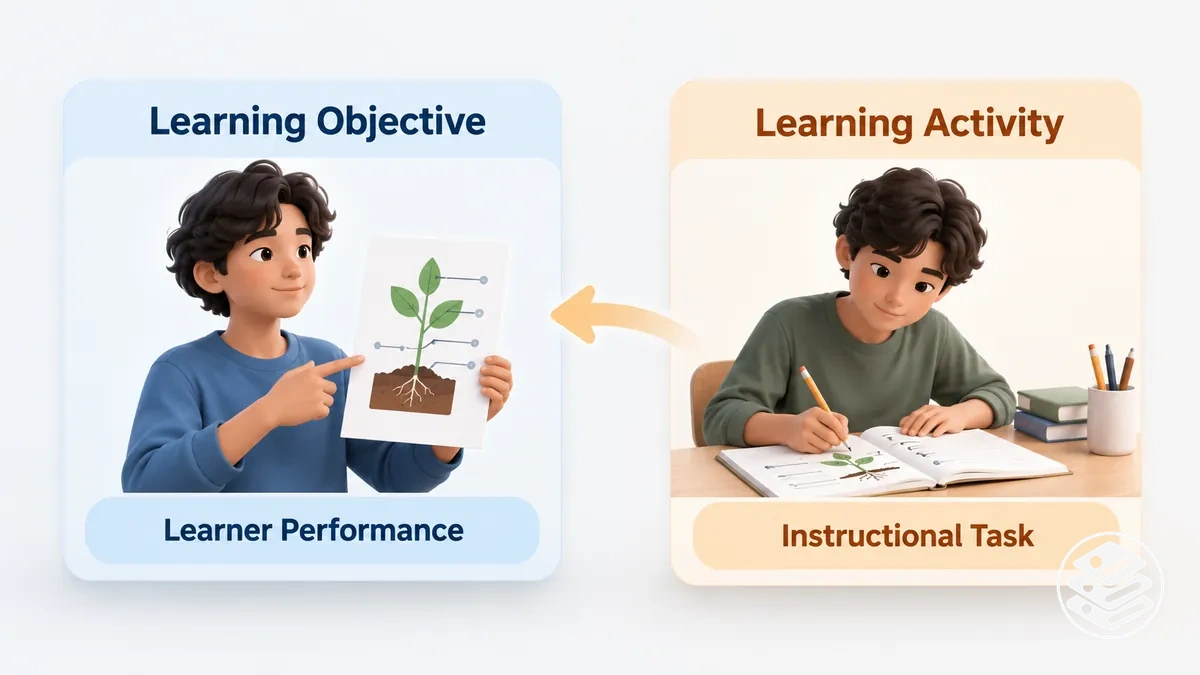
A learning objective and a learning activity both belong in lesson planning, but they perform different jobs: the learning objective describes the learner performance to be achieved, while the learning activity describes the instructional task used to support that performance.
Keeping this distinction clear prevents completion of a task from being treated as evidence of learning by itself.
The comparison shows how the two concepts differ in function, wording focus, what can be checked, and a matched example.
Dimension
Learning objective
Learning activity
Function
States the learner performance to be achieved.
Provides an instructional task that supports learners in developing or practising that performance.
Typical wording focus
Focuses on what the learner will demonstrably know or do, using observable performance where appropriate.
Focuses on what learners do during instruction or practice.
What is checked
Whether the learner can demonstrate the intended performance.
Whether the learner participated in or completed the instructional task; completion alone is not evidence that the intended performance was achieved.
Example
Learners will identify the main claim and two supporting reasons in a short argument.
Learners read a short argument and highlight its main claim and supporting reasons in pairs.
In the matched pair, highlighting the argument is the learning activity because it describes what learners do during instruction, while identifying the claim and supporting reasons is the learning objective because it states the performance learners are expected to demonstrate.
The graphic makes the relationship concrete by showing the intended learner performance beside the related instructional task and indicating that the activity supports, rather than proves, achievement of the objective.
How to Write Learning Objectives Step by Step
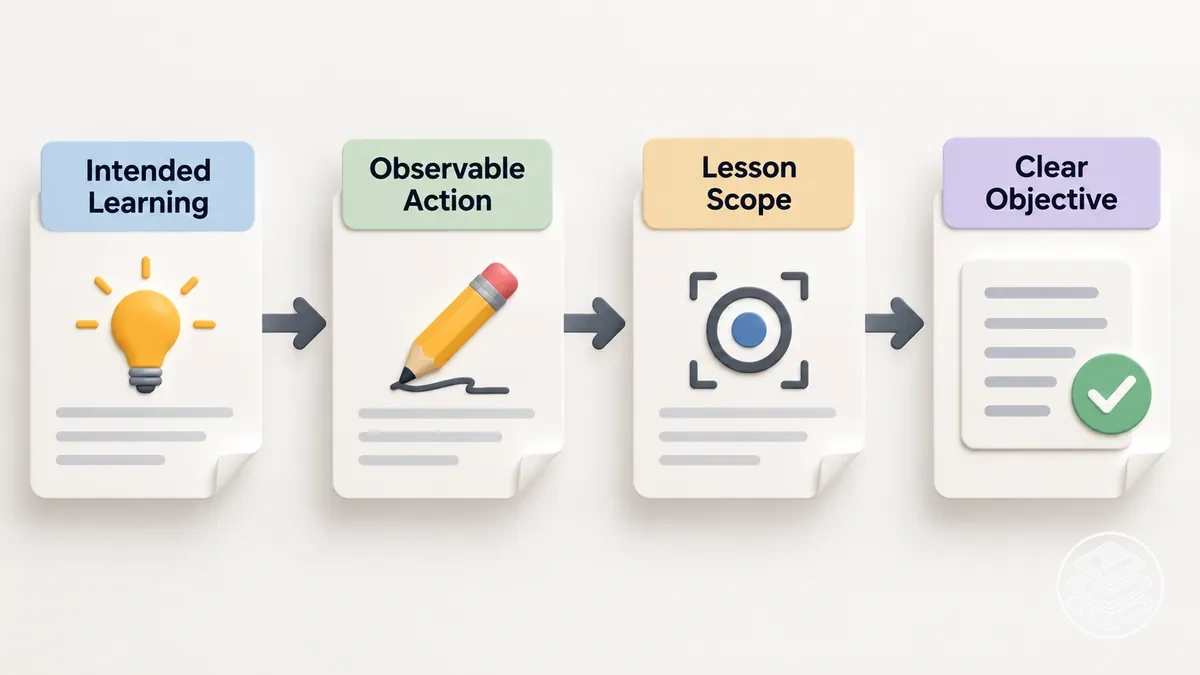
Start by defining the intended learning, express it as learner performance through an observable action, narrow it to a realistic lesson scope, and write one statement that can be checked.
This sequence keeps the objective focused on what the learner is expected to demonstrate rather than on choosing polished action wording first.
The order matters because the observable action and level of specificity should serve the intended learning, while the lesson scope constrains what can reasonably be expressed in the final objective statement.
The image organises these writing decisions from intended learning through observable wording and realistic scope to a usable objective statement that can be checked, while the detailed execution belongs to the individual steps that follow.
Define the intended learning before choosing the action wording.
Define the Intended Learning Outcome
Define the intended learning by identifying the knowledge or skill learners should be able to demonstrate by the end of the specific lesson before choosing action wording.
The intended outcome should describe learner performance as a lesson-level target, with the mastery level limited to what the planned instruction is intended to develop rather than a broader course-level expectation.
Narrow a broad teaching intention such as “teach learners about the main claim in an argument” to a learner-centred outcome such as “Learners will identify the main claim in a short argument.”
Curriculum requirements may act as a boundary condition on the lesson-level target, but the immediate task is to make the expected learner performance clear enough to support the next choice of wording.
The image demonstrates this change from a broad teaching intention to a specific lesson-level outcome by making the knowledge or skill, expected performance, and lesson scope explicit.
Choose an Observable Action Verb at the Intended Learning Level
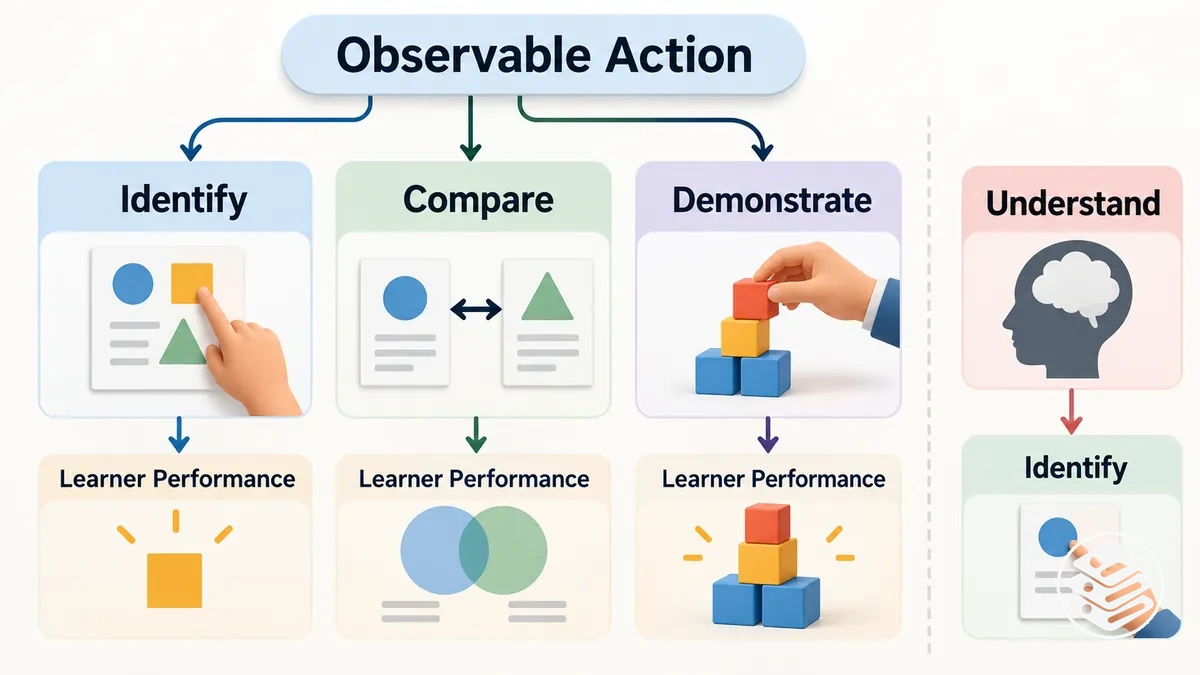
Choose an action verb that describes observable learner performance and matches the intended learning level, such as identify, compare, explain, construct, or demonstrate.
The verb should signal what learners will do to make their knowledge or skill evident, rather than relying on vague mental-state wording that does not specify observable performance.
An action verb does not make an objective measurable by itself: measurability also depends on what the learner acts on and, when relevant, the conditions or performance criteria.
Bloom's Taxonomy can be used as an optional classification aid for considering cognitive demand, but verb choice should follow the intended learning rather than a mandatory taxonomy.
These contrasts show how wording can move from a vague mental state towards performance that can be observed.
Observable performance
Identify: makes selection or recognition of specified information observable.
Compare: expresses learner performance by identifying relevant similarities or differences between specified subjects.
Explain: makes the learner's account of a concept, relationship, or process available as evidence of performance.
Construct: expresses performance through producing or assembling a specified response, representation, or product.
Demonstrate: expresses performance by showing a specified skill, procedure, or application.
Vague when used alone
Know: is vague when used alone; rewrite it by stating what learners will do to make the intended knowledge observable, such as identify relevant information.
Understand: does not specify observable performance by itself; rewrite it as the performance that will evidence the intended understanding, such as explain a relationship.
Appreciate or learn: can leave the expected performance unclear when used alone; replace the vague wording with the action learners are expected to demonstrate.
The diagram organises action verbs by the kind of learner performance they make visible and includes a vague-to-observable rewrite.
It illustrates differing performance demands without implying that the verb alone guarantees a measurable objective.
Set the Objective at a Realistic Lesson Scope
Set the lesson-objective scope so it is specific enough to describe meaningful learner performance while remaining realistic for the lesson's content and instructional conditions.
A workable objective narrows the intended learning enough to fit the lesson without reducing the target to an unnecessarily trivial performance.
Evaluate scope by considering the content breadth, action complexity, expected depth, available lesson time, and evidence that can realistically be obtained.
As breadth, complexity, or depth increases, the objective may exceed what can reasonably be taught and verified under the lesson's actual conditions; narrowing one or more of those demands can make the target more workable.
There is no universal word count or lesson-duration threshold that determines the correct level of specificity.
For example, a broad target such as “learners will explain the causes, major events, consequences, and historical significance of a conflict” can be narrowed to “learners will explain two causes of the conflict using evidence from the lesson materials” when that better matches the planned lesson scope.
Content breadth: If one objective combines several substantial topics or skills, its scope may become too broad; narrow the content to the portion learners can meaningfully address within the lesson.
Action complexity: The required learner performance should fit the instructional conditions; a complex action may require more preparation and evidence than the lesson can support.
Expected depth: The level of detail or reasoning expected should match what the lesson is designed to develop; excessive depth can make an otherwise specific objective difficult to complete or verify.
Available lesson time: Lesson time constrains how much content and performance can realistically be addressed, so scope should be reduced when the planned demand exceeds the available instructional opportunity.
Obtainable evidence: The objective should allow enough evidence of learner performance to be gathered under the lesson's conditions; if meaningful evidence cannot realistically be obtained, the target may need further narrowing.
Decide How Many Objectives the Lesson Needs
There is no universally correct fixed number of learning objectives for every lesson.
The appropriate objective count depends on lesson length, complexity, and how many distinct outcomes can realistically be taught and checked while maintaining lesson focus.
Treat the number of lesson objectives as a planning decision based on whether each statement represents a genuinely distinct learner performance and whether its cognitive demand and evidence requirements fit the lesson.
When several statements describe the same underlying outcome at a similar level of demand, consolidation may improve lesson focus by avoiding unnecessary overlap.
When outcomes require genuinely different performances or evidence, they may remain as separate objectives if they are teachable within the lesson conditions.
Use as many distinct objectives as the lesson can realistically teach and check without losing focus. Combine substantially overlapping outcomes; keep genuinely different outcomes separate only when their instructional and evidence demands still fit the lesson. A local policy or planning template may impose its own count.
Lesson length: Consider whether the available lesson length provides a realistic opportunity to teach and check each distinct outcome rather than using duration to impose a fixed objective count.
Outcome independence: Objectives that substantially overlap in the learner performance they describe may be combined through consolidation, while genuinely distinct outcomes may remain separate.
Cognitive demand: As the intended performances require more complex thinking or execution, each objective may require more instructional attention, which can constrain how many distinct outcomes fit the lesson.
Teachability: Each objective should represent an outcome that can realistically be developed under the lesson's content and instructional conditions; an overloaded set can weaken lesson focus.
Evidence burden: Consider the evidence needed to check each objective; when separate objectives require more evidence than can realistically be obtained, the planned objective count may need consolidation or reduction.
Write Each Objective as One Clear Statement
Write the objective statement as one clear, learner-centred statement that combines the selected outcome and scope with the learner, an observable action, and the object or content of that action.
Add conditions or performance criteria only when they materially define successful performance, and keep the statement focused on one primary performance rather than chaining unrelated actions together.
Remove teacher-centred wording, vague verbs, and extra detail that does not change what the learner must demonstrate.
In practice: one focused statement
Weak
“The teacher will help students understand and discuss the main idea and complete an activity.”
Clearer
“Learners will identify the main idea in a short text.”
The revision replaces teacher-centred and chained wording with one observable learner performance. Once the wording is complete, it is ready for the objective field in the lesson plan.
How to Check Whether a Learning Objective Is Observable and Measurable
A learning objective is observable and measurable when it describes learner performance that can be evidenced and judged against a clear expectation.
The wording should identify an action that can be observed through performance rather than relying only on an internal mental state, while measurability also depends on what the learner acts on and any conditions or performance criterion needed to clarify successful performance.
Check the completed objective for an observable action, a clear object or content focus, relevant conditions, a usable performance criterion when one is needed, and a realistic way to obtain evidence of performance.
These checks verify whether the objective wording is checkable; deciding how to collect and interpret that evidence belongs to the adjacent task of assessing planned learning outcomes rather than to objective verification itself.
For example, rewrite “Learners will understand the main idea” as “Learners will identify the main idea in a short text” so the intended learner performance can be observed.
Observable action: Check whether the objective states an action the learner can demonstrate. If the wording names only an internal mental state, the expected performance remains unclear and should be rewritten as an observable action.
Clear object or content focus: Check whether the action specifies what the learner acts on, such as a concept, text, procedure, problem, or skill. If the content focus is missing, the action may be too open-ended to establish a clear expectation.
Necessary conditions: Check whether relevant circumstances, resources, prompts, or constraints are stated when they materially change the expected performance. If such conditions affect successful performance but are omitted, the objective may not specify what is actually being verified.
Usable performance criterion: Check whether a performance criterion is stated when an acceptable level of performance needs to be explicit. If the required standard materially affects what counts as successful performance but remains unspecified, measurability may be incomplete.
Realistic evidence of performance: Check whether the stated learner performance can produce evidence that can realistically be observed or examined. If no feasible performance evidence corresponds to the wording, revise the objective rather than assuming an observable verb alone makes it measurable.
Measurable Learning Objective Examples
Measurable learning-objective examples show how weak or ambiguous wording can be revised to make the intended learner performance clearer and capable of producing usable evidence.
The examples demonstrate different improvements through an observable action, realistic scope, relevant conditions, and performance criteria rather than treating one wording pattern as universally required.
Make the action observable
Weak
“Learners will understand the main idea of a text.”
Clearer
“Learners will identify the main idea in a short text.”
The revision replaces a vague mental-state verb with an observable action and specifies the content of that action.
Narrow the scope and state a condition
Weak
“Learners will explain the causes, events, consequences, and significance of the conflict.”
Clearer
“Learners will explain two causes of the conflict using evidence from the lesson materials.”
The revision reduces an overloaded scope and states the resource condition used for the explanation.
Make the performance criterion explicit
Weak
“Learners will solve the problems successfully.”
Clearer
“Learners will solve four of five assigned problems correctly.”
The revision replaces an ambiguous success claim with a specific criterion. Across all three examples, add only the action, scope, condition, or criterion needed to make the intended performance clear.
Common Mistakes When Writing Lesson Learning Objectives
Learning-objective writing mistakes can reduce clarity about the learner performance a lesson is intended to develop and can make that performance harder to verify.
Common problems include teacher-centred wording, a vague verb that is not observable, confusion between a learning activity and an objective, combined performances, unrealistic lesson scope, and missing conditions or performance criteria when they materially define success.
Each mistake can be diagnosed by checking what the wording actually asks the learner to demonstrate and whether that expectation is sufficiently measurable for the lesson context.
The recognition cue identifies the wording problem, while the correction shows the smallest useful change rather than reworking the entire objective-writing process.
Mistake
Consequence
Recognition cue
Correction
Teacher-centred wording
The statement describes instruction rather than the learner performance to be achieved.
The teacher is the grammatical subject, such as “The teacher will explain...”
Rewrite the statement around what learners will demonstrate, such as “Learners will explain...”
Vague, non-observable verb
The intended knowledge or skill may not be expressed as observable, measurable performance.
The objective relies on wording such as “understand” without stating what learners will do to demonstrate that understanding.
Replace the vague verb with the intended observable action, such as identifying, comparing, or explaining specified content.
Missing or vague content focus
The action is observable, but the intended knowledge, text, problem, procedure, or skill remains unclear.
The statement says what learners will do without specifying what they will do it to or with.
State the content or object of the action so the expected performance is bounded and checkable.
Learning activity presented as the objective
Completing the activity can be mistaken for demonstrating the intended learning.
The statement mainly describes a task, such as reading, discussing, or completing an exercise, without specifying the performance the task supports.
State the learner performance as the objective and keep the learning activity as the instructional task used to support it.
Too many combined performances
An overloaded objective can make the intended performance and evidence unclear.
One statement chains several substantial actions or outcomes that do not represent one focused performance.
Narrow the objective to one primary performance, or separate genuinely distinct outcomes when the lesson can realistically support them.
Unrealistic lesson scope
The objective may demand more breadth, complexity, or depth than the lesson is designed to develop and verify.
The statement combines extensive content or a demanding performance that exceeds the planned lesson focus.
Narrow the content, action, or expected depth until the objective reflects a realistic lesson scope.
Missing condition or performance criterion when material
The meaning of successful performance can remain ambiguous when the omitted context or standard changes what counts as success.
The objective leaves out a circumstance, resource, constraint, or acceptable performance level that materially affects the intended result.
Add the relevant condition or performance criterion only when it is needed to clarify what the learner must demonstrate or what counts as acceptable performance.