
Choosing a Lesson Plan Template Format
Choose a lesson plan template format by matching five independent dimensions to the teaching task: planning horizon, required detail, degree of structure, adaptability and instructional organising logic. A daily or weekly view answers the time-span need; compact or detailed documentation answers the information need; and structured, flexible or hybrid characteristics answer the constraint-and-adjustment need. Treat any school-required format as a fixed constraint, then adapt only the fields, sequence or notes that are allowed to change.
Lesson plan format selector
Build a format profile from the planning conditions that actually change suitability. The result combines independent format characteristics; it does not rank one template as universally best.
How to read the result: choose each dimension independently. A required school or institutional format remains the outer constraint on the profile.
This selector recommends format characteristics from the article’s decision rules. It does not judge teaching quality or replace a required local planning format.
Use the selector as a quick profile, then use the criteria and comparisons below to check why each characteristic fits the planning context.
Table of Contents
Criteria for Choosing a Lesson Plan Template Format
Useful lesson plan format selection criteria are those that change suitability under specific planning conditions, rather than simply rewarding popularity or a greater number of fields.
The relevant criteria describe either the planning task, such as its planning horizon and required level of detail, or external constraints, such as documentation expectations and teacher needs.
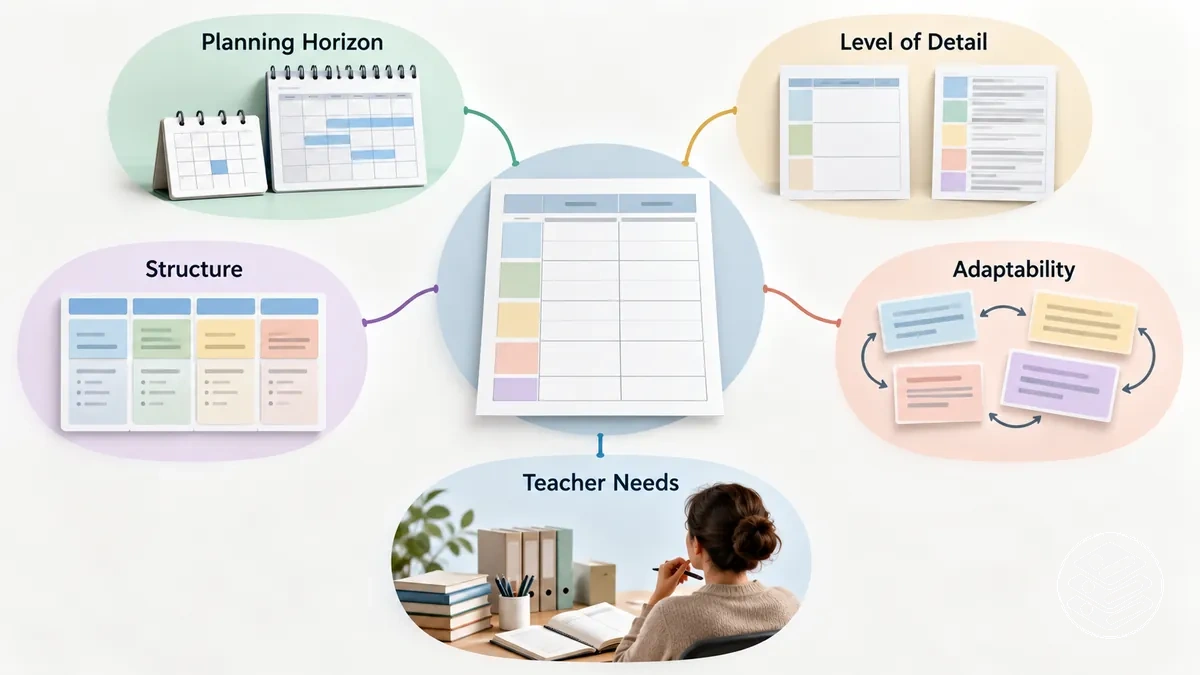
- Planning horizon: When planning covers a single lesson or a short daily period, the format can concentrate on that immediate time span; when planning extends across a week or longer sequence, the format needs a structure that keeps the wider planning horizon visible.
- Level of detail: When documentation, observation or handoff needs are greater, a format with space for more explicit planning information becomes more suitable; routine planning may support a more concise level of detail.
- Structure: When the teaching task has defined planning requirements, a more structured format can make those requirements easier to organise; when fewer elements are fixed, a less constrained structure can leave more room for teacher judgement.
- Adaptability: When lesson conditions are likely to change during planning or teaching, greater adaptability makes it easier to revise the plan without rebuilding its overall structure.
- Lesson context and teacher needs: When instructional complexity, documentation expectations or working practices change, the relative importance of the other criteria changes as well, so the same lesson plan format can be suitable in one context and inefficient in another.
Planning Period and Lesson Frequency
The planning period affects how much of the teaching timeline a lesson plan format needs to make visible, while lesson frequency and revision frequency affect how often that view needs to be updated.
A shorter planning horizon supports more local daily visibility, whereas a broader horizon may call for greater week-level coordination and a different level of format granularity.
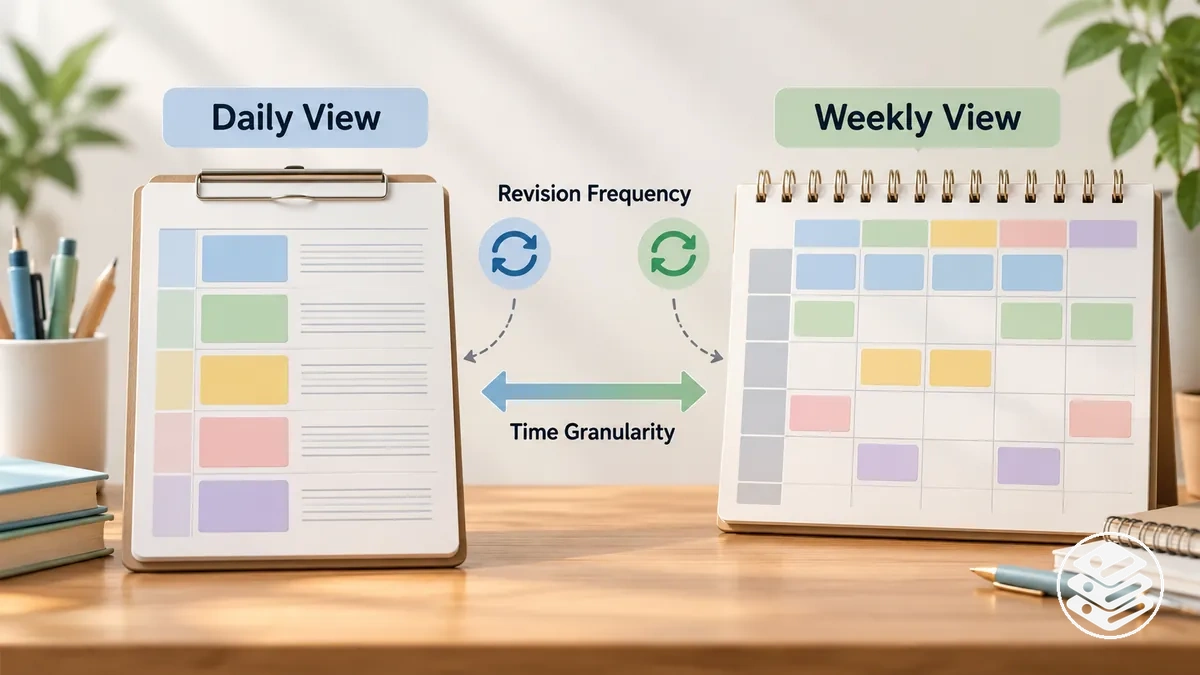
The planning horizon here refers to the time span represented within lesson-level planning, not to unit planning as an interchangeable task.
As the horizon broadens, the change may involve the category of planning document as well as its format, so the distinction between a lesson plan and a unit plan remains relevant when defining the boundary.
- Daily visibility: When planning focuses on an individual lesson or immediate teaching period, finer format granularity supports visibility of the lesson-level plan without requiring a broader planning window.
- Revision frequency: When plans are revised frequently, the format benefits from making the current planning period easy to identify and update without reorganising a wider time span.
- Lesson frequency: When related lessons occur repeatedly within the planning window, the format may need enough temporal structure to distinguish individual lessons while keeping their sequence visible.
- Weekly coordination: When planning needs to coordinate lessons across a broader weekly horizon, a wider view can make relationships across the planning period visible without adding lesson-by-lesson detail that is not needed for that view.
Lesson Length and Instructional Complexity
Lesson length and instructional complexity both affect the planning structure a lesson plan format needs, but neither condition alone determines format depth.
A lesson with more stages, activities, resources or coordination can increase the need for explicit sequencing and documentation, while a less complex lesson may support a lighter planning structure regardless of its duration.
Key distinction
Lesson duration
Describes the time available for the lesson.
Instructional complexity
Describes what must be organised within that time, including the relationships among stages, activities, resources and coordination.
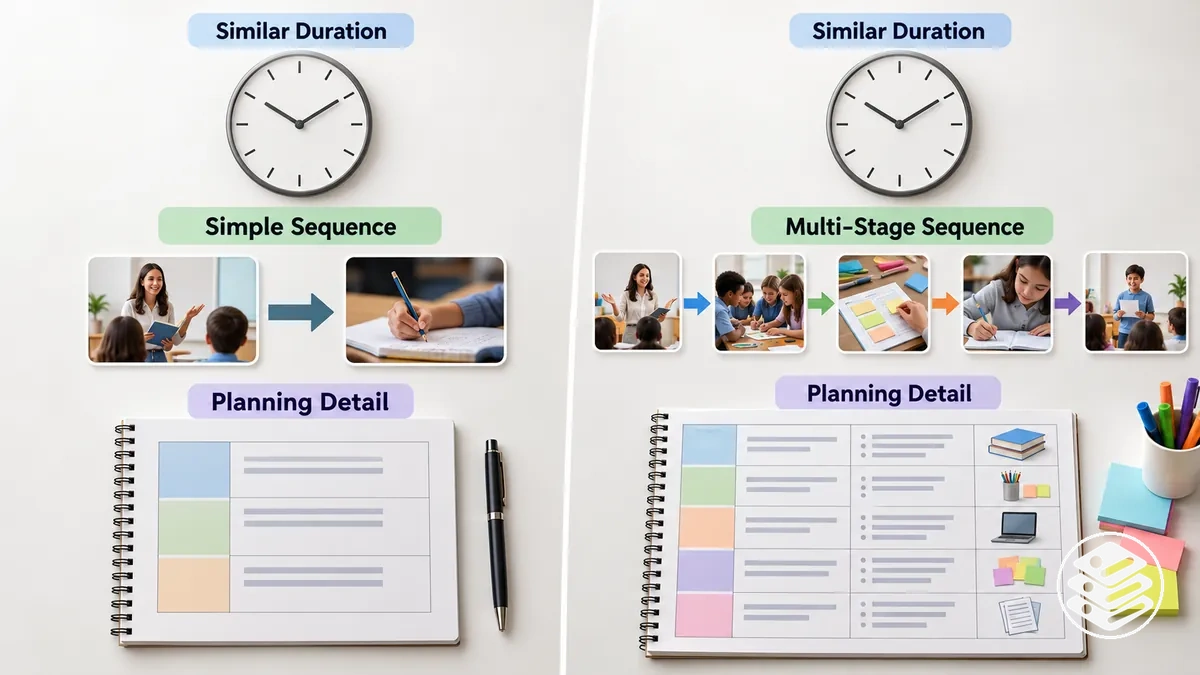
The recurring signals below help distinguish instructional complexity from lesson length before selecting format depth.
Detailed pacing and time allocation are a separate planning task, so format selection here focuses on how much structure the lesson itself needs rather than fixed minute allocations.
- Multiple stages: When a lesson contains several distinct stages or transitions, greater format depth can support clearer sequencing between them.
- Multiple activities: When different activities must be organised within the lesson, a more explicit planning structure can make their order and relationships easier to follow.
- Resource requirements: When activities depend on several resources or materials, additional planning detail can help connect those resources to the relevant parts of the lesson.
- Coordination needs: When the lesson requires coordination across activities, resources or participants, more explicit sequencing and documentation may make the plan easier to manage.
Required Planning Detail and Documentation
Planning detail should follow the intended use of the lesson plan and the documentation needed for that use, rather than a universal level of template depth.
A detailed lesson plan adds value when another person needs to review, interpret or act on the planning, or when lesson complexity makes important relationships difficult to capture in a compact record.
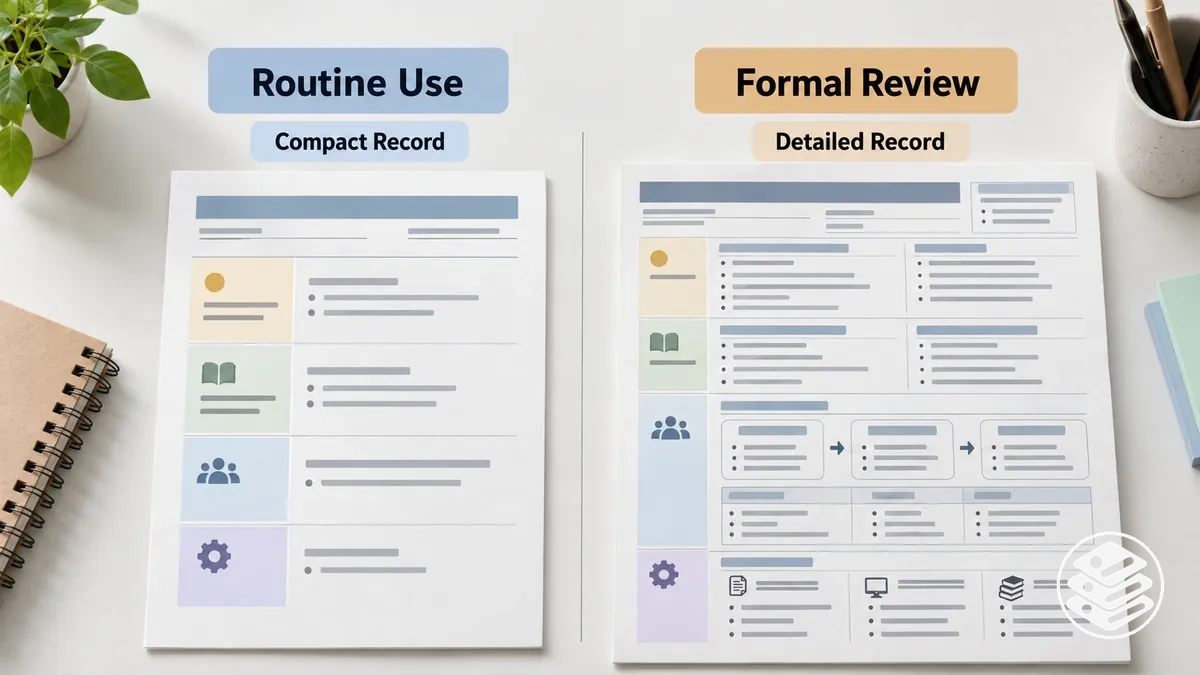
A detailed lesson plan may support formal observation, supervision or student teaching when planning decisions need to be explicit enough for another person to review, while a handoff can require enough clarity for another teacher to interpret the intended lesson.
Documentation requirements may also increase when the intended use calls for a more explicit record or when lesson complexity creates more planning relationships to communicate.
For routine recurring lessons, a compact record may be sufficient when the teacher mainly needs an efficient personal reference, although experience level alone does not determine the appropriate detail.
More planning detail is useful only when it serves a real planning, communication or review need.
- Experience level: When a teacher benefits from making planning decisions more explicit for reflection, discussion or supervision, greater template depth may support that purpose; experience alone does not determine whether a compact or detailed format is suitable.
- Formal observation or supervision: When another person needs to review the planned lesson, greater planning detail can make the intended decisions and relationships more explicit.
- Handoff: When another teacher needs to use or interpret the plan, additional documentation can reduce reliance on unstated context and support a clearer handoff.
- Required documentation: When the intended use calls for a more explicit planning record, a deeper template may support that documentation need; where no such need exists, a compact record may be sufficient.
- Lesson complexity: When activities, resources or sequencing create more relationships to organise, additional planning detail may help keep those relationships explicit without treating document length as a measure of quality.
Need for Adaptability in the Planning Format
Adaptability matters when a lesson plan needs to accommodate classroom changes in activities, learner response or available resources while still preserving fixed requirements.
An adaptable planning format should therefore provide flexibility only where the planning context allows adjustment, rather than treating every part of the plan as changeable.
How adaptability changes the structure
Prescribed
Required fields or institutional constraints stay fixed, so adaptation is limited to other parts of the plan.
Flexible
More of the planning structure can change when fewer elements are prescribed and classroom conditions require adjustment.
Hybrid
A fixed core preserves required structure while selected areas remain adaptable—for example, an activity sequence or notes area.
The format features below show where adaptability can operate without losing the constraints that the teacher must preserve.
The image illustrates how fixed and editable areas can coexist within the same planning format.
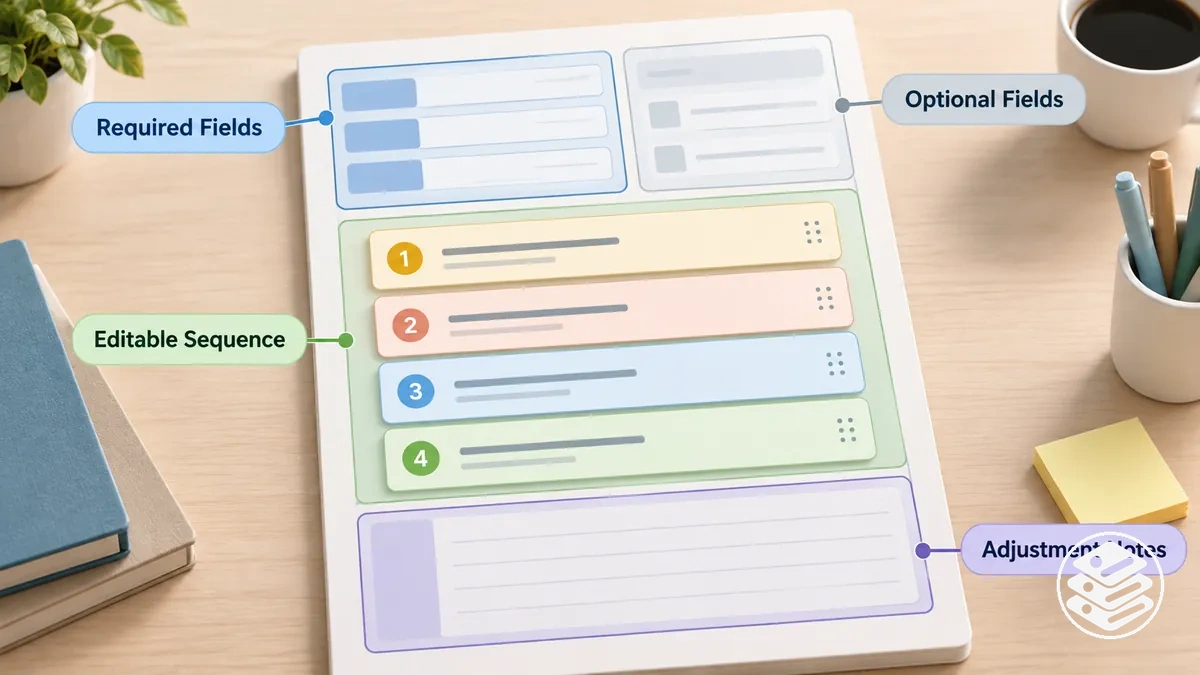
- Fixed requirements: When required fields or institutional constraints cannot be changed, a prescribed format preserves those elements and limits adaptation to other parts of the plan.
- Optional fields: When some planning information is useful only under particular conditions, optional fields can accommodate that information without changing the required structure.
- Editable sequence: When activities may need to change order in response to learner response, resources or classroom changes, an editable sequence allows that part of the plan to be adjusted while fixed requirements remain intact.
- Adjustment space: When in-lesson changes need to be recorded or anticipated, a notes or adjustment area can provide adaptable space without making the whole format unrestricted.
Flexibility is therefore a design property to match to the planning constraints, not an automatic quality advantage over a more prescribed format.
Comparing Common Lesson Plan Template Formats
Lesson plan format comparison works across separate dimensions rather than a single ranking: a format can differ by planning horizon, structure, level of detail and instructional organising logic.
Each dimension represents a different trade-off, so suitability depends on the planning context rather than a format occupying one overall position.
The image maps these independent dimensions and shows how they can combine rather than ranking lesson plan formats.
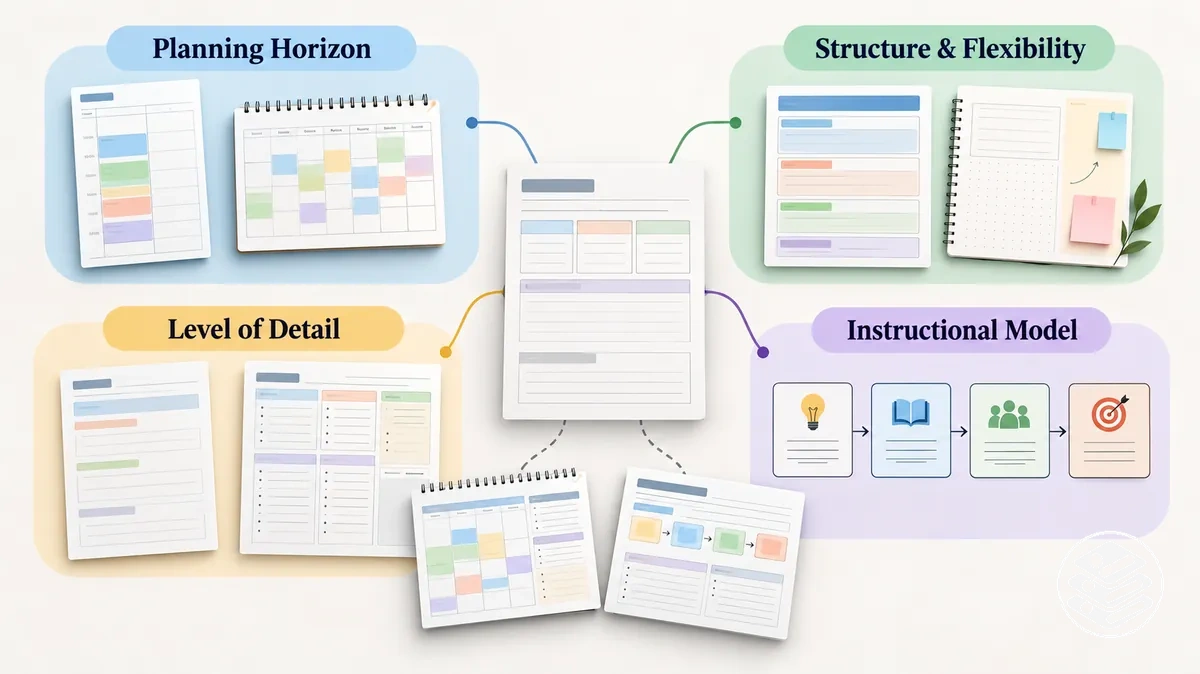
Four independent format dimensions
- Planning horizon
- Daily visibility or broader weekly coordination.
- Structure
- The balance between prescribed fields and room for teacher adjustment.
- Level of detail
- Compact planning or more explicit documentation.
- Instructional model
- An organising logic that shapes how the lesson sequence is planned.
These dimensions can combine rather than operating as mutually exclusive categories: a weekly format can remain flexible, while a daily format can use an instructional model and either compact or detailed documentation. The comparisons below use the same dimensions to show trade-offs without assuming one combination fits every context.
Daily vs Weekly Lesson Plan Formats
A daily format emphasises lesson-level granularity within a shorter planning horizon, while a weekly format emphasises cross-day visibility and coordination across several lessons.
Neither format is inherently more suitable; suitability depends on whether the teacher needs a detailed immediate reference or a broader view of teaching across the week.
Daily and weekly lesson plan formats can contain similar lesson information, but they organize that information across different time spans.
The comparison below shows how planning horizon, granularity, update frequency, cross-day visibility and coordination change the practical role of each format.
| Criterion | Daily Format | Weekly Format | Why It Matters |
|---|---|---|---|
| Planning horizon | Shows an individual day or lesson as the immediate planning view. | Shows lessons across a broader weekly planning horizon. | The visible time span determines whether the teacher sees immediate lesson planning or relationships across several days. |
| Granularity | Emphasises lesson-level detail within the day-level view. | Emphasises how multiple lessons or teaching periods fit within the week-level view. | The required granularity depends on whether immediate lesson detail or broader scheduling context needs to remain visible. |
| Update frequency | Supports updating the immediate day or lesson when planning changes. | Supports updating a broader weekly view when changes affect several days or lessons. | The appropriate update frequency depends on whether changes are local to one lesson or need to remain visible across the week. |
| Cross-day visibility | Keeps attention on the current day, with less emphasis on relationships across other days. | Makes relationships and recurring activity across several days visible in one view. | Cross-day visibility matters when the teacher needs to see how lessons relate across the week. |
| Coordination | Supports coordination of activities and resources within the immediate lesson or day. | Supports coordination of lessons, activities or recurring schedules across the week. | The suitable format depends on whether coordination is mainly local to one day or distributed across several days. |
| Suitable context | May suit a teacher who needs day-level instructional detail as an immediate planning reference. | May suit a teacher who needs week-level coordination across several lessons. | Suitability follows the planning task rather than the assumption that one time span is universally preferable. |
For example, a teacher preparing a lesson that needs close day-level instructional detail may use a daily format, while a teacher coordinating several related lessons across the week may use a weekly format to keep that broader relationship visible.
Structured vs Flexible Lesson Plan Formats
Structured and flexible lesson plan formats sit on a spectrum defined by how strongly they prescribe fields, sequence and documentation.
A structured format uses more prescribed fields and sequencing, while a flexible format allows more adaptable fields and changes to sequence; the trade-off is guidance versus room to adjust, not quality.
Many practical formats use a hybrid structure that can combine a fixed core with adaptable areas for activities or notes.
A more structured format may suit a context where prescribed information and documentation clarity need to remain explicit, while a flexible format may suit a context where classroom changes require more room to adjust activities or sequence.
Flexibility does not mean an absence of planning, and structure does not guarantee quality.
The comparison below treats these as degrees of prescription rather than absolute categories.
| Dimension | More Structured | More Flexible |
|---|---|---|
| Field prescription | Uses more prescribed fields to keep specified planning information explicit. | Uses more adaptable fields when the information recorded needs to change with the teaching context. |
| Sequence | Prescribes more of the planning sequence when a consistent order needs to remain visible. | Allows more of the sequence to be adjusted when activities need to respond to classroom changes. |
| Documentation clarity | Makes specified planning information explicit through a more consistent structure. | Allows documentation to vary where fixed fields are not required for the planning purpose. |
| Adjustment during teaching | Constrains adjustment within the parts of the format that are prescribed. | Provides more adaptable areas for revising activities, notes or sequence during teaching. |
| Planning burden | Can require more field-completion work when more elements are prescribed. | Can require fewer prescribed fields while leaving more decisions about what to record to the teacher. |
For example, a teacher who needs explicit fields and sequencing to reduce uncertainty about what to record may use a more structured format, while a teacher expecting classroom changes may use a more flexible format when activities or sequence need room for adjustment.
One-Page vs Detailed Lesson Plan Formats
One-page and detailed lesson plan formats differ mainly in information density and documentation burden, not inherent quality.
A one-page format condenses planning information into a compact view, while a detailed format exposes more planning information when the intended use calls for greater documentation depth.
Compactness can support faster at-a-glance reference when the layout keeps essential information easy to scan, while greater detail may support handoff or formal review when another person needs more planning context.
Preparation effort can increase as more information must be recorded, but layout, lesson complexity and intended use affect the practical burden.
Page length is therefore only a rough proxy for information density, not a quality score or a standard for how long a lesson plan should be.
The comparison below relates each format to the planning conditions in which its information density may be useful.
| Criterion | One-Page Format | Detailed Format | Suitable When |
|---|---|---|---|
| Scanability | Condenses information into a compact view that may support at-a-glance reference when the layout remains clear. | Exposes more information, which may require more scanning when additional planning detail is visible. | Choose the information density that keeps the required planning information usable for the intended task. |
| Preparation effort | May require less recording when fewer fields or details need completion. | May require more preparation effort when more planning information must be documented. | The relevant trade-off depends on how much information the lesson requires the teacher to record. |
| Documentation depth | Supports a compact record when essential planning information can be represented concisely. | Supports greater documentation depth when more planning decisions or relationships need to be explicit. | Match documentation depth to the information that needs to remain visible or interpretable. |
| Handoff value | May support handoff when the compact plan contains enough context for another person to interpret it. | May support handoff when another person needs more explicit context about activities, sequence or planning decisions. | Handoff needs depend on how much unstated context the next user of the plan can reasonably supply. |
| Formal review | May suit formal review when the required planning information can be shown clearly within a compact structure. | May suit formal review when the review requires more explicit documentation of the planned lesson. | The format should expose the information required for the specific review rather than follow an assumed page-count rule. |
| Lesson complexity | May suit routine or less complex lessons when the necessary planning relationships fit clearly within a compact plan. | May suit more complex lessons when additional activities, resources or sequencing relationships need to be made explicit. | Greater lesson complexity can justify greater information density when those relationships need to remain visible. |
The same teacher may reasonably use a one-page format for a routine lesson that needs quick reference and a detailed format for a more complex lesson that requires deeper documentation, handoff or formal review.
Instructional-Model Lesson Plan Formats
An instructional-model lesson plan format organises planning around a teaching sequence or learning process rather than primarily around a time span or document length.
Its organising logic determines how learning objectives, instructional activities and assessment are arranged.
The appropriate instructional model depends on the type of learning the teacher intends to structure.
A model-based format can still be daily or weekly, compact or detailed, because the instructional sequence and the document's planning horizon or information density are separate attributes.
The following examples illustrate distinct organising principles and instructional contexts rather than a ranking of models.
- 5E instructional model: Organises inquiry-oriented learning around five phases: Engage, Explore, Explain, Elaborate and Evaluate. It may suit lessons involving investigation and conceptual explanation, while the five phases can be planned across more than one lesson when the instructional context requires it.
- Backward Design and Understanding by Design (UbD): Organises planning through three stages: identifying desired outcomes, determining acceptable evidence and then planning learning experiences. It may suit contexts where alignment between intended learning, assessment and instruction is the central organising logic.
- Madeline Hunter model: Structures instruction through elements that frame teacher-guided instruction, checks for understanding and practice. It may suit lessons where those instructional elements provide a useful teaching sequence, without requiring every lesson to follow the same structure.
- Workshop model: Organises a lesson around focused instruction and a substantial period of learner practice or application, often followed by sharing or reflection. It may suit instructional contexts where learners need sustained time to apply a skill or work independently or collaboratively.
- SIOP (Sheltered Instruction Observation Protocol): Organises sheltered instruction through connected planning and teaching components, including attention to content and language objectives, interaction, practice and assessment. It may suit instructional contexts that integrate subject learning with language-development needs.
- Project-based learning: Organises learning around an extended question, problem or challenge, with individual lessons contributing to the broader project. A project-based learning format may suit lessons that form part of a sustained investigation, while a single lesson plan may represent only one stage of that wider sequence.
Matching a Lesson Plan Format to Planning Needs
Select a lesson plan format by matching the planning needs of the task to the format characteristics that support them.
Check the planning horizon, required detail, degree of structure, adaptability and instructional logic while treating any school-required format as a constraint on the available choice.
The selection method is conditional rather than a search for one universal format.
Start with the planning horizon, then check how much documentation and structure the task requires, how much adaptability the format should allow, and whether an instructional model needs to shape the organising logic.
When several conditions matter at once, select or allow for a hybrid format characteristic that satisfies them within any required institutional structure.
- What planning horizon must the format show? If the task centres on one lesson or day, match it to a format with lesson-level visibility; if coordination across several days matters, select a format characteristic that keeps the broader planning horizon visible.
- How much detail must be recorded? If observation, handoff or another documentation need requires planning decisions to be explicit, use a format with greater required detail; if the plan is primarily a routine personal reference, a more compact level of detail may be sufficient.
- What degree of structure is required? If required fields or institutional expectations prescribe what must be recorded, select within that constraint; where fewer elements are prescribed, the format can allow more teacher-defined structure.
- How much adaptability is needed? If activities, sequence or notes may need adjustment, allow for adaptable areas while retaining any fixed requirements. A hybrid format can combine prescribed fields with flexible planning space when both conditions apply.
- Does an instructional model determine the organising logic? If the lesson needs to follow a particular teaching sequence, match the format to that instructional logic while retaining the planning horizon, detail and structural characteristics required by the task.
For example, the same teacher may use a compact lesson-level format for routine teaching, a more detailed and structured format for formal observation, and a broader format for coordinating a multi-lesson sequence.
Once the format fit is resolved, the separate next task is to fill out the chosen template.