
Planning Lesson Time in a Lesson Plan Template
Allocate lesson time from the time actually available for teaching: subtract only fixed time that sits outside the planned lesson phases to establish usable lesson time, then allocate that remainder across the opening, core learning, activity overhead, any purposeful buffer, and a protected closing. There is no universal percentage split; the plan should change with lesson length, task complexity, learner independence and response, and classroom logistics.
Lesson time allocation planner
Use the planner to test whether a lesson fits the scheduled period. Enter each time demand once: fixed deductions reduce the scheduled period to usable lesson time, while opening, setup and instructions, transitions, buffer, and closing are allocations within that usable time.
Scheduled period − fixed deductions = usable lesson time
Usable lesson time − planned overhead and protected phases = core learning time available
What changes the allocation
- Lesson length: changes the space available for activity chunks, transitions, depth, and closure.
- Task complexity: more stages, explanation, practice, or discussion can require more time.
- Learner response and independence: slower understanding or more prompting can extend a task; confident independent work may require less teacher input.
- Classroom logistics: materials, movement, regrouping, technology, and pack-up can add overhead.
Table of Contents
Determine the Usable Lesson Time Before Assigning Activity Durations
Usable lesson time is the portion of the scheduled period left after fixed, predictable time that sits outside the planned lesson phases has been accounted for. Activity durations should be assigned from that remainder rather than from the full scheduled period.
The illustration below distinguishes the scheduled period from the time that can realistically be allocated to planned activity.

Separate fixed deductions from the overhead that belongs inside a planned lesson phase or activity, and count each time demand once. A fixed minute deduction is not appropriate for every class because readiness, setup, instructions, transitions, and pack-up occur under different conditions and often belong inside the opening, an activity, or the closing.
- Settling: Include normal settling and readiness work in the opening. Treat it as a fixed deduction only when it is genuinely outside the planned lesson phases.
- Setup and materials: Include preparation, distribution, collection, or equipment setup in the phase or activity that requires it rather than subtracting the same time twice.
- Instructions: Include required directions, explanation, or brief modelling in the relevant phase or activity, separately from students' active task time.
- Transitions: Include necessary changes of group, location, materials, or task as transition overhead between activities.
- Pack-up: Reserve necessary pack-up or room reset within the closing when it occurs before the scheduled lesson ends.
After subtracting only the fixed time that genuinely sits outside the planned phases, treat the remaining usable lesson time as the planning baseline. Allocate the opening, activity-specific overhead, core learning, buffer where needed, and closing against that same baseline so their combined timing fits the time actually available.
Allocate Time Across the Opening, Main Learning, and Closing
Distribute usable lesson time across the opening, main learning, and closing according to what each phase needs to accomplish rather than by applying a universal percentage split.
The main learning phase may receive the largest time share when the lesson objective and activity design require substantial core activity, practice, or response time.
The illustration shows the three phases as sequential planning blocks without implying fixed proportions.

The three lesson phases can be compared on the same basis: each has a distinct purpose, and that purpose creates different timing considerations.
The opening supports orientation and readiness, main learning carries the core learning work, and the closing provides space for summary, reflection, or other required closure.
Their relative time shares therefore depend on the lesson objective and task demands rather than a standard ratio.
The table organizes each phase by its purpose and the condition that should influence its allocation.
| Phase | Purpose | Timing consideration |
|---|---|---|
| Opening | Prepare learners for the lesson and establish readiness for the core task. | Allow enough time for necessary orientation and setup without reducing the time required for the main learning work. |
| Main learning | Complete the core activity, practice, discussion, or other work tied to the lesson objective. | Allocate time according to the amount and complexity of the learning work and the response time it requires. |
| Closing | Bring the lesson to a deliberate endpoint through summary, reflection, or other required closure. | Protect sufficient time for the intended closing function instead of treating it only as residual time after the main activity. |
Use these distinct phase functions to decide how the usable lesson time should be divided for the specific lesson.
A longer main learning block is appropriate only when its task demands justify it, while the opening and closing should retain the time required to perform their separate functions.
Set Time for the Lesson Opening
Lesson opening time should cover only the preparation needed for the core task to begin, including settling, activating relevant prior knowledge, brief orientation, and essential directions when those functions are required.
The illustration shows how these opening actions consume planned start-up time before learners move into the main task.

Settling requires more opening time when learners are not yet ready to start, while prior knowledge activation adds time only when it supports readiness for the core task.
Orientation and directions should take only the time needed to establish what learners must do next; if either becomes more complex, the lesson opening requires more planned time and leaves less time for the main learning phase.
There is no universal opening duration because the required time depends on the specific preparation conditions of the lesson.
Set Time for the Main Learning Phase
Main learning phase time should reflect the amount and complexity of the core learning work, including the task chunks required to complete it, rather than simply using all remaining lesson time.
The illustration shows how teacher input, student practice, and other duration-bearing parts of the learning block can be separated while keeping a protected endpoint before the closing.

More complex task chunks may require more time when they involve extended teacher input, several stages of student practice, discussion, or longer response time.
Greater learner independence can reduce the amount of teacher input needed, while activities that require explanation, discussion, or repeated checks need corresponding time within the main learning phase.
Checks should take only the time needed to confirm progress at the relevant point rather than becoming a separate assessment plan.
Set a hard stop for the learning block so the closing retains the time required for its own function.
Reserve Time for the Lesson Closing
Lesson closing time should be reserved before the main learning phase consumes the available period, rather than being limited to whatever happens to remain.
The illustration shows how a protected closing segment provides time for the functions that must occur before the lesson reaches its endpoint.
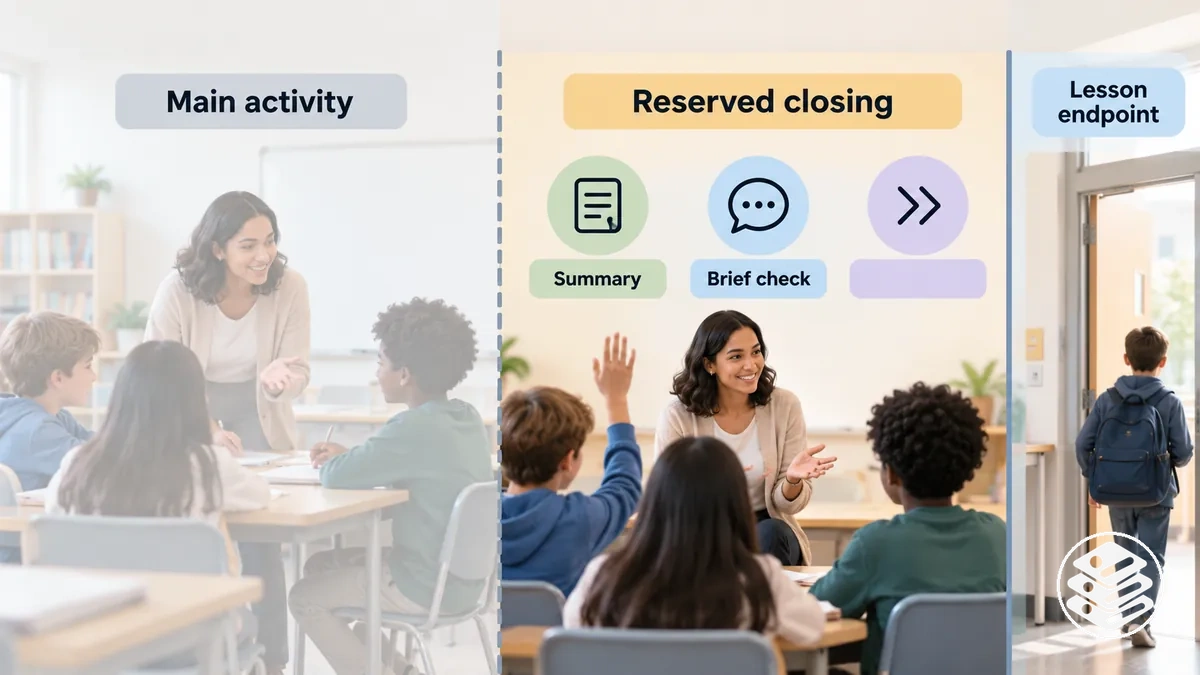
A summary or brief reflection needs enough reserved time to bring the learning together, while checking may require additional time when understanding or completion must be confirmed.
Next-step directions and pack-up also consume closing time when they are necessary, so their duration should be allowed for before the main activity is scheduled to end.
The lesson closing is therefore protected time whose length depends on the closing functions required for that lesson, not a fixed universal duration.
Estimate Each Activity's Duration, Including Setup and Transitions
An activity duration estimate should include both the core task time and the necessary overhead for setup time and transition time.
The estimate is therefore a practical planning value whose actual duration remains conditional on the activity and classroom conditions.
The illustration separates active work from the overhead that can extend the total activity duration.
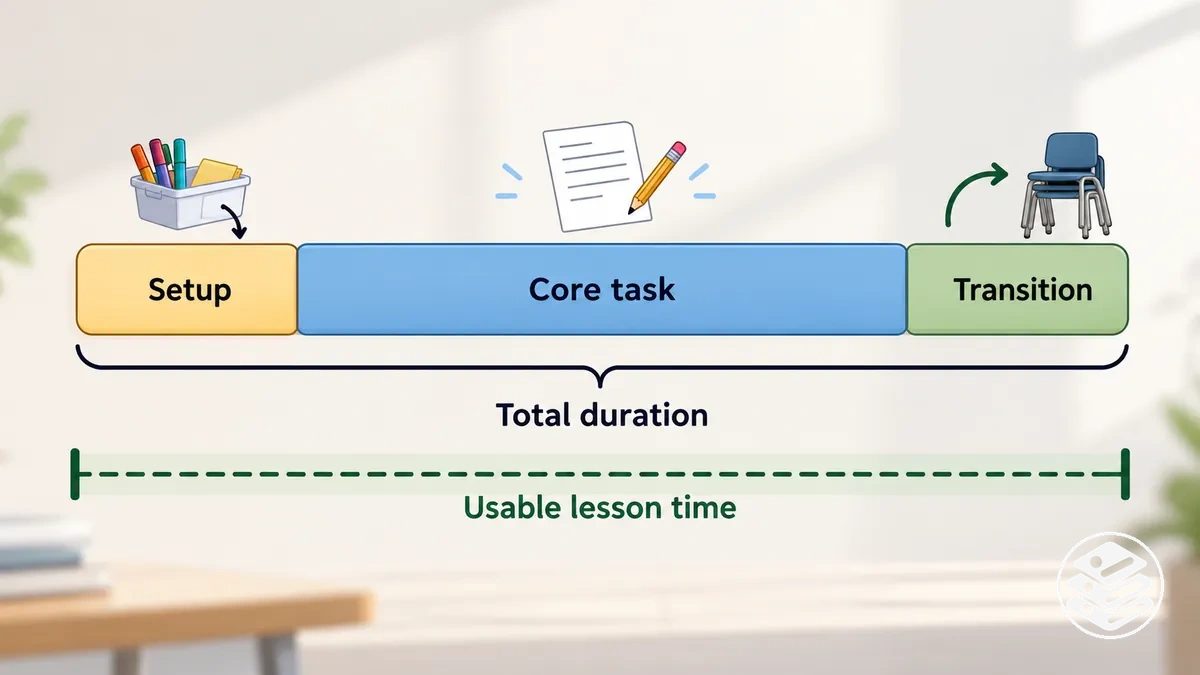
Use the same ordered sequence for each activity so the estimate can be checked consistently against usable lesson time.
The method separates the work students actually perform from the time required to start, switch, and finish the activity.
Verification occurs when the combined duration is compared with the time available and revised when it does not fit.
- Define the activity: Identify the specific learning task whose duration needs to be estimated so unrelated lesson work is not included.
- Estimate active work: Approximate the core task time required for the intended amount and complexity of learning work.
- Add overhead: Include setup time and transition time that are necessary to prepare materials, organise the group, begin the task, or move to the next activity.
- Compare with usable time: Check the combined activity duration against the usable lesson time available for that part of the lesson.
- Revise the estimate: If the total does not fit, adjust the task scope, active work allowance, or applicable overhead rather than treating the first estimate as fixed.
Prior experience and an observed timing from a similar lesson can provide a starting point, but task complexity, group configuration, learner independence, and likely student response can change the actual duration.
A task with more materials or group movement may need more setup or transition time, while a familiar task completed independently may require less overhead.
Treat each estimate as approximate and record observed timing when useful so later planning can be calibrated from what actually occurred.
For example, a hypothetical activity estimated at 12 minutes of core task time could require 3 minutes of setup time and 2 minutes of transition time, producing a 17-minute activity duration estimate.
Those figures are illustrative rather than a universal allowance; the planning implication is to combine the relevant components, check the total against usable lesson time, and recalibrate future estimates from observed timings rather than assuming false precision.
Account for Instructions and Setup Time
Instructions and setup time are start-up overhead that should be counted separately from students' active task time when they are required for the activity.
Scan the applicable preparation demands before finalising the activity duration estimate.
- Instructions: Add time when learners need directions before they can begin; simpler or already familiar tasks may require less instructional overhead.
- Materials: Include setup time when materials must be distributed, arranged, collected, or made ready before active work can start.
- Group formation: Allow for group formation when learners must move, reorganise, or take assigned positions before the task begins.
- Technology: Count task-launch time when devices, software, displays, or other technology must be opened and made ready for use.
- Modelling: Include modelling when the teacher must demonstrate the expected process or task before students can work independently.
- Essential setup questions: Allow time for brief questions that must be resolved before the task can begin correctly, without treating general discussion as setup overhead.
Only the categories that apply to the specific activity should be included, and they do not need equal amounts of time.
Activities involving several materials, group formation, technology, or modelling may carry more setup overhead than a familiar task that can start after brief instructions.
Adding the applicable setup and instruction time makes the activity duration estimate reflect the conditions required to launch the task rather than active work alone.
Include Transition Time Between Activities
Transition time is the activity changeover time used for movement, changing materials, regrouping, or task switching between planned activities.
What changes transition time
- Changeover frequency
- More required switches create more cumulative transition overhead because each one consumes part of the lesson period.
- Changeover complexity
- Movement, new materials, regrouping, or a more complex task switch may require more time than a simple change between similar activities.
- Planning rule
- Estimate the specific changeover conditions rather than applying a universal allowance, and count transition time once within the relevant activity sequence.
When the combined transition load leaves insufficient usable learning time, shorten, combine, or simplify activities so their planned duration still fits the lesson.
Build Flexibility Into the Timing Plan
A flexible timing plan builds pre-planned capacity to adjust activity timing while protecting the lesson objective and closing.
Instead of relying on unprioritised improvisation, identify likely timing risks before the lesson and assign an appropriate response such as buffer time, a hard stop, a cut line, or an optional extension.
Each contingency should connect a predictable timing risk to an adjustment and its effect on the remaining lesson time.
Buffer time can absorb modest uncertainty, while a hard stop or cut line protects later priorities when an activity threatens to overrun.
An optional extension provides extra work only when sufficient time remains, so essential learning does not depend on completing it.
- If an activity has uncertain completion time: Reserve buffer time where the uncertainty is meaningful so a modest overrun does not immediately displace the closing.
- If an essential activity could continue beyond its planned slot: Set a hard stop that ends or pauses the activity before it consumes time reserved for later lesson priorities.
- If part of an activity is useful but non-essential: Establish a cut line so that portion can be shortened or omitted when the earlier work takes longer than expected.
- If an activity may finish earlier than expected: Prepare an optional extension that can use the available time without making the lesson objective dependent on the extension.
- If several activities carry timing uncertainty: Prioritise which activity may be shortened before teaching begins so cumulative variation does not leave the closing unprotected.
The appropriate buffer time and cut lines depend on the uncertainty of the activities, learner response, and how much remaining time must be protected; there is no universally correct buffer percentage.
Planned flexibility therefore means choosing contingencies and priorities in advance, not making unprioritised adjustments only after timing pressure appears.
Allow Timing to Change With Student Responses
Timing may change when observable student responses show that the planned pace no longer fits the lesson, while the lesson objective and total period remain fixed constraints.
Use response signals such as understanding, questioning, discussion, wait time, and faster completion to make a proportionate timing adjustment rather than changing pace automatically.
- If understanding develops more slowly than expected: Extend the current activity only when additional time is likely to support the intended learning, and shorten a lower-priority activity if the extra time must come from elsewhere.
- If questioning continues because learners are clarifying the task or concept: Allow more time when the questions are necessary for progress, but maintain the planned pace when further questioning is no longer essential to the lesson objective.
- If productive discussion is still contributing directly to the intended learning: Extend it within the available period when its value justifies using more remaining time; otherwise use the planned stopping point.
- If learners need more wait time before responding: Slow the pace when additional response time is appropriate, without treating any fixed wait-time threshold as universally required.
- If students reach the intended task outcome faster than expected: Reduce the planned activity time or move on so the recovered time can support later priorities rather than filling the original allocation unnecessarily.
Each response signal should be interpreted in context because the same student response can support different pacing decisions under different lesson conditions.
A timing adjustment should therefore be proportionate to what is observed: extend, maintain, or reduce time while protecting the remaining period.
When one activity is extended, another activity usually needs to be shortened or omitted so the lesson still fits within the fixed total time.
Identify Activities That Can Be Shortened or Extended
Classify activity flexibility before the lesson by deciding what must be preserved, what can be compressed, and what can be extended if timing changes.
A core learning activity tied directly to the lesson objective should normally be protected, while a cut line can identify where less essential work may stop without removing required learning or the planned closing.
- Preserve: Protect a core learning activity when shortening it would remove work required to meet the lesson objective; adjust lower-priority elements instead.
- Shorten: Compress an optional example, repeated explanation, or extra practice when the essential learning has already been addressed and remaining time needs to be protected.
- Extend: Extend extra practice or enrichment when students have completed the required work and sufficient remaining time is available without reducing the closing.
The classification depends on the role each activity plays in the specific lesson, so an optional example or enrichment task is flexible only when it is not required for the intended objective.
Set the cut line in advance so the teacher knows which portion can be shortened when time contracts and which activity can extend when time remains.
This protects core learning and the closing while allowing non-essential or expandable work to change with the available time.
Adjust Time Allocation for Different Lesson Lengths
A short lesson period and a long lesson period should not be planned as proportionally enlarged or reduced copies of the same sequence.
Lesson length changes the available time for activity chunks, transitions, depth, and closing time, so pacing choices must be adapted to the period rather than copied at a different scale.
The same planning dimensions apply across different durations, but their practical limits change with available time.
A shorter period usually requires tighter activity chunking, fewer avoidable transitions, and a narrower depth of work, while a longer period can support more developed chunks or checkpoints when they serve the lesson objective.
The comparison below shows how lesson length changes these dimensions without implying standard period cutoffs or mandatory activity counts.
| Planning dimension | Short lesson period | Long lesson period | Pacing implication |
|---|---|---|---|
| Activity chunks | Use fewer or more tightly scoped chunks when available time cannot support several complete activities. | Use additional or more developed chunks when the extra time supports the intended learning. | Choose the number and scope of chunks according to the work that can be completed within the period. |
| Transition load | Limit unnecessary changeovers because each transition consumes a larger share of the available time. | More transitions may fit when they support distinct stages of learning and still leave sufficient teaching time. | Evaluate transition load against the amount of usable time that remains for learning. |
| Depth | Use a narrower scope when deeper treatment would crowd out essential learning or closure. | Allow greater depth when additional explanation, practice, discussion, or checking is useful. | Adjust depth to the available time rather than expanding every activity equally. |
| Closing time | Protect a defined closing even when earlier activities need tighter limits. | Protect the closing while allowing earlier phases more room when the longer period supports it. | Closing time remains a planned requirement rather than residual time at either lesson length. |
The adaptation principle stays the same across lesson durations: fit the scope, activity chunks, transition load, depth, and closing time to the available period while protecting the lesson objective.
Different lesson lengths change the planning constraints, but they do not require a different underlying timing logic or determine the lesson-plan format.
Adapt Time Allocation for Short Lesson Periods
A short lesson period requires stronger prioritisation of the core learning objective, with fewer activities, fewer avoidable transitions, efficient setup, and a protected closing.
Limited lesson time should change which elements receive priority rather than causing every phase to be reduced by the same proportion.
Use fewer activities when additional tasks would fragment the time needed for the core learning objective, and limit transitions when changeovers would consume a disproportionate share of the available period.
Tighten setup when materials or preparation can be simplified without preventing the activity from functioning as intended, while reserving enough closing time to complete the planned lesson endpoint.
The amount of compression depends on the lesson's specific demands, so the plan should prioritise essential learning and closure rather than follow a universal timing cutoff or formula.
Adapt Time Allocation for Long Lesson Periods
A long lesson period needs deliberate chunking, planned checkpoints, and purposeful depth rather than simply adding more content or separate tasks.
Structure the longer duration so each activity chunk has a clear role, the pacing remains deliberate, and the closing is still protected.
Use chunking to divide extended work into meaningful parts, and vary the activity mode only when the change supports the lesson objective rather than creating unnecessary transitions.
Place checkpoints where they help confirm progress or signal a pacing adjustment, include a transition allowance when movement or task changes are required, and use additional time for deeper practice when that depth serves the intended learning.
The amount of chunking, variation, deeper practice, and transition time should remain conditional on the objective and learners, with enough time retained for the closing.
Correct Lesson Pacing When Activities Run Over or Finish Early
Activities that run over or finish early are observable lesson pacing symptoms, not diagnoses of a single planning problem.
The diagnostic comparison below separates each pacing mismatch from the possible causes, checks, and corrective action that may follow.
| Symptom | Possible cause | Check | Corrective direction |
|---|---|---|---|
| Activity runs over its planned duration | The duration may have been underestimated, setup or transitions may have taken longer than expected, discussion expansion may have extended the task, or the lesson may contain more work than the available time can support. | Compare the planned duration with the observed duration and review actual timestamps for setup, transitions, discussion, and active task time to identify where the overrun occurred. | Revise the future estimate for the component that took longer, or use an appropriate hard stop or pre-planned cut line when later priorities and closure need protection. |
| Activity finishes earlier than planned | The task difficulty may have been overestimated, the required work may have been narrower than expected, or students may have completed the task unusually quickly. | Compare the planned duration with the observed duration and confirm whether the intended task outcome was reached before treating the unused time as evidence that the original estimate was too long. | Reduce the future estimate when repeated observations support that change, or use prepared extension work when additional practice or depth serves the lesson objective and sufficient time remains. |
The likely cause should be checked against what actually happened before the timing plan is changed.
A run over associated with long transitions requires a different adjustment from an overrun produced by discussion expansion, while an early finish after unusually fast completion may not justify the same revision as a task that is consistently easier than expected.
Planned duration and observed duration provide the main comparison for deciding which part of the estimate needs attention.
Corrective action should match the checked cause rather than the symptom alone.
Future estimates can be revised when observed timings repeatedly differ from the plan, while hard stops and cut lines can protect the closing when a task is liable to expand and prepared extension work can absorb useful remaining time after an early finish.
These responses remain conditional on the lesson objective and the circumstances that produced the pacing mismatch.
Record the observed duration of relevant task, setup, transition, and discussion components and compare them with their planned durations after the lesson.
Repeated differences provide a basis for recalibrating later estimates, while isolated differences should be interpreted in the conditions in which they occurred rather than treated as proof of a permanent timing rule.
Example of Lesson Time Allocation for a Single Period
Consider an illustrative 50-minute single-period lesson in which 4 minutes of scheduled time are reserved for predictable non-instructional demands, leaving 46 minutes of usable time.
These figures are illustrative rather than universal and are included so the allocation arithmetic can be checked.
The 46 minutes of usable time are assigned across the opening, main learning activities, setup, transitions, buffer, and closing rather than treating the full scheduled time as available for learning tasks.
In this sample allocation, 6 minutes are used for the opening, 31 minutes for setup and main learning work including the transition between activities, 4 minutes for buffer, and 5 minutes for the closing.
The detailed allocation totals 46 minutes, which matches the usable time after the 4-minute deduction from the 50-minute scheduled time.
| Lesson component | Illustrative minutes | Planning role |
|---|---|---|
| Opening | 6 minutes | Orient learners and prepare them for the main learning. |
| Setup for main learning | 3 minutes | Prepare materials and directions before active work begins. |
| Main learning activity 1 | 14 minutes | Complete the first core learning task. |
| Transition | 2 minutes | Change materials or task configuration before the next activity. |
| Main learning activity 2 | 12 minutes | Complete the second core task, with a pre-set cut line for its optional final practice. |
| Buffer | 4 minutes | Absorb limited timing variation before later priorities need adjustment. |
| Closing | 5 minutes | Protect the planned lesson endpoint. |
| Total usable time | 46 minutes | Matches the usable time available for the planned lesson. |
If discussion during the first main learning activity runs 6 minutes beyond its planned duration, the 4-minute buffer can absorb the first part of the overrun and the optional final practice in the second activity can be shortened by 2 minutes at its cut line.
That adjustment keeps the total within the same 46 minutes of usable time while preserving the core learning work and 5-minute closing.
A different lesson could require a different adjustment because the appropriate cut line depends on which work is essential to its objective.
The reusable logic is to convert scheduled time into usable time, allocate that usable time explicitly, verify that the minute totals balance, and decide in advance where an adjustment can occur if pacing changes.
The numbers themselves should change with the lesson conditions; the transferable principle is the arithmetic and priority logic, not the sample allocation.