
Aligning a Lesson Plan Template with Curriculum Requirements
Curriculum alignment in a lesson plan template is a traceable match from the selected curriculum requirement to the lesson scope, objective, content, learner activity and evidence of learning. Each link must preserve the same intended knowledge, skill and learning demand; repeating curriculum wording is not enough when the lesson asks learners to know or do something different.

Curriculum-alignment traceability check
Use these six checks in order against your own lesson plan. Tick a link only when the planned component preserves or supports the same intended learning represented by the selected curriculum requirement.
Decision rule: if any link cannot be confirmed, review that link before treating the plan as aligned. Confirming all six supports curriculum-to-lesson traceability; it does not by itself prove that the lesson will be effective in practice.
The chain starts with the curriculum requirement that defines the expected learning. The objective narrows that learning to a lesson-sized target, content and activity provide instruction and practice, and evidence indicates what learners can demonstrate. A broad curriculum requirement may extend across several lessons, so alignment depends on accurate traceability and an honest coverage claim, not on forcing full coverage into one lesson.
Table of Contents
What Curriculum Alignment Means at Lesson Level
Curriculum alignment at lesson level is the deliberate correspondence between a selected curriculum requirement and what learners are expected to learn, do and demonstrate in that lesson.
In a lesson plan template, the learning expectation, instruction and assessment evidence should therefore represent the same intended learning rather than merely use similar terminology.
Alignment roles at a glance
- Curriculum requirement
- Establishes the expected learning. Depending on the curriculum system, it may be expressed as an outcome, standard or descriptor.
- Lesson objective
- States the lesson-sized intended learning while preserving the required knowledge, skill and learning demand.
- Instructional activity
- Gives learners an opportunity to practise or apply the intended learning rather than merely encounter the same topic.
- Evidence of learning
- Provides an observable basis for judging what learners can demonstrate in relation to the aligned objective and requirement.
The illustration below labels these lesson-level elements so their intended correspondence can be seen directly.
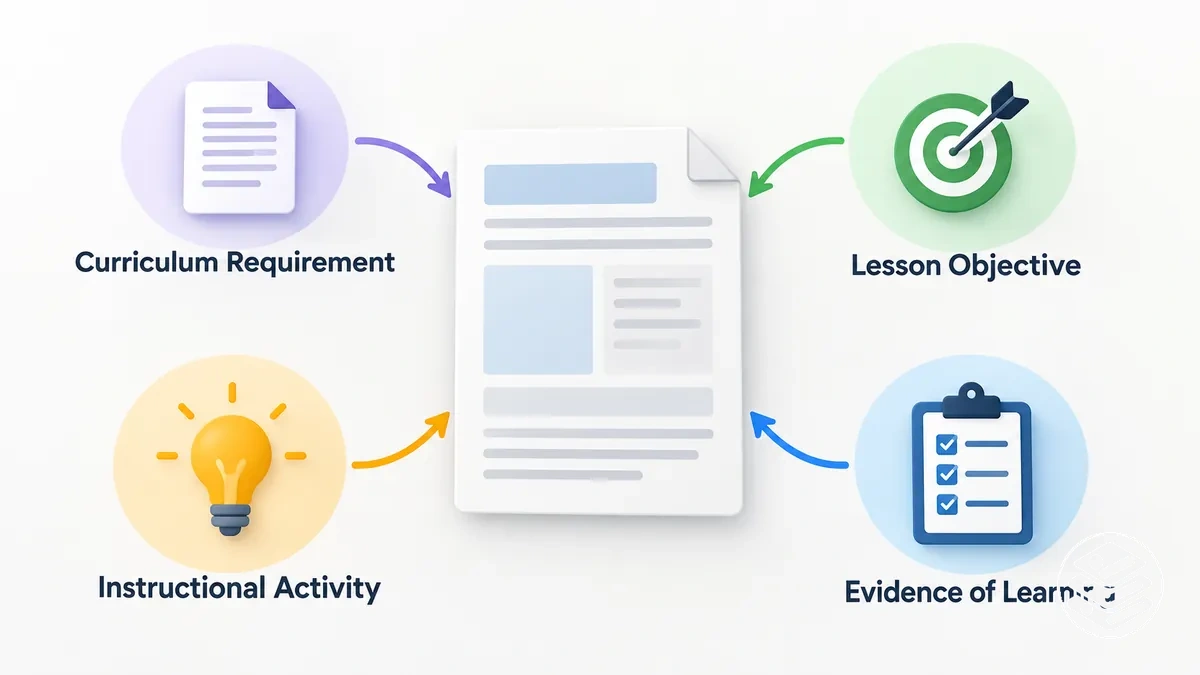
Genuine curriculum alignment requires a match in expected learning and learning demand; shared words alone do not establish alignment.
A lesson can repeat terminology from a curriculum requirement yet remain only superficially aligned if its objective, activity or evidence asks learners to know or do something different.
Define the Curriculum Scope for the Lesson
A lesson should target the teachable portion of a curriculum requirement that is feasible and meaningful under the lesson's actual conditions.
Lesson scope should reflect the required learning while accounting for prior learning, lesson duration, conceptual depth and cognitive demand rather than treating one lesson as responsible for all related coverage.
Curriculum scope becomes more defensible when the selected curriculum outcome is considered alongside the learners' prerequisite knowledge, its position in the learning sequence and the instructional time available.
These constraints help narrow a broad requirement without changing its intended learning demand.
The diagram below shows how prerequisite learning and available lesson time can narrow a broad curriculum requirement to a lesson-sized target while leaving the remaining scope outside the current lesson.
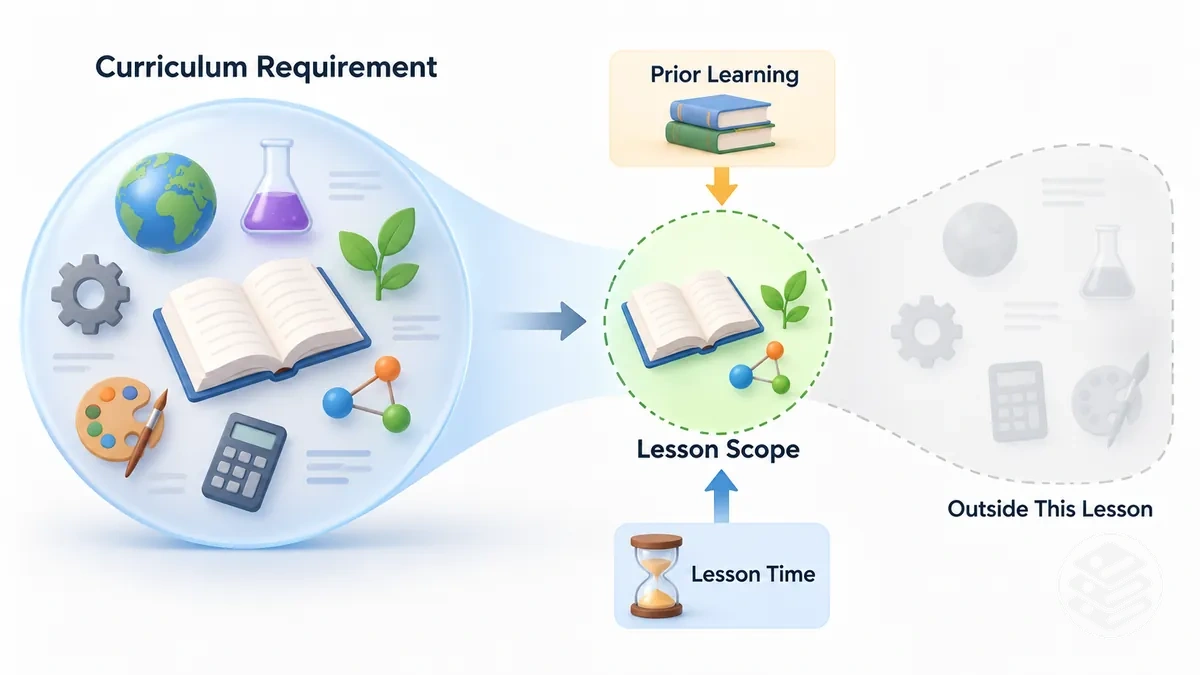
- Identify the intended curriculum requirement. Select the curriculum outcome or expectation that the lesson is meant to address, then check that the proposed lesson focus retains the knowledge, skill or learning demand expressed by that requirement.
- Check prior learning and sequence position. Identify the prerequisite knowledge or skills learners need for the proposed focus, then check whether those prerequisites have been established sufficiently for the lesson to proceed meaningfully.
- Constrain the scope by time and learning demand. Narrow the planned content according to the available lesson duration, conceptual depth and cognitive demand, then check that the selected portion allows enough instructional time for learners to engage with the intended learning rather than merely encounter it.
- Verify the lesson boundary. State the specific teachable portion the lesson will address, then check that the resulting coverage claim describes only that portion and does not imply that the broader curriculum requirement has been exhausted.
For example, suppose a broad curriculum expectation requires learners to analyse several related causes and consequences, but the current lesson conditions support focused work on one clearly bounded cause and its consequence.
The lesson scope can preserve the analytical demand while limiting the content to that teachable portion, provided the necessary prior learning is in place.
Other parts of the curriculum expectation remain outside the boundary of that lesson rather than being treated as completed coverage.
The final scope check is whether the selected target remains faithful to the curriculum requirement and is realistically addressable within the lesson.
Identify the Relevant Curriculum Outcomes or Standards
Identify the curriculum outcome or curriculum standard that actually applies to the lesson before planning objectives or activities around it.
The relevant requirement should match the lesson's subject or learning area, year or level and intended learning demand, not simply contain words that resemble the planned activity.
Test each candidate requirement against its official context, because a descriptor gains meaning from the curriculum framework in which it appears.
Check the surrounding level, sequence position and required knowledge or required skill before deciding that the requirement fits the lesson.
The annotated example below labels the contextual fields that may identify a requirement, including the learning area, year or level, descriptor and any curriculum code the framework actually provides.
Use those same fields as criteria for distinguishing official contextual fit from superficial wording similarity.
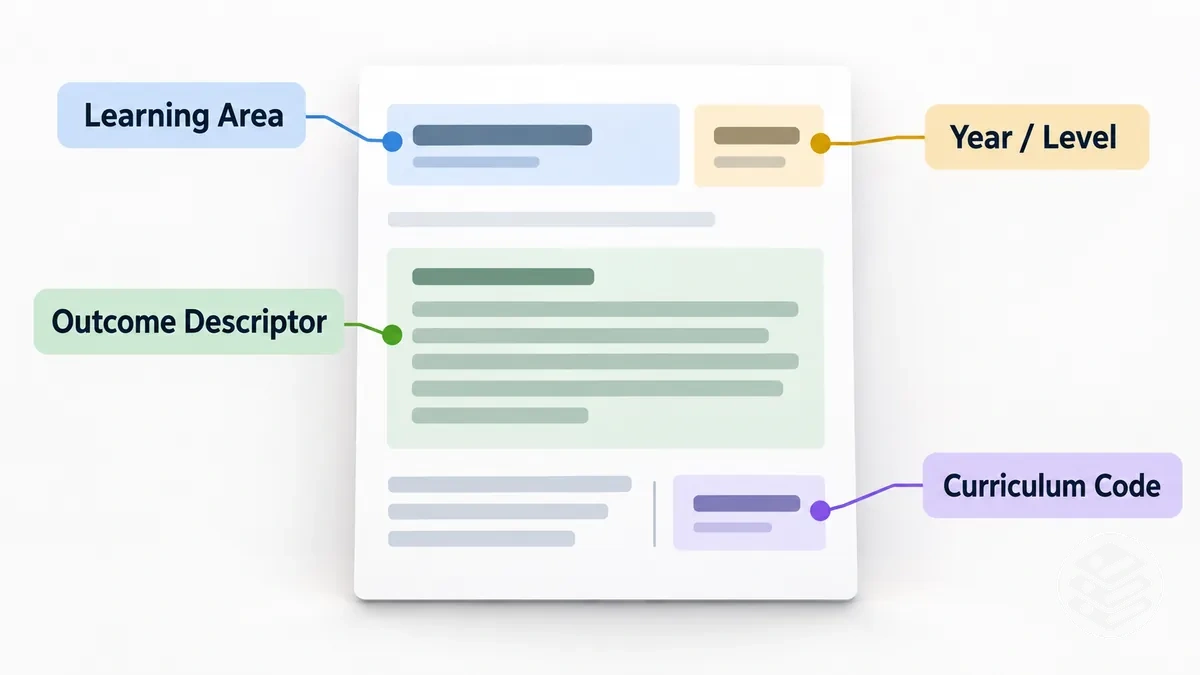
- Subject or learning area: confirm that the curriculum outcome belongs to the subject or learning area being taught; similar wording from another area does not establish relevance.
- Year or level: check that the requirement applies to the learners' stated year, stage or level where the curriculum defines one; a requirement for a different level may represent a different learning expectation.
- Sequence position: establish where the outcome or standard sits within the curriculum progression so the lesson does not rely on knowledge or skills assigned to a later stage.
- Required knowledge or required skill: compare what learners are expected to know or do with the lesson's intended learning; the candidate is relevant when that learning demand corresponds to the lesson focus.
- Descriptor or curriculum code: retain the official descriptor and, when the curriculum system provides one, its curriculum code or reference rather than inventing an identifier. When these identifying attributes agree with the lesson context, the selected requirement is established in its defining context.
Limit Coverage to What One Lesson Can Reasonably Address
One lesson may address only part of a broad curriculum requirement when lesson duration, prerequisite knowledge and the required learning demand make fuller treatment unrealistic.
Lesson coverage should therefore state the specific portion the lesson can meaningfully teach and practise rather than imply that the entire requirement has been fully covered.
The defensible lesson boundary depends on how instructional time, conceptual depth, cognitive demand and prior learning interact with the requirement's place in the broader learning sequence.
A curriculum requirement can be addressed in this lesson without being fully covered, and simple exposure or mention does not by itself establish meaningful coverage.
The diagram below separates the portion addressed in the current lesson from the remaining progression, while these criteria define the scope implication of each constraint.
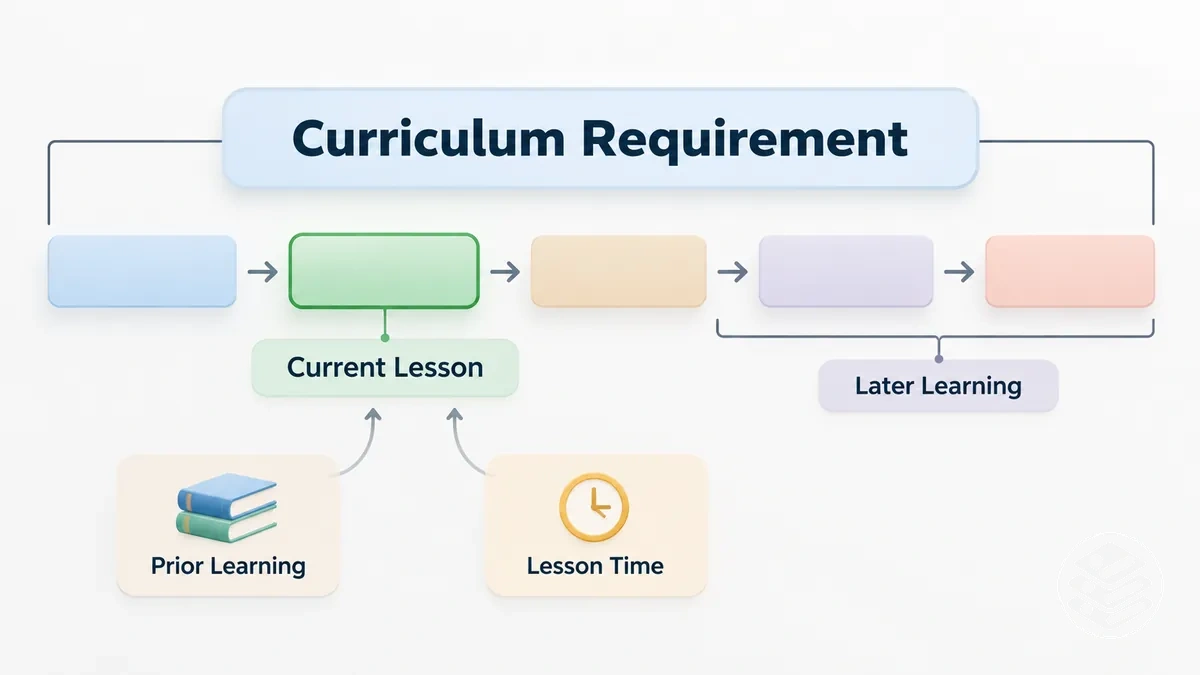
- Lesson duration: limit the lesson scope to learning that can receive meaningful instructional attention and practice within the available time, leaving additional portions for later learning.
- Prerequisite knowledge: narrow coverage when the selected portion depends on knowledge or skills learners have not yet established, because those prerequisites affect what can reasonably be addressed now.
- Conceptual depth: reduce the amount of content when the curriculum requirement calls for deeper explanation, connection or application rather than brief exposure to several ideas.
- Cognitive demand: match the amount covered to the type of thinking the curriculum requirement expects, allowing sufficient lesson time for learners to engage with that demand rather than merely encounter the content.
- Learning sequence: treat the lesson as one contribution within a broader progression when the curriculum requirement develops across multiple learning experiences, and claim only the portion actually addressed in this lesson.
For example, a broad curriculum outcome may require learners to examine several connected ideas across a progression, while one lesson concentrates on understanding and applying only the first relationship.
That lesson can accurately claim partial coverage of the curriculum requirement without implying that later relationships have also been taught or practised.
The defensible claim is the specific portion addressed in the lesson, not the broader outcome in its entirety.
Map Curriculum Requirements to Lesson Objectives
Mapping a curriculum requirement to a lesson objective means converting the selected requirement into a lesson-sized target without changing its required knowledge, required skill or cognitive demand.
The wording of the learning objective can become more specific, but the substantive learning demand must remain traceable to the curriculum requirement.
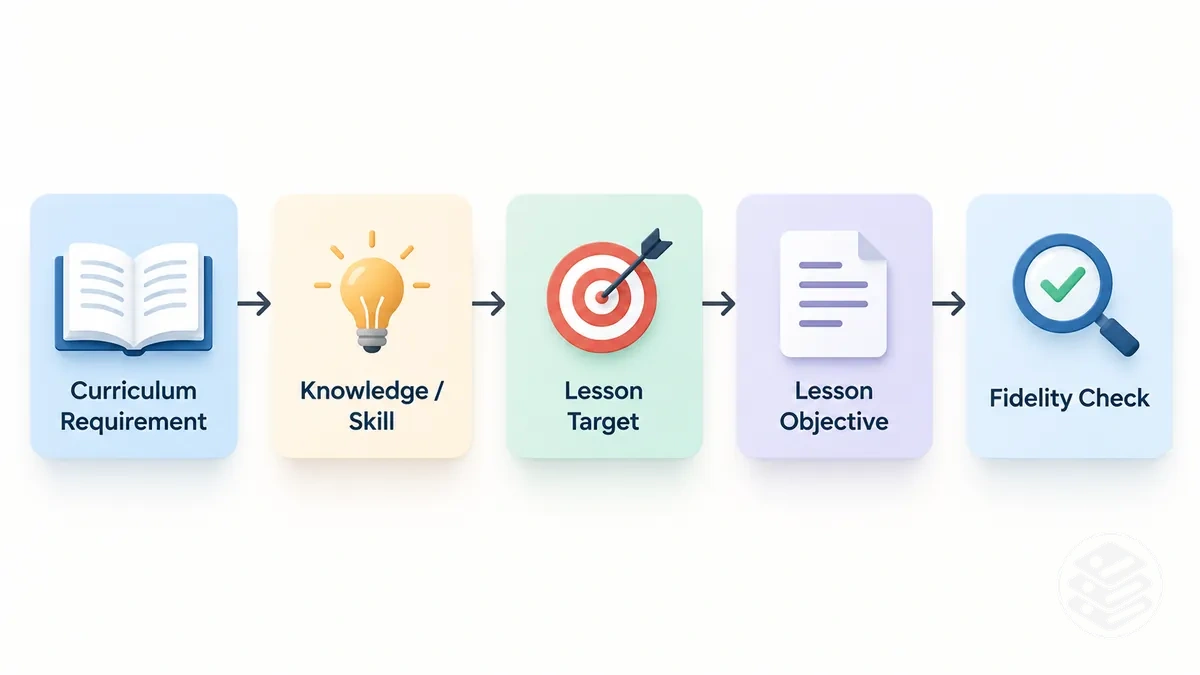
The mapping sequence narrows scope while preserving meaning: first identify what the curriculum requires, then isolate the portion relevant to the lesson, express that portion as a lesson target and verify semantic fidelity.
The visual below traces this relationship from the source curriculum requirement through the extracted knowledge or skill to the resulting lesson objective.
The ordered steps then make the conditions for alignment explicit.
- Identify the required knowledge or skill. Extract what learners are expected to know or do from the curriculum requirement, and retain the cognitive demand that defines how that learning should be demonstrated.
- Isolate the lesson-relevant portion. Narrow the curriculum requirement to the knowledge or skill that fits the current lesson scope, provided the selected portion remains a legitimate part of the original curriculum expectation.
- Express the lesson target. Write a learning objective that states the lesson-sized target clearly enough to guide instruction, while preserving the required knowledge, required skill and cognitive demand in its meaning.
- Verify semantic fidelity. Compare the lesson objective with the curriculum requirement and confirm that changes in wording or scope have not weakened, replaced or removed an essential part of the required learning demand.
For example, if a curriculum outcome requires learners to analyse how two factors influence a result, a lesson objective may focus on analysing how one of those factors influences the result when the other is addressed later in the learning sequence.
An objective that merely asks learners to list the factor would narrow the cognitive demand from analysis to recall, so the mapping would lose semantic fidelity.
The exact wording and number of objectives can vary with the curriculum and lesson scope; the final alignment check is whether the lesson target remains faithful to the selected requirement rather than whether it follows a particular objective-writing formula.
Match Each Objective to a Specific Curriculum Outcome
Each lesson objective needs a recoverable alignment rationale showing which curriculum outcome or curriculum standard it advances and how it contributes to the required learning.
The relationship does not have to be mechanically one-to-one, but traceability should make the reason for each connection clear.
A one-to-one relationship may be appropriate when one lesson objective directly advances one curriculum outcome.
A one-to-many relationship can be defensible when one objective contributes to closely related outcomes that share the same required learning, while a many-to-one relationship can occur when several lesson objectives contribute to different parts of one broader outcome.
The example below shows how traceability can remain explicit across these patterns without treating shared wording as proof of alignment.
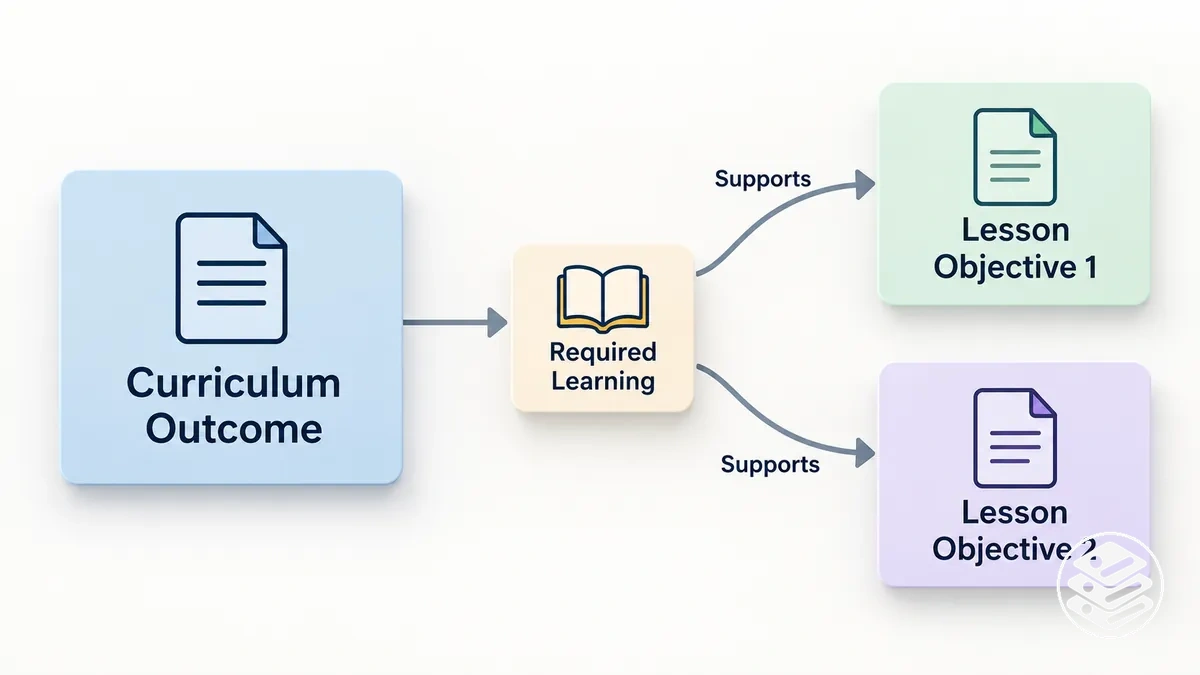
For example, one lesson objective might advance a curriculum outcome by developing one required skill, while a second objective advances another closely related part of the same outcome; conversely, one objective may contribute to two curriculum outcomes when both genuinely require the same knowledge or skill.
The alignment rationale is defensible when achieving the lesson objective would represent meaningful progress toward the linked curriculum outcome or curriculum standard.
If the connection relies only on shared words and does not advance the stated required learning, the relationship lacks sufficient traceability.
Preserve the Knowledge, Skill and Level of Learning Required by the Outcome
An aligned lesson objective must preserve the curriculum outcome's required knowledge or content, required skill or learner action, appropriate cognitive demand and any material condition attached to the required learning.
All four dimensions can affect fidelity, so a match in topic alone is not enough when another dimension changes.
- Knowledge or content: check that the lesson objective retains the knowledge or content identified by the curriculum outcome; a mismatch means learners may work on a related topic without addressing the required knowledge itself.
- Learner action or skill: check that the lesson objective asks learners to perform the required skill or a lesson-sized part of it; changing the learner action can alter the learning demand even when similar vocabulary is retained.
- Cognitive demand: check that the lesson objective requires the kind of reasoning represented by the curriculum outcome; for example, an objective asking learners to recall information does not preserve an outcome that requires them to analyse relationships merely because both refer to the same topic.
- Condition or constraint: retain any stated condition that materially defines how the required learning is to be demonstrated; omitting or changing that condition can produce a mismatch even when the knowledge and skill appear similar.
For example, an objective that asks learners to list causes may have a surface topic match with a curriculum outcome requiring learners to analyse how causes interact, but it lowers the cognitive demand from analysis to recall.
An objective asking learners to analyse how selected causes interact can preserve the required learning while narrowing the content to a lesson-sized target.
Cognitive demand should be interpreted from the selected curriculum outcome rather than from an assumed fixed taxonomy, and more difficult wording is not automatically better aligned.
The fidelity check is whether the lesson objective retains the relevant knowledge, skill, learning demand and condition represented by the curriculum outcome.
Select Content and Activities That Support the Mapped Outcomes
Instructional content
Supplies the knowledge and concepts learners need to pursue the mapped lesson objective. Relevant material is insufficient if an essential part of the required knowledge is missing.
Learner activity
Requires learners to use that knowledge through the intended action, skill or cognitive demand. An engaging task can still be misaligned when learners can complete it without practising the required learning.
Shared check: both choices should serve the same mapped curriculum outcome and lesson objective; topical relevance alone does not establish alignment.
- Check the instructional content against the required knowledge. Select content that gives learners access to the knowledge or concepts needed for the lesson objective; relevant material is insufficient when it omits an essential part of the required knowledge.
- Check the learner activity against the required skill or thinking. Choose an activity that requires learners to practise the learner action or cognitive demand expressed by the lesson objective rather than merely encounter the topic.
- Check the combined lesson scope. Confirm that the selected instructional content and learner activity remain realistic for the lesson while still serving the mapped outcome and lesson objective.
For example, if the mapped outcome requires learners to analyse relationships between causes and the lesson objective targets that same analysis, instructional content describing the relevant causes may supply the required knowledge.
A learner activity limited to copying or recalling those causes would still be poorly aligned because it does not require the intended analytical action, whereas an activity asking learners to examine how the causes relate would more directly practise the required skill.
The resulting learner work may also provide likely evidence of progress, but evidence planning remains separate from this content-and-activity decision.
Alignment is strongest when both the instructional content and the learner action serve the same mapped outcome and lesson objective.
Choose Curriculum Content That Directly Serves the Outcome
Select curriculum content because it is necessary or directly supportive of the mapped outcome and lesson objective, not merely because it is interesting or topically related.
Each included item should supply, clarify or support the required knowledge or concept that learners need for the intended learning.
The content filter should distinguish essential or directly supportive material from related enrichment that does not materially advance the mapped outcome.
For example, when an outcome requires learners to explain a particular process, information needed to understand the stages of that process may belong in the lesson, while additional facts about the wider topic may be omitted when they do not support that explanation.
The following criteria filter curriculum content from semantic necessity through practical delivery constraints, with the goal of identifying the minimum sufficient content for the intended learning.
- Direct relevance: include curriculum content when it directly serves the required knowledge or concept represented by the mapped outcome; content that is only loosely related can broaden the topic without strengthening alignment.
- Sufficiency: include enough content for learners to engage meaningfully with the lesson objective; omitting an essential concept can leave the required learning unsupported, while over-expanding the content can dilute the lesson focus.
- Accuracy: use content that represents the relevant subject knowledge accurately within the lesson context; inaccurate or misleading content can undermine the intended learning even when its topic appears relevant.
- Prerequisite fit: select content that fits the prerequisite knowledge learners are expected to bring to the lesson, or account for missing prerequisites when they are necessary for understanding the mapped outcome.
- Learner accessibility: present the required knowledge in a form learners can reasonably access given their current language, background knowledge and learning context without changing the substantive meaning of the outcome.
- Feasibility: keep the selected content realistic for the available lesson boundary so that it can be addressed within the planned lesson without unnecessary expansion.
Plan Activities That Practise the Required Learning
A learner activity is aligned when the learner action practises the knowledge application, required skill or cognitive demand expressed by the lesson objective.
The activity should therefore make learners perform the intended learning, not merely participate in a task related to the same topic.
- Name the target objective. Identify the lesson objective the learner activity is meant to support, keeping the required skill and cognitive demand explicit.
- Specify the learner action. State what learners will actually do so the activity requires them to apply, practise or demonstrate the learning represented by the objective.
- Set the task condition and expected performance. Define the relevant task condition and describe the expected performance closely enough to show how learners will use the required skill, while allowing for variation in actual learner response.
- Run the alignment check. Verify that the observable learner action rehearses the required learning under the stated condition; revise the activity if participation is possible without practising the skill or thinking required by the lesson objective.
For example, if the lesson objective requires learners to analyse relationships between causes, an engaging sorting activity that asks them only to group cause cards by colour or category may involve active participation without practising the required analysis.
An activity asking learners to compare the causes and explain how they relate more directly requires the intended cognitive demand.
The resulting performance may provide evidence of how learners approached the required skill, but participation alone does not establish alignment.
The final alignment check is whether the learner activity requires the learner action, task condition and expected performance that serve the lesson objective.
Record Curriculum Alignment in the Lesson Plan Template
Record curriculum alignment in the lesson plan template so another teacher can trace the selected curriculum requirement to the planned learning.
The alignment record should connect the curriculum reference, lesson objective and instructional plan clearly enough that the relationship does not have to be inferred.
A compact mapping table can organise the curriculum reference and the lesson decisions linked to it while keeping traceability visible.
The fields distinguish the intended objective, the aligned content or learner activity and a brief evidence indicator without expanding into detailed assessment design.
| Curriculum Reference | Lesson Objective | Aligned Content or Activity | Evidence Indicator |
|---|---|---|---|
| Outcome: analyse relationships among causes | Analyse how selected causes relate to one another | Content on the relevant causes; learner activity comparing and explaining their relationships | Learner explanation of the relationships |
In this completed example, the curriculum reference identifies the required learning, while the lesson objective states the lesson-sized target.
The aligned content supplies the relevant concepts and the learner activity requires the intended analytical action, making the instructional connection visible.
The evidence indicator remains a brief cue to likely observable performance rather than a full assessment plan.
Field names and layout may differ between lesson plan templates, but the record should remain clear enough for another teacher to follow the curriculum-to-objective-to-instruction relationship.
Document Curriculum Codes or References Accurately
Record the curriculum reference accurately enough that the selected curriculum requirement can be checked against the source curriculum.
Reproduce the official identifier or descriptor used by that source, noting that not every curriculum framework uses a curriculum code and that identifier structures can differ by jurisdiction or version.
- Curriculum code or identifier: record the official code when the source curriculum provides one, and verify that it corresponds to the exact requirement being targeted rather than inferring or constructing a missing identifier.
- Descriptor: reproduce enough of the official descriptor to identify the intended requirement and distinguish it from closely related outcomes.
- Year or level: include the applicable year or level when it forms part of the requirement's identifying context, because the same learning area may contain different expectations across levels.
- Learning area: retain the source curriculum's own learning-area label when it helps distinguish the requirement from similarly worded material elsewhere in the framework.
An outdated curriculum reference may point to a superseded requirement, while a partial reference may leave the intended outcome unclear and a mismatched reference may identify the wrong requirement.
These problems reduce verification because another teacher may be unable to confirm that the recorded identifier corresponds to the intended curriculum requirement.
Do not repair an uncertain curriculum code, descriptor, year or level by inference; check the applicable source curriculum instead.
Complete the verification by confirming that every recorded reference element matches the source system's own terminology and identifier structure.
Keep the Curriculum-Objective-Activity Connection Explicit
Make the curriculum requirement, lesson objective and learner activity explicit enough that another reader can recover the alignment rationale without inference.
Traceability is strongest when each link preserves the same target knowledge or required skill and a compatible learning demand.
Curriculum requirement
Identifies the target knowledge, required skill and learning demand.
Lesson objective
States the lesson-sized version of that learning demand.
Learner activity
Requires the learner action that supports or advances the same demand.
For example, a curriculum requirement to analyse relationships remains traceable when the lesson objective asks learners to analyse a defined relationship and the learner activity requires them to explain how the elements connect.
An activity that merely repeats the same topic words but asks learners only to recall facts creates surface similarity without the corresponding learner action, signalling possible misalignment.
The explicit connection should therefore let the reader follow the shared knowledge, skill and learning demand across the entire chain without having to infer why the three elements belong together.
Verify Curriculum Alignment Before Teaching
Before teaching, use an alignment check to verify that the lesson forms a coherent chain from the curriculum requirement through the lesson scope, objective, content, activity and evidence.
The check should confirm both traceability and continuity of the required learning demand rather than treating the presence of each lesson component as sufficient on its own.
The following gatekeeping checks test whether each major link in the alignment chain is consistent with the intended learning.
A failed or uncertain condition identifies the point that needs review before teaching.
- Correct curriculum requirement: confirm that the selected curriculum requirement is the one the lesson is intended to address; if the reference or requirement is uncertain, review the source curriculum before relying on the rest of the alignment chain.
- Realistic lesson scope: check that the lesson scope represents a teachable portion of the requirement without implying coverage beyond what the lesson can reasonably address; if the scope is too broad or unclear, review the lesson boundary.
- Objective fidelity: confirm that the lesson objective preserves the required knowledge, skill and learning demand represented by the curriculum requirement; if those elements have shifted, review the objective.
- Content relevance: check that the planned content supplies or supports the knowledge needed for the objective; if essential knowledge is missing or unrelated material dominates, review the content selection.
- Activity contribution: confirm that the learner activity requires learners to practise or apply the skill or thinking expressed by the objective; if participation can occur without that learner action, review the activity.
- Evidence compatibility: check that the planned evidence can indicate whether learners performed or demonstrated the intended learning; if the evidence addresses a different demand, review that link rather than assuming the rest of the lesson is misaligned.
A failed check flags the specific link that needs deeper review; it does not necessarily invalidate every other part of the lesson.
Partial or uncertain alignment may result from a single weak connection while other links remain coherent.
Passing these checks confirms planned alignment, not teaching effectiveness. The checklist verifies the curriculum-to-lesson relationship only; effectiveness still depends on how the lesson is taught and how learners respond.
Direct the next review to the failed or uncertain link rather than restarting the entire lesson plan without cause.
Check That Each Activity Contributes to an Aligned Objective
A learner activity contributes to an aligned objective when the learner action meaningfully practises or demonstrates part of the intended learning.
Diagnose the activity through what learners actually do, not through its topic, popularity, enjoyment or time-on-task.
Use the following diagnostic questions to test the learner action rather than the activity's topic or popularity.
- What is the learner action? Identify what learners actually do during the activity rather than describing only the task format or topic.
- Which aligned objective does the action advance? Check whether the learner action practises or demonstrates the target knowledge or required skill represented by that objective.
- Does the cognitive demand match? Compare the thinking required by the activity with the cognitive demand of the aligned objective; a topic match alone does not establish a meaningful contribution.
- What observable contribution does the activity make? Identify what learner performance would show that the activity supports part of the intended learning; if that contribution is unclear, the connection suggests revision.
For example, a popular card-sorting activity about the lesson topic may be relevant to the subject but weakly connected when learners only group items by superficial features while the aligned objective requires them to analyse relationships.
The activity may still serve another classroom purpose, but that does not make its learner action aligned to the required skill.
A weak or missing connection does not invalidate every other activity in the lesson.
Where appropriate, revise, replace or remove the learner activity so its observable contribution to the aligned objective is clear.
Confirm Assessment Evidence Matches the Same Curriculum Outcome
Assessment evidence is aligned when it can demonstrate the same knowledge, skill and level of learning targeted by the lesson objective and curriculum outcome.
Diagnose the match by comparing what the planned evidence can demonstrate with what the objective requires, rather than treating participation or task completion alone as confirmation of learning.
- Evidence relevance: check whether the assessment evidence addresses the target knowledge or required skill represented by the lesson objective and curriculum outcome; evidence that is only topically related may be insufficient for alignment.
- Performance match: check whether the evidence captures the required learner performance; completing a task or participating in an activity does not by itself demonstrate the intended performance when the objective requires a specific learner action.
- Cognitive demand: check whether the learner performance represented in the evidence matches the level of thinking required by the objective; evidence of recall, for example, does not demonstrate an objective requiring analysis merely because both concern the same topic.
For example, if a lesson objective requires learners to analyse relationships between causes, evidence that learners completed a worksheet listing those causes is topically relevant but does not demonstrate the required analytical performance.
Whether assessment evidence supports an interpretation of learning depends on what the task actually requires learners to demonstrate.
Detailed decisions about assessment formats, rubrics or scoring systems belong to assessment planning rather than this diagnostic check.
The evidence-match decision is whether the planned evidence can demonstrate the target knowledge or skill, required learner performance and cognitive demand represented by the same lesson objective and curriculum outcome.
Correct Surface Alignment, Coverage Gaps and Unsupported Coverage
Lesson-level curriculum misalignment can appear as surface alignment, a coverage gap or unsupported coverage, and each state requires a different alignment check.
Surface alignment shares wording with the selected requirement without matching its learning demand, a coverage gap leaves a selected requirement without sufficient objective or instructional support, and unsupported coverage introduces content or activity with no clear relationship to the selected requirement.
The troubleshooting table distinguishes each diagnostic signal from its likely cause and corrective direction.
A signal may suggest where the misalignment occurs, but it does not establish one cause without checking the relevant objective, instruction and curriculum relationship.
| Misalignment State | Diagnostic Signal | Likely Cause | Corrective Direction |
|---|---|---|---|
| Surface alignment | The objective or activity repeats curriculum wording, but the learner action does not match the required learning demand. | The lesson may have been connected through shared wording rather than the knowledge, skill or cognitive demand represented by the requirement. | Check the intended learning demand, then revise the objective or activity so the learner action meaningfully addresses it. |
| Coverage gap | A selected curriculum requirement lacks sufficient support in the lesson objective or instruction. | The requirement may have been selected without a corresponding lesson target or enough instructional support for the intended learning. | Check whether the requirement belongs within the lesson scope, then add or revise the objective or instructional support where appropriate. |
| Unsupported coverage | Planned content or activity has no clear relationship to the selected curriculum requirement. | The material may have been included because it is topically related without establishing how it contributes to the required learning. | Clarify and support the relationship when one exists; otherwise revise or remove the content, activity or claimed coverage. |
For example, before correction, an objective may ask learners to list causes while the selected curriculum outcome requires them to analyse relationships among causes, creating surface alignment despite shared topic wording.
After the alignment check, revising the objective and learner activity to require analysis of those relationships can correct that specific learning-demand mismatch.
If the lesson cannot support that analytical work, narrowing the claimed coverage may instead be the defensible correction.
The appropriate corrective direction follows the diagnosed state and checked likely cause rather than functioning as a universal fix.