
Planning Assessment in a Lesson Plan Template
Assessment planning in a lesson plan template means linking the learning objective to observable evidence, then choosing an assessment method, lesson timing, and success criteria that make that evidence interpretable. There is no single best assessment method: use the method and timing that can produce the required evidence and support a useful teaching decision.
Assessment planning sequence
Start with the lesson objective, then keep each later decision connected to the same intended learning so the evidence is observable, interpretable, and usable during the lesson.
- Learning objectiveIdentify the knowledge, skill, explanation, application, or performance students must demonstrate.
- EvidenceSpecify the response, product, performance, or decision that would make that learning observable.
- Method and taskChoose a question, observation, written response, poll, quiz, or performance task that can elicit the required evidence.
- TimingPlace the check where its result can serve a real purpose: before instruction, during instruction, or at the end when confirmation and follow-up are useful.
- Success criteriaDefine the observable features that make the evidence judgeable, such as relevant accuracy, completeness, quality, independence, or application.
- Instructional response and recordDecide how the evidence may affect the next teaching step, then record the phase, method, evidence, criteria, and useful follow-up note concisely in the template.
Alignment rule: if one link changes the intended performance—for example, an explanation objective assessed only through recognition—the assessment plan is misaligned and should be revised before teaching.
For example, if the objective asks students to explain a process, the assessment should require an explanation rather than only recognition or participation; place the check where the result can still guide instruction, then record the evidence and criteria in the lesson plan.
Table of Contents
Match the Assessment to the Learning Objective
Assessment alignment depends on whether the assessment elicits the knowledge, skill, or observable performance expressed by the learning objective; sharing the same topic is not enough.
The evidence must allow the teacher to interpret whether students demonstrated the intended learning.
The annotated example shows how a learning objective can be connected to the evidence and assessment method needed to assess that intended performance.

A measurable learning objective makes the required performance explicit, providing the basis for deciding what evidence is needed and which assessment method can elicit it.
The sequence below tests alignment by moving from the objective's observable demand to the required evidence and then to a suitable method, rather than relying on topic similarity.
Different objective demands can therefore require different forms of evidence and different assessment methods.
- Identify the objective's observable demand. Determine whether students are expected to recall or recognise information, explain an idea, apply knowledge, or perform a skill.
- Define the evidence required. Specify the student response or performance that would demonstrate the objective's demand; recall or recognition may require an accurate response, while explanation, application, or performance requires evidence that displays that capability.
- Select an assessment method that can elicit that evidence. Choose a method capable of producing an interpretable response under the lesson conditions rather than selecting a method simply because it covers the same subject matter.
For example, an objective requiring students to explain a process calls for evidence of their explanation, whereas an objective requiring them to perform the process calls for evidence from the performance itself.
The assessment method should therefore change when the learning objective requires a different form of observable performance.
Define the Evidence That Would Demonstrate the Intended Learning
Evidence of learning should be an observable response, product, performance, or decision that is directly relevant to the intended learning.
Depending on the learning objective, this evidence might appear in a written task response, oral explanation, piece of student work, or task performance that gives the teacher something specific to interpret.
The image illustrates the distinction between completing an activity and producing observable evidence, while the criteria identify the features that make that evidence useful for interpreting the stated objective.

- Observable: The response, explanation, student work, performance, or decision can be seen, heard, or otherwise inspected.
- Specific: The evidence contains an identifiable feature of the knowledge, skill, or performance being assessed rather than only showing participation or completion.
- Connected to intended learning: The observable feature corresponds to what the learning objective asks the student to demonstrate, so it can support an inference about that objective.
Completing an activity is not sufficient evidence by itself unless the completion displays the knowledge, skill, or performance expressed by the objective.
For example, finishing a worksheet shows that student work was completed, while the answers on that worksheet may provide evidence of learning if they require an observable response connected to the intended learning.
A single task response can support an inference about what a student demonstrated in that task, but it does not by itself establish durable or comprehensive learning.
Evidence should therefore support an inference about the stated objective rather than merely record that an activity occurred.
Set Success Criteria for Judging the Evidence
Success criteria depend on the lesson objective and specify the observable conditions used to judge whether the evidence reflects the intended lesson outcome.
They should describe what the teacher needs to observe in the evidence, such as relevant accuracy, completeness, quality, independence, or application, rather than relying on vague judgements or an arbitrary percentage.
The relevant criteria vary with what the lesson objective asks students to demonstrate.
For example, replacing a vague criterion such as “good explanation” with observable conditions such as including the required ideas and connecting them accurately makes the evidence more interpretable without creating a full grading rubric.
The annotated example illustrates how specific criteria make a student response judgeable against its intended outcome.

- Accuracy: Required information, reasoning, or execution is correct where correctness is part of the lesson objective; this helps judge whether the evidence reflects the intended knowledge or skill.
- Completeness: The response contains the required parts of the intended outcome rather than omitting an essential element; this indicates whether the evidence addresses the objective as specified.
- Quality: A relevant feature of the response is described through an observable condition, such as ideas being connected coherently, rather than through a label such as “good”; this makes the judgement interpretable.
- Application: The student applies the required knowledge or procedure in the context specified by the lesson objective; this helps judge evidence when correct application is the intended performance.
- Independence: The student produces the required response or performance without assistance when independent performance is part of the objective; this distinguishes independent evidence from evidence produced with support.
Choose Assessment Methods That Produce the Needed Evidence
Assessment method selection should begin with the evidence required by the lesson objective, followed by a method capable of eliciting that evidence under the lesson conditions.
The comparison organizes common methods by the evidence they produce, their suitable use, and the practical limitations that affect interpretation.

Questioning can elicit oral explanations or brief responses and suits situations where the teacher needs immediate evidence, although the evidence may represent only the students who respond.
Observation captures visible performance or behaviour during a task, while a written response, quiz, or poll can provide inspectable responses from more students; a performance task is more appropriate when the objective requires students to demonstrate a skill or application.
The relevant lesson conditions include available time, response coverage, task demands, and whether the resulting evidence can be interpreted against the objective.
| Assessment method | Evidence produced | Suitable use | Practical limitation |
|---|---|---|---|
| Questioning | Oral answers, explanations, or reasoning | Checking selected student thinking during instruction when an immediate response is useful | Response coverage can be limited when only some students answer |
| Observation | Visible actions, processes, or performance | Objectives requiring the teacher to inspect how a student performs a task or applies a process | Interpretation is limited to features that can be observed during the performance |
| Written response | Inspectible written answers, explanations, or worked responses | Collecting individual evidence that can be reviewed against the intended knowledge or reasoning | Requires sufficient lesson time for students to produce and the teacher to interpret the response |
| Quiz or poll | Responses to a common set of prompts | Obtaining response coverage across multiple students when the prompts match the evidence required | The evidence is constrained by what the selected prompts allow students to demonstrate |
| Performance task | Observable application, product, or task performance | Objectives requiring students to apply knowledge or demonstrate a skill through performance | Can require more lesson time and observation than a brief response method |
No assessment method fits every lesson objective or classroom condition.
A method should be selected because the evidence it elicits is suitable for interpreting the intended learning and practical to collect under the lesson conditions, not because the technique is popular or because more techniques are available.
Select Tasks That Make Learning Observable
An assessment task must require students to perform the knowledge or skill being assessed so that the student action produces observable learning.
The task demand should align with the learning objective: recall should elicit recall, explanation should require an explanation, application should require students to apply what they know, and performance should require the intended performance.
The contrast shows how changing the task demand changes the evidence available to the teacher.
An engaging card-sort about causes of an event can show participation and completion, but it may not reveal whether a student can explain the causal relationships.
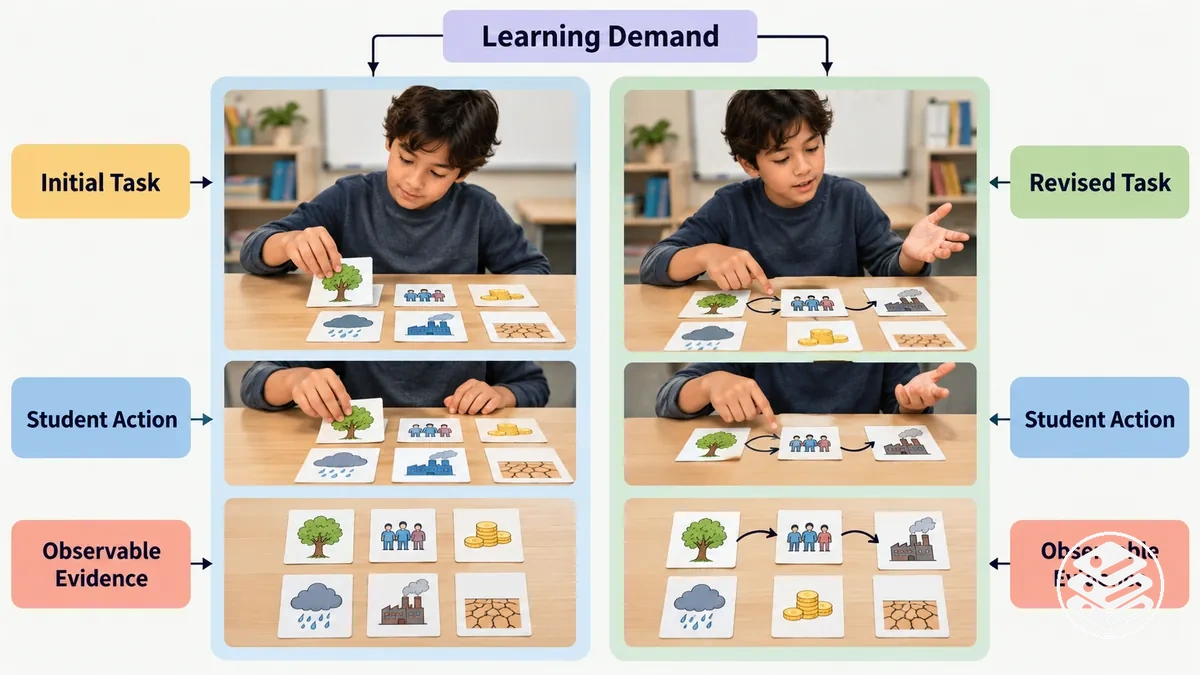 Revising the assessment task so the student sorts the causes and then explains the relationship between two selected causes elicits observable evidence of explanation; similarly, asking a student to perform a target procedure provides evidence of performance that watching a demonstration and completing a related activity does not provide.
The resulting evidence supports the teacher's inference about the intended learning, although evidence from a single assessment task should not be treated as proof of learning in every context.
Decide When to Assess During the Lesson
Assessment timing should reflect the instructional decision the evidence needs to support and the lesson phase in which the teacher can still respond to that evidence.
Not every lesson requires assessment at the start of the lesson, during instruction, and at the end of the lesson; schedule only the checkpoints that serve a useful decision.
The three lesson phases provide different opportunities to collect evidence and respond to it.
A start-of-lesson checkpoint can reveal prior understanding before new instruction, a check during instruction can provide formative evidence while adjustment is still possible, and an end-of-lesson checkpoint can confirm what students can demonstrate and inform follow-up.
These are conditional assessment points rather than a fixed schedule.
- Start of lesson: Collect evidence of prior understanding when it can inform a readiness decision, such as whether prerequisite knowledge needs attention before new instruction.
- During instruction: Schedule a formative check when the evidence can inform feedback, an instructional adjustment, or the next step while learning is underway.
- End of lesson: Collect evidence when confirmation of what students can demonstrate independently can inform follow-up; this checkpoint does not automatically make the assessment summative.
A lesson may use one, two, or all three assessment points depending on the learning objective, the evidence purpose, and whether the teacher has a meaningful opportunity to respond.
Select only the checkpoints whose evidence can inform a real instructional decision, confirm progress, or determine appropriate follow-up.
Check Prior Understanding at the Start of the Lesson
A prior-understanding check is useful when evidence about prior knowledge, a possible misconception, or readiness could change how instruction begins.
Use a concise opening check, such as a retrieval question, prompt, brief written response, or quick poll, when the response can support an instructional adjustment rather than serve as a grade or proof of ability.
- PromptUse a concise retrieval question or other brief check when earlier learning matters for the new concept.
- InterpretLook for evidence that prerequisites are sufficiently secure, need review, or contain a possible misconception.
- RespondReview a prerequisite, modify the opening explanation or example, or move ahead more quickly when the evidence supports that choice.
- Keep the inference proportionateOne brief response may be incomplete, so make an instructional adjustment only when the starting evidence justifies it.
Place Formative Checks Where Results Can Inform the Next Teaching Step
A formative check should be placed before an instructional decision where the evidence can still affect the next teaching step, such as whether to continue, clarify, reteach, or change the task.
The checkpoint is useful when its evidence state can be interpreted before the teacher commits to the next action.
- Sufficient evidence
- Continue with the planned teaching step.
- Partial or mixed evidence
- Clarify or probe again; if the main idea is secure but one misconception remains, target that point rather than reteaching the whole concept.
- Evidence of substantial misunderstanding
- Reteach or change the task before moving on.
When the evidence is incomplete or ambiguous, keep the interpretation tentative and gather another formative check before making a larger instructional adjustment.
Collect End-of-Lesson Evidence When Confirmation Is Needed
End-of-lesson evidence is useful when the teacher needs to confirm what students can demonstrate at that point and use the result to plan follow-up.
The evidence is most interpretable when the final task reflects the intended objective and the student's response can be considered against the relevant success criteria.
For example, a final task might ask for an exit response in which students give a short explanation of the concept targeted by the intended objective.
An explanation that meets the success criteria provides evidence of lesson learning at that point and can support follow-up in the next lesson, while an incomplete or inconsistent response can indicate where clarification or further evidence may be needed.
Record the Assessment Plan in the Lesson Template
An assessment entry in the lesson plan template should make clear what will be assessed, the lesson phase in which assessment occurs, the assessment method, the expected evidence, and how that evidence will be judged or acted on.
Keep the assessment field concise enough for the teacher to use during instruction rather than reproducing the full assessment rationale.
Record the lesson phase first so the assessment is located within the planned instruction, then specify the assessment method and the expected evidence students should produce.
Note the success criteria that will support interpretation of that evidence, using the terminology already established for the lesson objective.
Where useful and supported by the lesson plan template, add a brief instructional response or follow-up note describing what the teacher may do after interpreting the evidence.
Exact field names and whether every check needs a formal recording note can vary with the template and local requirements.
For example, a concise assessment entry could record: during guided practice; short explanation; evidence that the student can explain the target relationship; success criteria based on the intended explanation; instructional response to clarify the relationship if the evidence is incomplete.
The entry is usable when the teacher can quickly identify the lesson phase, assessment method, expected evidence, success criteria, and possible response without reading a long narrative.
Record the Method, Evidence, and Success Criteria
An assessment entry should identify the method, expected evidence, and success criteria used to judge that evidence in relation to the lesson objective.
Separating what the teacher will do, what students will produce or demonstrate, and how the evidence will be judged makes the entry specific enough to support interpretation.
| Method | Expected evidence | Success criteria | Follow-up note |
|---|---|---|---|
| Short written explanation | Student explains the relationship between two causes identified in the lesson objective | Explanation identifies both causes and states how one relates to the other | If the relationship is unclear, clarify the causal connection and check again |
In this example, the assessment entry records observable evidence rather than using a vague label such as “assessment” or “check understanding”. The success criteria link the evidence to interpretation, while the follow-up note records a possible response only where it helps the teacher act on the result.
Exact field names can vary between lesson-plan formats, so keep the wording specific to the assessment decision without over-documenting routine details.
Check the Assessment Plan for Alignment and Feasibility
Before teaching, assessment-plan verification should confirm that the planned assessment aligns with the lesson objective, produces evidence that can be interpreted against the success criteria, and is feasible within the lesson conditions.
Alignment and interpretability are the primary checks; timing, response coverage, and workload determine whether the plan can be carried out and used as intended.
The checklist separates alignment checks from feasibility checks so that a concern can be traced to the revision it requires.
A method that produces evidence unrelated to the lesson objective indicates an alignment problem, while a check that cannot be completed or interpreted within the available lesson time indicates a feasibility problem.
- Alignment — objective match: Check that the assessment elicits the knowledge or skill stated in the lesson objective; evidence of a different capability indicates a concern and requires revision of the assessment task or method.
- Alignment — evidence quality: Check that the expected evidence is relevant and observable enough to support interpretation of the intended learning; evidence that shows only participation or completion requires a more informative student response.
- Alignment — success criteria: Check that the success criteria identify what features of the evidence will indicate the intended performance; criteria that cannot be applied to the planned response require clarification before teaching.
- Alignment — interpretability: Check that the teacher can connect the resulting evidence to a meaningful instructional decision; if the same response could support several conflicting interpretations, revise the prompt, criteria, or evidence source.
- Feasibility — timing: Check that the assessment can be completed and interpreted within the available lesson phase; if it cannot, shorten, reposition, or replace the check while preserving its assessment purpose.
- Feasibility — response coverage: Check that the planned responses provide enough relevant evidence for the decision the teacher intends to make; if the available responses leave that decision unsupported, revise how evidence will be collected.
- Feasibility — workload: Check that collecting and interpreting the evidence is manageable within the lesson conditions; if the workload prevents timely interpretation or response, simplify the collection or recording process without weakening the required evidence.
A failed alignment or interpretability check requires revision because the assessment may otherwise produce evidence that cannot answer the intended question, while feasibility concerns require adjustment when lesson conditions prevent useful collection or response.
Completing these assessment-specific checks establishes assessment readiness only; broader lesson readiness also depends on factors outside the assessment plan.
Correct Mismatches Between Objectives, Evidence, and Assessment Methods
An assessment alignment mismatch occurs when the assessment method elicits evidence of a different skill or outcome from the stated learning objective, or when the evidence cannot support the intended inference about learning.
The correction is to revise the method or task so the evidence directly reflects the intended learning rather than relying on topic similarity alone.
| Mismatch | Consequence | Recognition cue | Correction |
|---|---|---|---|
| Objective requires explanation, but the assessment method asks students only to select a correct answer. | The evidence shows selection accuracy but does not demonstrate the intended explanation. | The student can complete the task without explaining the relationship or reasoning named in the objective. | Add a concise explanation requirement so the response elicits the intended evidence. |
| Objective requires application of a procedure, but the assessment asks students to describe the procedure. | The evidence reflects descriptive knowledge rather than the intended application skill. | A correct response can be produced without performing or applying the procedure. | Revise the task so students apply the procedure in an appropriate lesson-level problem or performance. |
| Objective requires identifying a relationship, but the collected evidence records only task completion. | The evidence may be insufficient to support an inference about whether the relationship was understood. | The record shows that the activity was completed but not what relationship the student identified. | Require an observable response that states or demonstrates the intended relationship. |
For example, changing a task from selecting the correct cause of an event to selecting the cause and explaining its relationship to the event can correct a mismatch when the learning objective requires explanation rather than recognition.
Other alignment errors can be diagnosed by asking whether the assessment method measures the skill named in the objective and whether the resulting evidence supports the intended inference.
A recognition cue that reveals a different skill or insufficient evidence suggests revision of the task, method, or expected response rather than objective rewriting by default.
The corrective principle is to restore coherence from learning objective → evidence → assessment method.
Revise Assessments That Cannot Be Carried Out or Interpreted During the Lesson
An assessment may align with the intended learning yet still present an assessment feasibility problem when its time demand, evidence volume, response coverage, or unclear criteria make execution or interpretation difficult under the lesson conditions.
In that case, revision should reduce the practical constraint while preserving the intended evidence rather than changing the learning target.
- Excessive time demand: If administering the assessment uses more of the available lesson phase than the intended instructional decision allows, the time demand limits feasibility. Revise the method by shortening the response or sampling the essential evidence while retaining the part needed for interpretation.
- Excessive evidence volume: If the teacher collects more evidence than can reasonably be reviewed before the intended next teaching step, the evidence volume delays interpretation. Reduce the amount recorded or focus the response on the evidence required for that decision.
- Unclear criteria: If similar student responses could be interpreted differently because the expected features are not explicit, unclear criteria obscure the meaning of the evidence. Clarify the response criteria so the teacher can distinguish whether the intended learning is demonstrated without adding unnecessary assessment burden.
- Insufficient response coverage: If evidence comes from too few students or responses to support the intended class-level decision, response coverage may be inadequate for that use. Revise the participation pattern or collection method so the evidence better represents the students about whom the teacher needs to make the decision.
- Results arrive too late: If evidence cannot be collected or interpreted until after the teaching decision it was meant to inform, the assessment cannot serve that intended in-lesson purpose. Simplify or reposition the assessment so interpretable evidence is available before the relevant decision, while preserving the evidence needed to assess the intended learning.
For example, if a written response is aligned with the lesson objective but produces an evidence volume that cannot be interpreted before the next teaching step, the teacher can revise it to request only the essential response needed for that decision.
Acceptable timing, workload, and response coverage depend on the lesson conditions and the decision the evidence must support, so revision should target the constraint that makes execution or interpretation difficult.
Simplifying an assessment is useful only when it preserves alignment and the intended evidence while reducing unnecessary time, workload, or ambiguity.