
Lesson Plan Templates for Structured Lesson Planning
A lesson plan template is a reusable planning structure for organising recurring lesson-level information such as learning objectives, activities and sequence, resources, timing, and assessment or checks for learning. It is most useful when a lesson benefits from explicit structure, repeatability, documentation, or coordination; the template organises decisions, while teacher judgement determines the lesson-specific content and level of detail.
Lesson planning at a glance
Use the template as a reusable frame, then replace the recurring prompts with the decisions for the lesson you are actually planning.
- Learning objectiveWhat learners are intended to know, understand, or do
- Activities & sequenceHow learners will engage with the intended learning, and in what order
- ResourcesWhat the planned activities require
- TimingHow the sequence fits within the available lesson period
- Assessment / checksHow understanding or progress will be examined
- Structure
- Reusable fields or prompts; the completed lesson plan contains the lesson-specific entries.
- Best fit
- Planning that benefits from repeatability, explicit documentation, coordination, or a clear shared structure.
- Detail level
- Use enough detail to support the planning task; unnecessary fields can add work and rigidity.
- Boundary
- A template can organise planning, but it does not determine teaching quality or learning outcomes by itself.
Lesson plan templates bring learning objectives, activities, resources, timing, and assessment into one coordinated lesson-planning framework.
Learning objectives establish the intended learning, while activities describe how learners will engage with that learning.
Resources support those activities, timing helps organise their sequence and duration, and assessment or checks for learning provide a way to consider whether the intended learning is being demonstrated.
These dimensions work together as connected planning decisions rather than as a procedural checklist that prescribes one teaching method.
The usefulness of a lesson plan template depends on its fit with the lesson purpose, the required detail, and the teaching context; a structure that is appropriate in one setting may be unnecessarily detailed or insufficient in another.
The template provides the reusable organisation and prompts, whereas a completed lesson plan contains the lesson-specific decisions and details entered into that structure.
Table of Contents
What a Lesson Plan Template Is
A lesson plan template is a reusable planning structure that provides predefined planning fields or prompts for recurring lesson-planning information.
It organises the structure of a lesson before lesson-specific instructional details are added.
The illustration shows this distinction through a blank template whose fields organise the main categories of planning information.
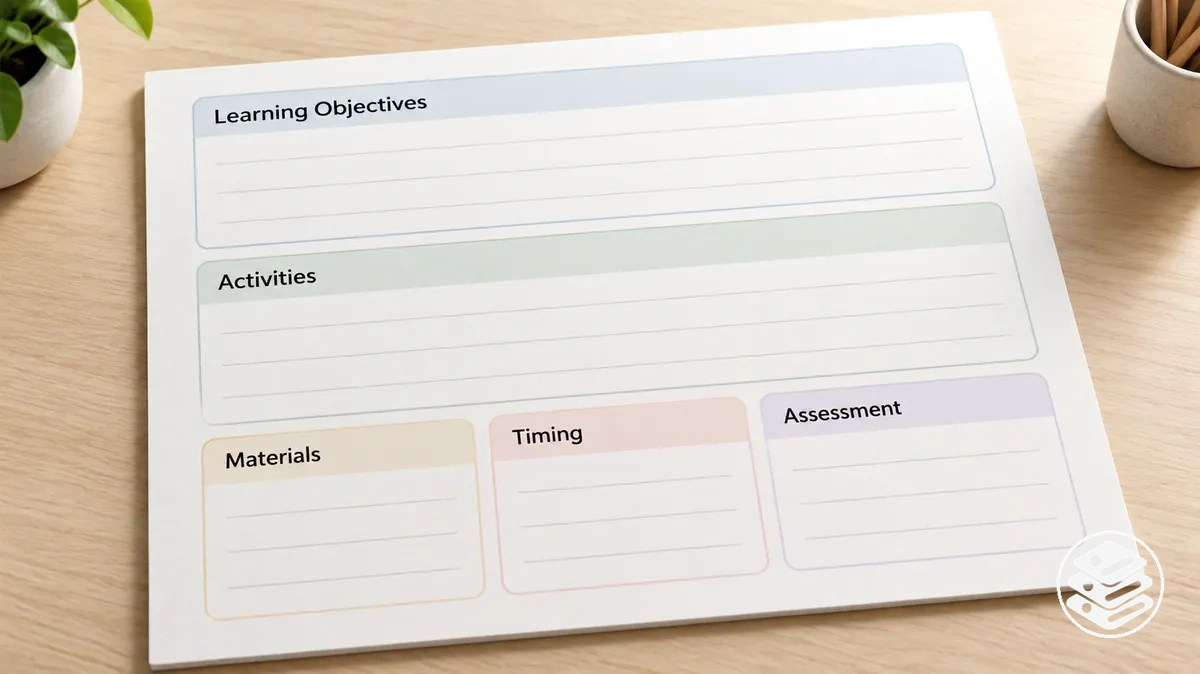
Typical planning fields cover learning objectives, activities, materials or other resources, timing or sequence, and assessment information.
Learning objectives record the intended learning, while activity and materials fields organise what learners will do and what the lesson requires.
Timing or sequencing fields place those activities within the available lesson period, and assessment prompts record how learning or understanding will be checked.
The exact planning fields can differ according to the template structure and teaching context.
A blank lesson plan template provides the reusable structure rather than the finished instructional content.
A completed lesson plan contains the lesson-specific objectives, activities, materials, timing, assessment details, and other required planning information entered into that structure.
What Lesson Plan Templates Are Used For
Lesson plan templates are used to organise recurring planning decisions so that lesson preparation is more consistent, visible, and easier to reuse.
They give teachers a repeatable structure for recording the information needed to prepare a lesson without prescribing how the lesson must be taught.
The illustration shows how recurring planning decisions can be organised within one lesson-planning structure.
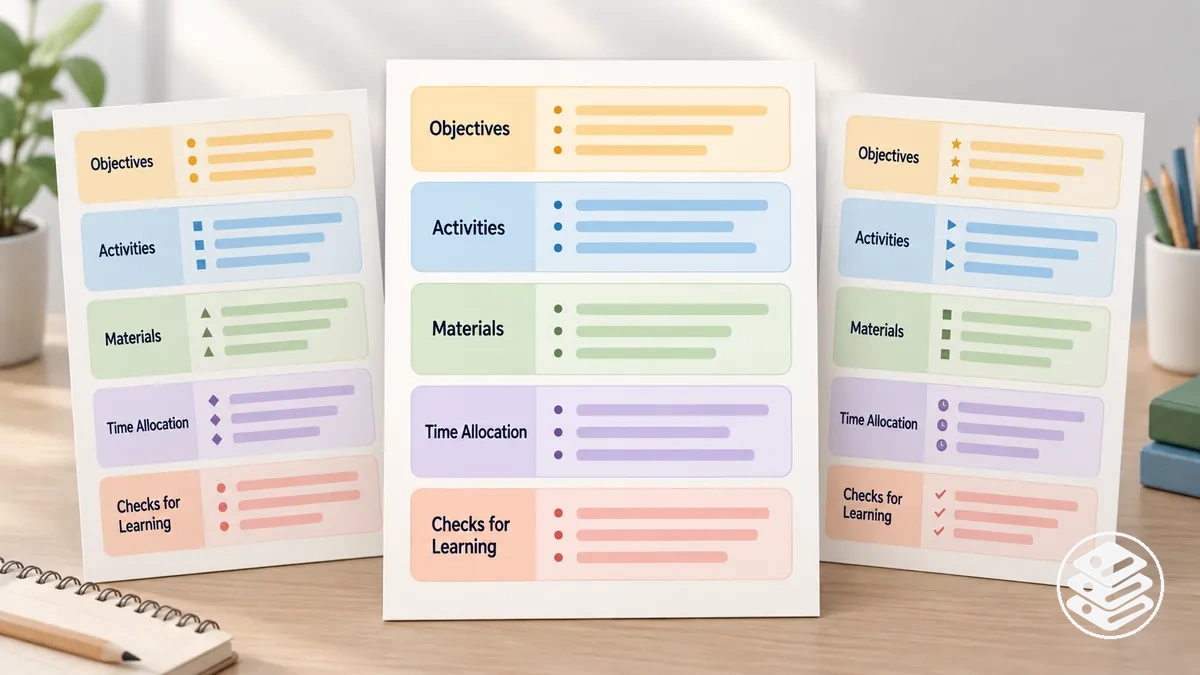
A lesson plan template can organise objectives, activities, materials, time allocation, and checks for learning within the same planning structure.
Objectives make the intended learning explicit, while activities and materials make the planned learning experience and required resources visible.
Time allocation supports the sequencing and pacing of activities, and checks for learning record where a teacher intends to assess understanding.
These functions keep related planning decisions accessible together rather than dispersed across separate notes.
Organising recurring information in consistent locations can make lesson sequences easier to review and can reduce the risk that a recurring planning consideration is overlooked.
The structure also makes relationships between objectives, activities, timing, resources, and assessment more visible, which helps a teacher check whether the planned elements support the same lesson purpose.
The template supports organisation and consistency, while the specific planning decisions remain dependent on teacher judgement and the teaching context.
Reuse is most useful when lessons share recurring planning requirements, because the same structure can be retained while lesson-specific objectives, activities, materials, timing, and checks for learning change.
A teacher might therefore use the same reusable format for different lessons while adapting its contents to each lesson's purpose and learners.
The lesson plan template supports repeatable preparation, but it does not determine teaching quality or learning outcomes by itself.
Planning Challenges Templates Can Help Reduce
Planning friction can arise when a teacher starts each lesson from a blank page, forgets recurring information, keeps planning details in scattered notes, or repeatedly rebuilds the same structure.
A lesson plan template can reduce this repeated setup by giving recurring planning information a consistent place.
The illustration shows how a repeatable structure can bring dispersed planning tasks into one organised framework.
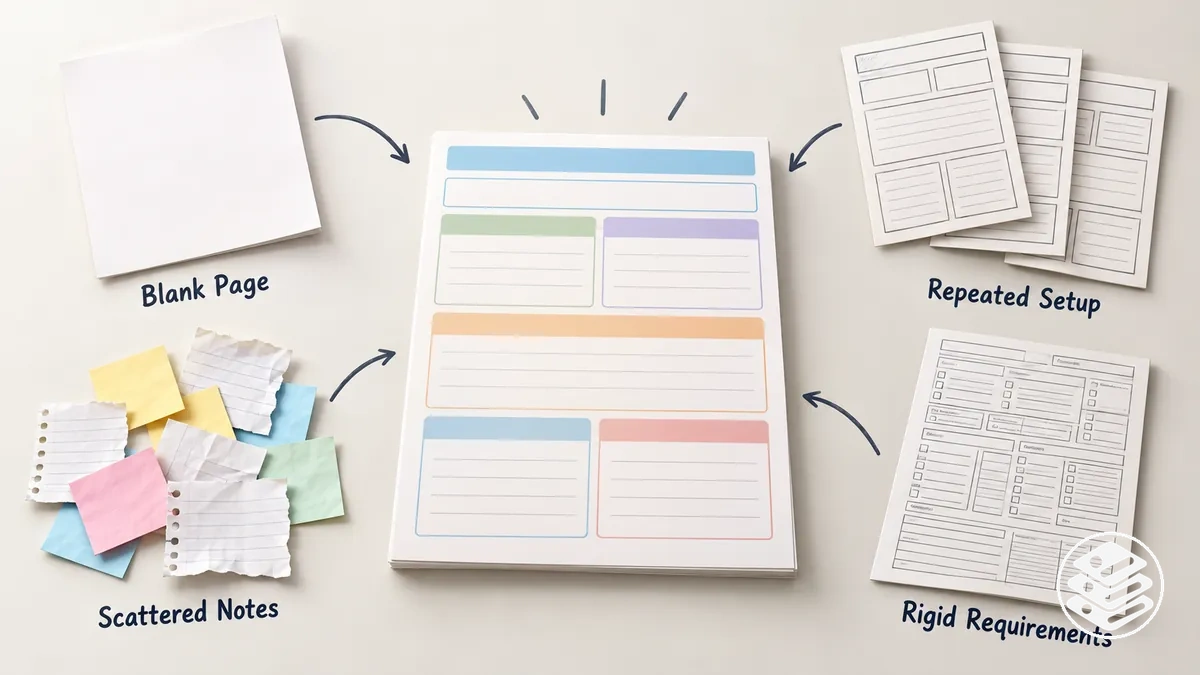
A repeatable structure provides predefined places for recurring information such as objectives, activities, materials, timing, and checks for learning.
This organisation can make planning details easier to locate and review, while consistent prompts can reduce the risk that a recurring consideration is omitted.
Keeping related information together can also reduce the need to reconstruct the same planning layout for each similar lesson.
These benefits address repeated setup and information organisation rather than every cause of planning difficulty.
Core Information a Lesson Plan Template Organises
A lesson plan template commonly organises learning objectives or standards, activities and sequence, materials or resources, time allocation, and assessment or checks for learning.
These planning fields make lesson-level decisions explicit so related information can be reviewed as part of one planning structure.
The illustration shows how these information categories sit within a shared template rather than as disconnected notes.
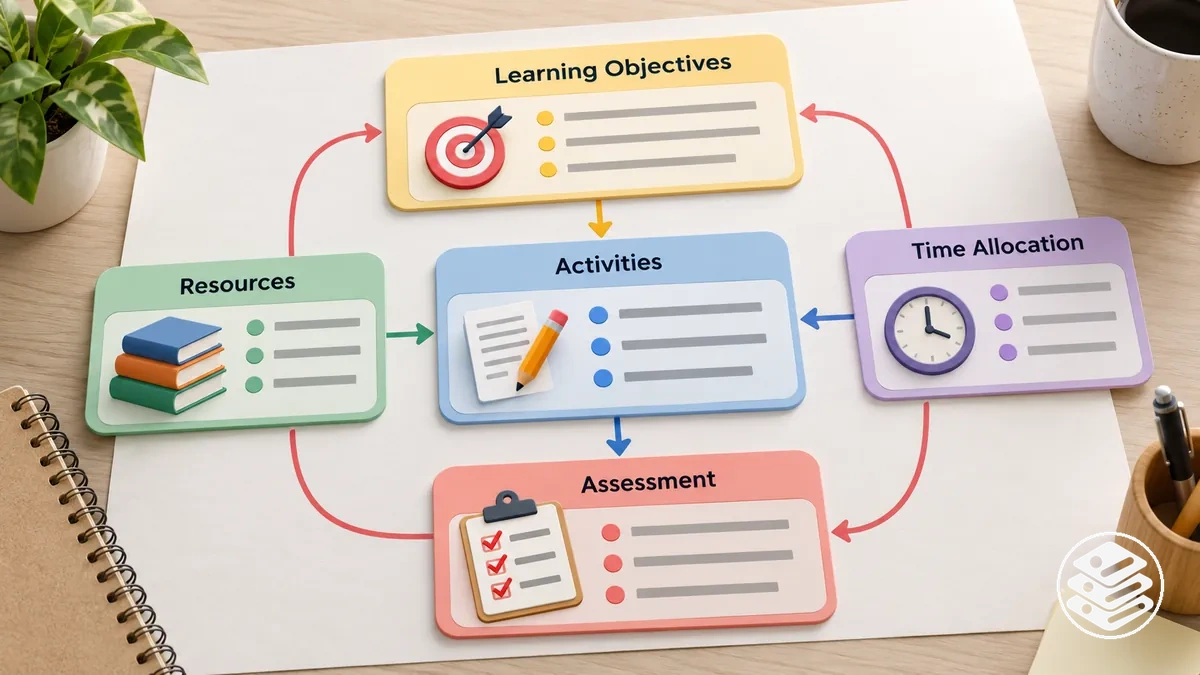
Learning objectives or standards identify the intended learning, while activities and sequence record how learners will engage with it.
Materials and resources identify what those activities require, and time allocation makes the intended lesson flow visible.
Assessment and checks for learning record how understanding or progress will be examined in relation to the intended learning.
The table connects these recurring information categories with the planning decisions they make explicit and their practical planning implication.
| Planning field | Information captured | Planning implication |
|---|---|---|
| Learning objectives or standards | Intended learning and any relevant standard or outcome | Provides a reference point for aligning activities and assessment |
| Activities and sequence | Planned learning tasks and their order | Makes lesson flow and progression visible |
| Materials and resources | Items, content, or resources needed for planned activities | Connects preparation requirements with lesson activity |
| Time allocation | Approximate time assigned to lesson elements | Helps organise the sequence within the available lesson time |
| Assessment or checks for learning | Planned ways to examine evidence of learning or understanding | Makes the relationship between intended learning and its assessment visible |
Learning objectives provide the reference point for what a lesson intends learners to achieve, while activities and sequence represent how that intended learning will be approached.
Time allocation places those activities within the available lesson period, and assessment or checks for learning make the planned evidence of learning visible alongside the objective.
Materials and resources support the activities required by that relationship.
Component sets vary by template and requirement, so no single fixed number of planning fields is universally authoritative.
For example, a teacher planning a discussion lesson might record an objective about analysing a text, sequence activities that require evidence-based discussion, note the necessary materials, allocate time to those activities, and include a check for learning that asks students to justify an interpretation.
The lesson plan template does not determine those choices; it keeps the objective, activities, resources, timing, and assessment information visible as one coherent planning relationship.
Common Lesson Plan Template Formats
Lesson plan template formats vary mainly by planning horizon, level of detail, flexibility, and imposed requirements.
Daily formats organise lesson-level planning within a teaching day, while weekly formats group lesson-level planning across a week.
The illustration contrasts these planning horizons and levels of detail without implying that one format is preferable in every context.
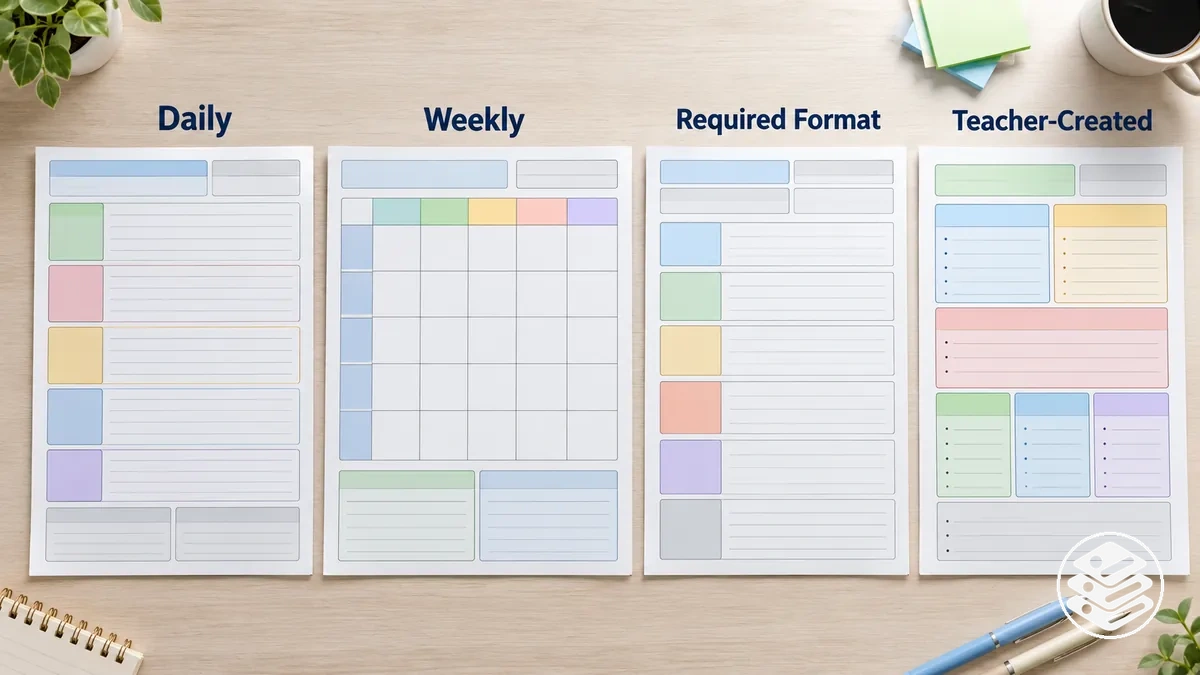
A useful comparison considers the period covered, the amount of information recorded, and how easily the layout can be adapted.
A more detailed format can make objectives, activities, resources, timing, and assessment decisions more visible, while a lighter layout records fewer planning details.
Daily and weekly formats can therefore support different lesson-level planning scopes without representing a universal hierarchy.
The table summarises recurring format categories on the same planning criteria.
| Format | Planning horizon | Level of detail and flexibility | Planning implication |
|---|---|---|---|
| Daily | A teaching day or individual lesson-level entries within that day | Can provide detailed fields while keeping the planning horizon short | Supports close documentation of lesson-level decisions |
| Weekly | Lesson-level planning across a week | Groups recurring planning information across several lesson entries | Makes relationships and continuity across the week easier to view together |
| Detailed single-lesson | One lesson | Provides more space for objectives, activities, resources, timing, assessment, or other required information | Improves documentation depth but can increase planning burden when the added detail is unnecessary |
| Flexible lesson-level | One lesson or another defined lesson-level period | Uses adaptable fields that can be adjusted according to the planning need | Allows the structure to respond more closely to the lesson context |
There is no single lesson plan format that applies across all teaching contexts; suitability depends on the planning job and any institutional requirement.
A required format can support consistency or documentation but may reduce flexibility when its fields exceed what a particular lesson needs, whereas a teacher-created format can allow greater adaptation while still needing enough structure to make important planning decisions visible.
More detail therefore has a trade-off: it can strengthen documentation, but unnecessary detail can add planning burden rather than improve the lesson-planning process.
When to Use a Lesson Plan Template
A lesson plan template is most useful when the planning task benefits from explicit structure, repeatability, required documentation, or coordination.
Its suitability increases when important planning decisions need to remain visible and consistent across a lesson or across people working from the same plan.
The illustration shows how different planning situations can create different needs for a reusable structure.
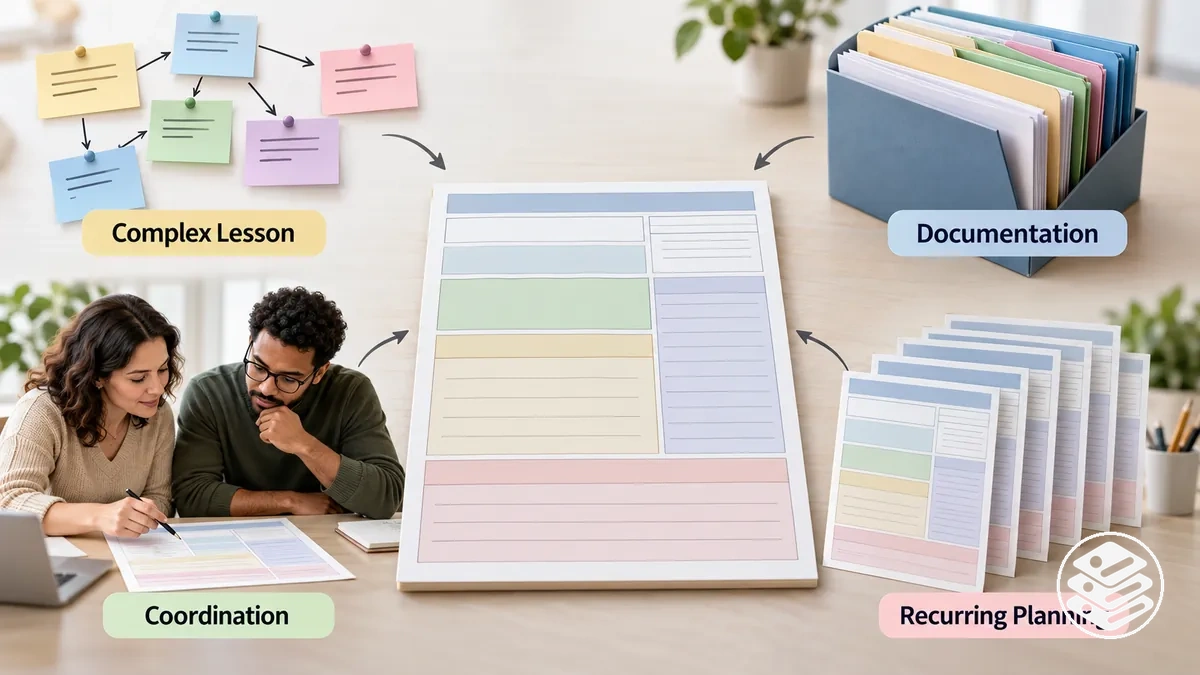
The strongest use cases are planning situations in which a common structure addresses a specific planning need.
A new lesson or complex lesson can benefit from more explicit planning detail, while required documentation can make a consistent structure useful for completeness and planning consistency.
Coordination between teachers or colleagues can benefit from shared visibility, and recurring lessons can use a reusable structure to reduce repeated setup.
These criteria describe planning needs rather than rules about who should use a template.
- New or complex lesson: more planning decisions need to be made explicit and kept together.
- Required documentation: a consistent structure can help make expected planning information visible and complete.
- Coordination: a common structure can make lesson information easier for multiple people to review or use.
- Recurring lesson structure: a reusable structure can support repeatability while allowing lesson-specific details to change.
For a simple lesson, a familiar lesson, or a situation with limited documentation needs, lighter planning may be sufficient because fewer decisions need to be externalised in a detailed structure.
An experienced teacher may still benefit from a template when coordination or documentation is important, while a less experienced teacher may not need an elaborate format for a straightforward planning task.
Template suitability therefore depends primarily on the demands of the planning context rather than on teacher experience alone.
Benefits and Limitations of Lesson Plan Templates
Lesson plan templates can improve organisation, consistency, reuse, and visibility when their structure fits the planning task, but the same structure can create rigidity or extra documentation when it does not.
The practical effect therefore depends on template fit, the teaching context, and how much structure the planning task actually needs.
| Template feature | Helpful condition and benefit | Limiting condition | Practical implication |
|---|---|---|---|
| Consistent planning fields | When recurring information needs to be visible, the structure supports organisation and consistency | When fixed fields do not match the lesson, the same structure can create rigidity or context mismatch | Consistency is useful when the repeated fields remain relevant to the planning task |
| Reusable structure | When lessons share recurring planning needs, reuse can reduce repeated setup | When each lesson requires substantially different planning, repeated fields may add unnecessary work | Reuse is most useful when the structure can accommodate meaningful variation |
| Explicit objectives, activities, and assessment fields | When these elements need to be reviewed together, the template can make alignment more visible | When completion becomes the main goal, filled fields can create a false sense of completeness | Recorded alignment should support teacher judgement rather than substitute for it |
| Shared planning layout | When several people contribute to or review planning, a common structure can support collaboration and visibility | When collaborators need different levels of detail, a rigid shared layout can constrain useful adaptation | The shared format should remain proportionate to the coordination need |
| Detailed documentation | When extensive records are genuinely required, added detail can make planning decisions easier to inspect | When that detail is unnecessary, over-documentation can increase planning time | Documentation depth should match the actual requirement rather than become an end in itself |
Organisation and consistency are most useful when a template keeps recurring planning information visible without forcing irrelevant detail.
Reuse can reduce repeated setup when similar lessons share a workable structure, while collaboration can benefit when teachers need a common view of objectives, activities, resources, timing, or assessment.
Explicit fields can also make alignment between intended learning, activities, and assessment easier to inspect.
These benefits remain conditional on the template matching the planning context rather than simply containing more fields.
Limitations become more likely when rigid requirements or excessive detail create context mismatch between the template and the lesson being planned.
Over-documentation can add planning time, while compulsory fields can shift attention toward completing the form rather than considering whether each planning decision is useful.
In a 2022 RSC Education opinion article, Colin McGill argues that detailed lesson plan templates can add substantial planning work and risk turning planning into a form-filling exercise.
Template completion indicates documented planning, not automatic lesson readiness or teaching quality.
The trade-off is clearest when two similar planning tasks require different levels of structure: a concise reusable template may reduce repeated setup, whereas a compulsory over-detailed template may create additional work without adding useful planning information.
Effective template fit means retaining enough structure to support organisation, alignment, consistency, reuse, or collaboration while avoiding unnecessary rigidity and documentation burden.