
Creating a Reusable Lesson Plan Template
Create a reusable lesson plan template by keeping recurring planning fields and their purpose stable while leaving lesson-specific values editable. Build the fields from decisions that genuinely recur, order dependent decisions in a workable sequence, then test the template across different lessons and refine only patterns that repeat.
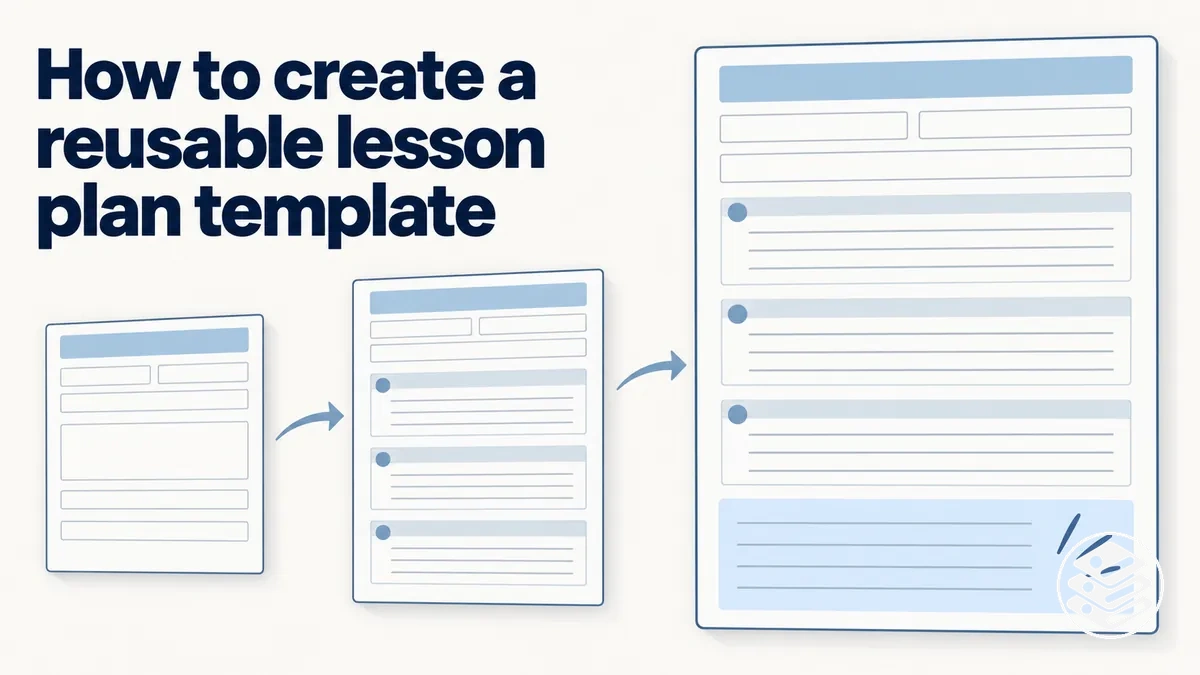
Reusable lesson plan template blueprint
Use one stable planning framework, vary the lesson-dependent entries, and change the structure only when repeated use shows a recurring need.
Keep stable
- The recurring purpose of a field.
- Recognisable labels and positions when they continue to support the same decision.
- Field order when later decisions depend on earlier ones.
Keep editable
- Subject or lesson focus.
- Activities, resources and timing.
- Assessment details and other values that depend on the lesson context.
Adapt conditionally
- Make a field optional when it is needed only in some lesson contexts.
- Expand a field when the same decision needs more detail.
- Replace a context-specific prompt only when the planning decision itself changes.
- Build: Identify planning decisions that recur and order fields by real decision dependencies.
- Test: Reuse the template and watch for repeated rewriting, unused or missing fields, and sequence friction.
- Refine: Make a targeted change for a recurring pattern, reuse the template, then retain, revise or reverse the change.
A reusable template preserves the planning decisions that repeat, not a completed lesson. The framework can stay recognisable while the subject, activities, timing, assessment and other lesson-dependent entries change.
The stable-versus-editable boundary depends on the planning routine and teaching context: keep structure that repeatedly supports planning, and keep values flexible when the appropriate choice changes from lesson to lesson.
Table of Contents
Design the Template Around Stable Structure and Flexible Lesson Content
Template structure should keep stable fields for recurring information while leaving context-dependent lesson content flexible.
The main reuse criteria are whether information recurs in the planning routine, how often its value changes, what lesson context it depends on, and what happens if that value is fixed.
Stable therefore describes the recurring role or position of a field, not an unchangeable value entered into it.
Classify each field by recurrence, edit frequency, dependency on lesson context, and the consequence of fixing its content.
These criteria create a practical split between what to keep stable and what to leave flexible, while the image illustrates the distinction between recurring structure and variable information.

- Keep stable when the field serves a recurring purpose: a field that remains relevant across the planning routine can retain its label and position, supporting reuse while allowing its entered value to change.
- Leave flexible when information depends on the lesson: content that changes with subject matter, learner needs, activities, timing, or assessment should remain editable so the template can accommodate the relevant lesson context.
- Use edit frequency as a classification signal: information changed from lesson to lesson warrants flexible content, while a recurring field can remain structurally stable even when its value changes frequently.
- Check the consequence of fixing information: if an unchanged value would restrict necessary lesson-specific decisions, keep the recurring field but leave its content editable.
For example, an Activities section can remain a stable field while the activity entered beneath it changes for each lesson.
This field-versus-value distinction supports reuse without turning recurring fields into permanent content, and the appropriate balance depends on the planning routine and lesson contexts the template is intended to support.
Keep Recurring Planning Fields Consistent
A recurring field is worth keeping consistent when it serves a stable purpose in repeated planning and is used often enough to remain recognisable across lessons.
Its consistent label and predictable position give the planner a familiar place to make the same type of decision when that decision is relevant.
Consistency applies to the field structure rather than to the lesson-specific entry, so the value inside the field can still change.
The most useful attributes to assess are the field's recurring purpose, wording, position, and frequency of use.
These attributes show why a recurring field can support planning continuity without implying that it belongs in every teaching context.
The image highlights these structural attributes while showing different values entered into the same recurring field.
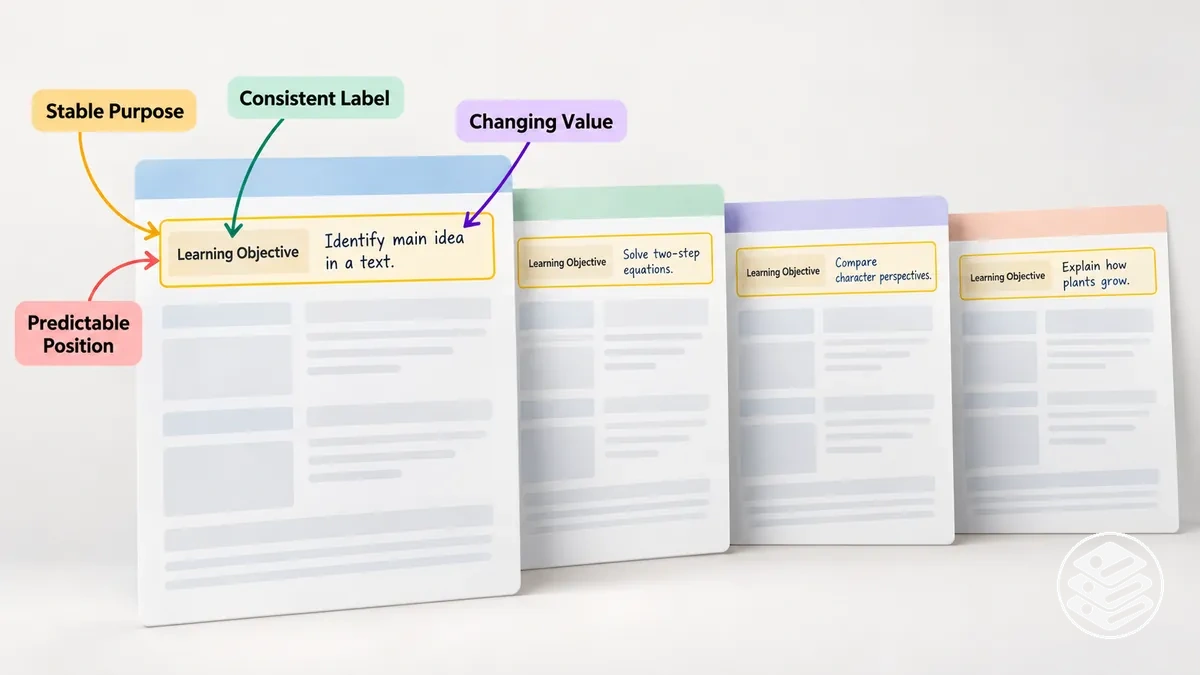
- Stable purpose: retain a recurring field when it repeatedly prompts the same type of planning decision.
- Consistent label: keep the wording recognisable when the field continues to represent the same planning purpose.
- Predictable position: place the recurring field consistently when its location supports a familiar planning routine.
- Frequency of use: greater recurrence can justify keeping a field structurally consistent, while fields relevant only in particular contexts can remain conditional.
A recurring field such as Activities can retain the same purpose, label, and position while its field value changes with each lesson.
Consistent field design therefore supports planning continuity without requiring identical lesson-specific entries.
Leave Lesson-Specific Decisions Editable
Lesson-specific decisions should remain editable when their appropriate value depends on the individual lesson and its teaching context.
The reusable structure can define where a decision is recorded without fixing what that decision must be.
A variable field value therefore changes when the relevant lesson condition changes, while the surrounding template structure can remain consistent.
Lesson-specific content can vary across several decision classes because each responds to different conditions.
The image illustrates how activities, resources, timing, and assessment entries can change inside unchanged fields without rebuilding the template.
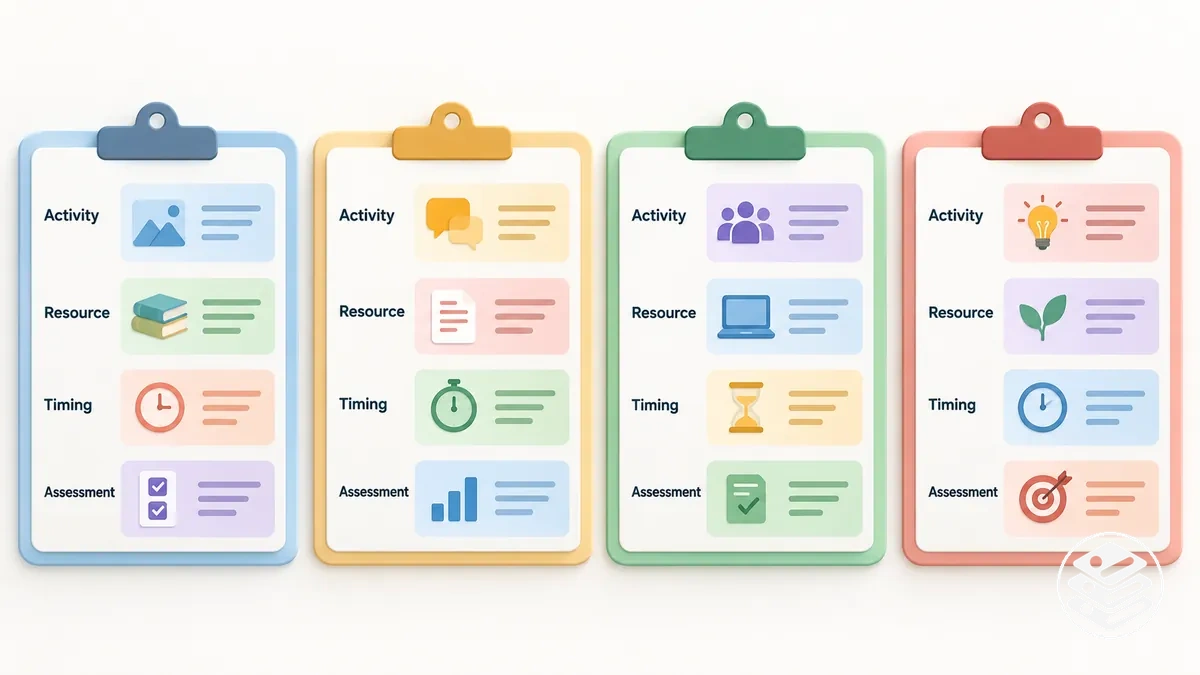
- Activity: usually stable as a field but usually editable as a value when the lesson purpose or planned learning experience changes.
- Resource: usually stable as a field but usually editable as a value when the materials or tools relevant to the lesson change.
- Timing adjustment: usually stable as a field but usually editable as a value when the planned sequence or lesson circumstances call for a different allocation of time.
- Assessment detail: usually stable as a field but usually editable as a value when what needs to be checked in the lesson changes.
These changing entries provide controlled flexibility rather than an absence of structure: a stable field can contain flexible content whose value depends on the teaching context.
Reuse therefore comes from keeping the template framework available while leaving lesson-dependent values editable.
Build the Template Around a Repeatable Planning Workflow
A repeatable planning workflow should arrange template fields in the order that recurring planning decisions are normally made.
Each recurring planning decision becomes a field or group of fields positioned according to its dependency on earlier decisions.
The planning sequence should make it possible to repeat or revisit the routine without turning the template into a fixed lesson plan.
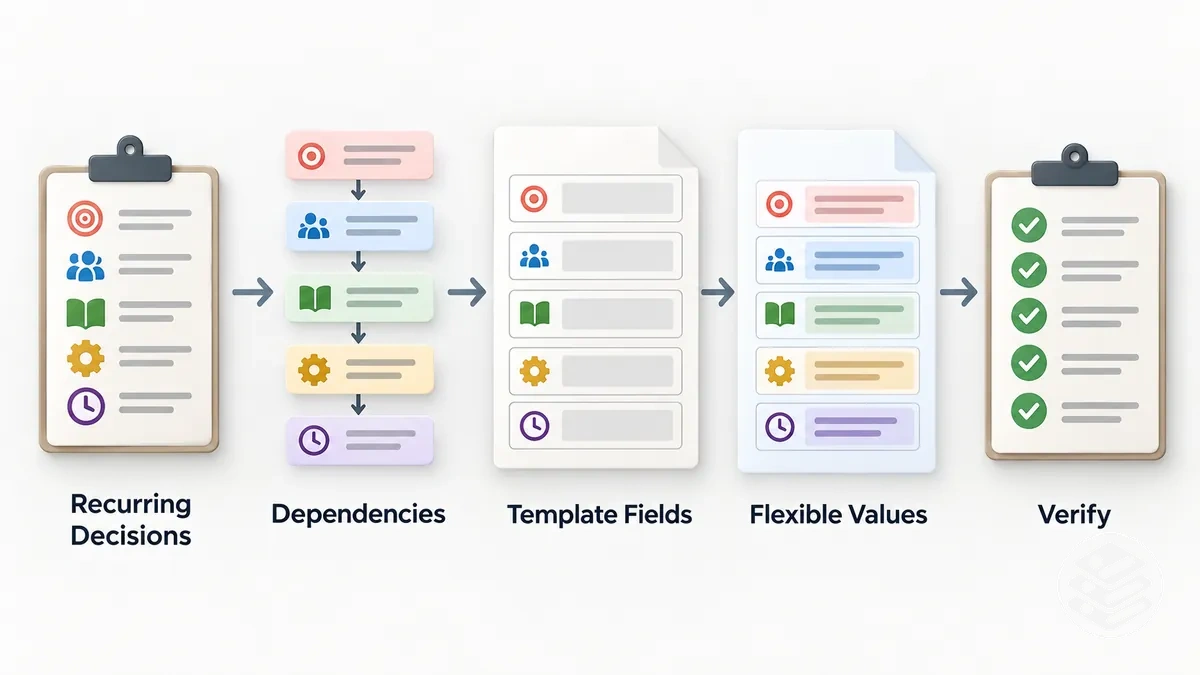
Build the workflow by identifying recurring decisions first, then ordering their dependencies before placing the corresponding template fields.
The numbered sequence keeps template construction focused on what must be decided, what depends on an earlier decision, and what should be verified before continuing.
- Identify recurring planning decisions. List decisions that regularly need a place in the planning routine so the template represents repeatable work rather than one completed lesson. Verify that each decision is relevant often enough to justify a recurring template field.
- Order the decisions by dependency. Place a decision later in the planning sequence when it relies on information established earlier. Verify that the order reflects a usable planning dependency rather than an arbitrary layout preference.
- Place the corresponding template fields. Give each recurring decision a stable location in the workflow while keeping lesson-dependent content flexible. Check that the field order follows the decision sequence instead of forcing the planner to move repeatedly between dependent fields.
- Keep revisable decisions accessible. Position fields so a later decision can be revisited when an earlier choice changes without requiring the reusable structure to be rebuilt. Verify that adaptation changes the relevant field value rather than the underlying workflow unnecessarily.
- Verify the completed planning sequence. Follow the fields in order and check whether each recurring decision has the information it needs at that point. Adjust the sequence when a field repeatedly requires information that is only established later.
For example, a planning routine can establish an intended lesson focus before selecting an activity, then identify the resources associated with that activity before verifying the sequence as a whole; another teaching context may require a different order.
The workflow is ready to repeat when its dependencies can be followed with limited backtracking while lesson-specific values remain adaptable.
The image makes this construction sequence visible by showing recurring decisions feeding template fields in directional order and ending at a verification point.
Identify the Planning Decisions That Repeat Across Lessons
Recurring planning decisions are decisions that recur with a stable purpose across lessons, not details that happen to appear more than once.
Repeated planning becomes a candidate for standardisation when the same type of judgement or prompt repeatedly needs a place in the planning process while its lesson-specific answer can still change.
Coincidental repetition does not warrant a reusable field simply because similar content appeared in a few lessons.
The distinction depends on evidence of recurrence and whether standardisation preserves instructional judgement.
Evaluate each recurring decision by its frequency, stable purpose, rework effort, and dependence on lesson context.
These criteria distinguish evidence of genuine recurrence from coincidental repetition, while the image makes the standardise-or-not boundary visible across several lesson examples.
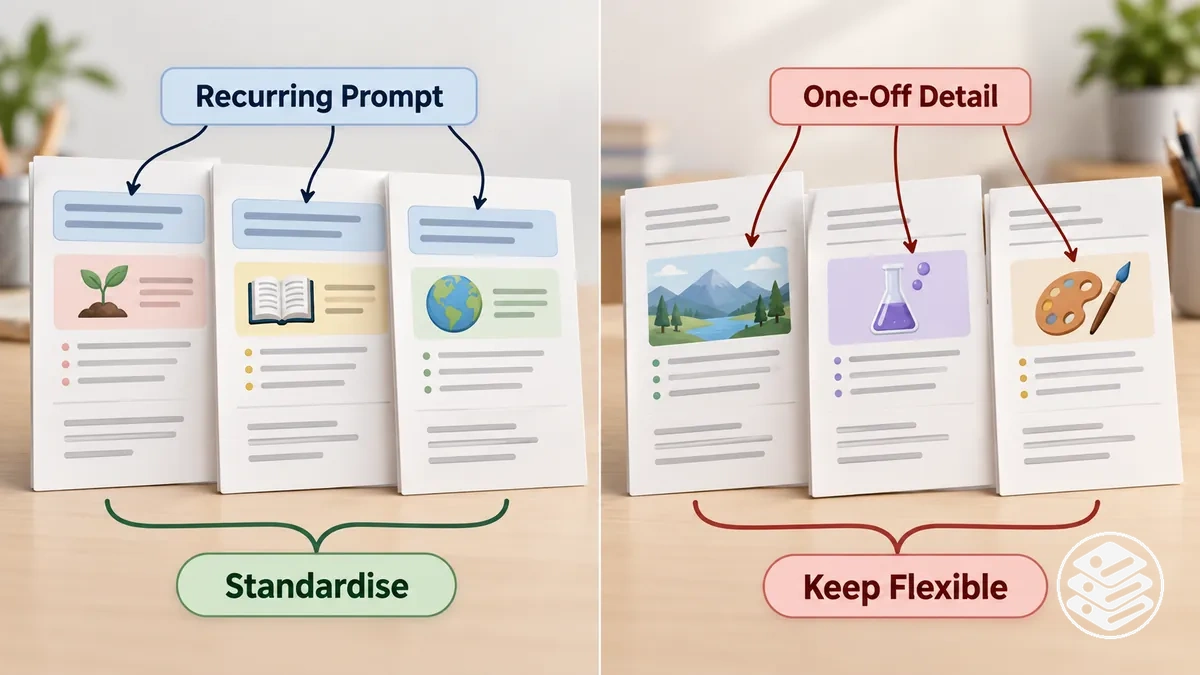
- Frequency: evidence of genuine recurrence exists when the same planning question returns as part of repeated planning; coincidental repetition reflects a detail that appears again without becoming a recurring planning need.
- Stable purpose: a repeated prompt is a stronger candidate for standardisation when it continues to request the same type of planning judgement even though its lesson-specific answer changes.
- Rework effort: repeatedly recreating the same prompt or template field supports standardisation when the recurring structure remains useful across relevant lesson contexts.
- Instructional judgement: standardise the recurring structure only when the field preserves flexibility for the teacher to make the lesson-specific decision rather than fixing that decision in advance.
For example, a recurring planning question about which activity supports the current lesson purpose can warrant a stable field when the question recurs but the activity itself remains flexible.
Standardising that prompt can reduce repeated lesson planning work without treating repeated content as automatically reusable.
A recurring decision therefore belongs in the template when recurrence is meaningful, its purpose remains stable, and standardisation retains the instructional judgement required by the lesson context.
Order Fields to Follow the Planning Sequence
Field order should follow the dependency between planning decisions so an earlier decision provides the context needed for a later field.
A field should precede another when its entry informs the next planning action; when no such dependency exists, their relative order can vary with the planning routine.
This dependency-led planning sequence supports a clearer planning flow and can reduce backtracking caused by reaching a field before the information needed to complete it is available.
A short sequence can make the dependency explicit: establish the lesson focus first, use that earlier decision to inform the activity field, then let the selected activity inform the resources needed for that lesson.
The image illustrates this dependency chain and shows how poor field order can create backtracking when a later field depends on information positioned after it.
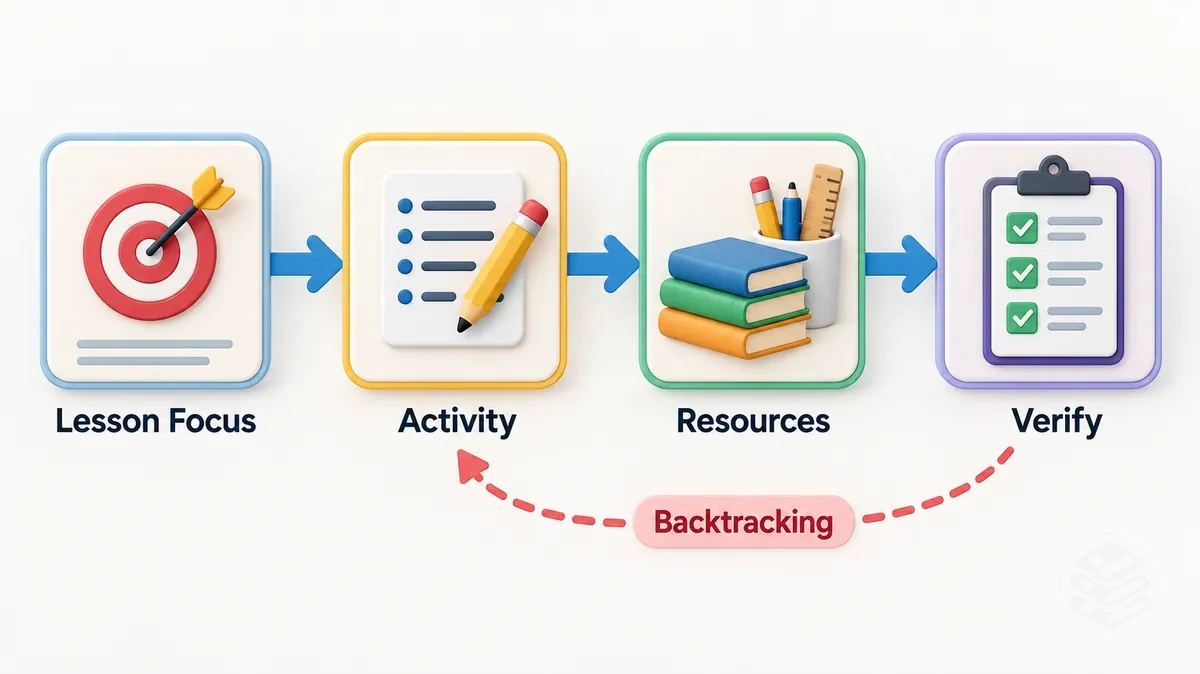
- Lesson focus precedes activity: the earlier decision establishes what the lesson is intended to address, giving the dependent activity field the context needed for the next planning action.
- Activity precedes resources: the activity decision identifies what materials or tools the lesson may need, so the resource field follows that dependency.
- Review the sequence for backtracking: if a later field requires information that appears only afterward, adjust the field order so the prerequisite decision comes earlier and the planning flow requires less backtracking.
Leave Adaptation Points for Different Subjects and Lessons
Adaptation points let a reusable template keep its core structure when the subject, lesson type, or teaching routine changes the information required for planning.
An adaptation point should respond to a meaningful context condition rather than make every part of the template changeable.
The affected field can become optional, expandable, or replaceable while the recurring planning structure remains recognisable.
This controlled variation supports reuse without requiring the template to be rebuilt for each context.
Choose the smallest adaptation that fits the lesson context
- Optional field
- Keep the field available when a subject or lesson type sometimes needs the prompt, without forcing it into every plan.
- Expandable field
- Keep the same planning decision but allow more space or detail when a particular lesson requires it.
- Replaceable field
- Substitute a context-specific prompt when that context requires a different planning decision in the same part of the workflow.
For example, two lesson contexts can use different activity-related prompts while retaining the same surrounding core structure.
Controlled adaptation therefore preserves reuse when permitted variation is limited to fields affected by the context, rather than rebuilding the template or leaving its structure entirely blank.
Test the Template Across Several Lessons
Template testing means repeated practical use across several lessons rather than judging whether one completed plan looks polished.
Repeated use reveals how the reusable structure behaves when lesson content and planning conditions change.
Verification should therefore focus on observable planning friction and continuity across uses rather than treating a single successful lesson as evidence that the template is ready.
The verification checklist assesses how the template functions during repeated use, including completion effort, unnecessary rewriting, field relevance, missing information, and planning flow.
Record these observations across several lessons so recurring signals can be distinguished from isolated exceptions.
- Completion effort: note whether completing the template repeatedly requires unnecessary decisions or work that the reusable structure could reasonably carry forward.
- Repeated rewriting: check whether the same prompt, label, or structural content is repeatedly rewritten instead of remaining part of the reusable template.
- Unused field: observe whether a field remains unused across different lessons, which may indicate that it should become optional, be revised, or be removed from the core structure.
- Missing prompt: identify planning decisions that repeatedly require information for which the template provides no suitable field or prompt.
- Sequence friction: note whether completing one field repeatedly requires returning to an earlier part of the template because the planning sequence does not follow the necessary decision dependencies.
- Cross-lesson clarity: check whether the same structure remains understandable when reused in different lesson contexts without requiring its basic organisation to be reconstructed.
Interpret the observations as a recurring signal when the same friction persists across several lessons; treat an isolated issue as a one-off exception when it arises from conditions specific to one lesson and does not recur.
This distinction helps verify template readiness without using a single experience as a universal benchmark.
Revision is warranted when a recurring pattern shows that the structure repeatedly creates unnecessary rewriting, unused fields, missing prompts, or sequence friction while lesson-specific exceptions remain isolated.
Track What Still Has to Be Rewritten From Scratch
Repeated rewriting is a diagnostic signal when the same planning logic has to be recreated unnecessarily across lessons.
That rewrite pattern may indicate a structural gap or a generic prompt that does not preserve enough reusable guidance.
The distinguishing check is whether the recreation repeats the same planning purpose or instead reflects lesson-specific content that genuinely needs to change.
Use the rewrite pattern to distinguish avoidable recreation from necessary variation before deciding whether to standardise more structure.
Repeated recreation of the same prompt suggests a reusable prompt may be missing, while repeated clarification of a generic prompt may indicate that the field needs more specific guidance.
By contrast, rewriting unique activities, resources, or other lesson-specific content is expected when those values depend on the lesson context.
More structure warrants standardisation when the recurring rewrite reflects the same planning decision rather than necessary lesson-specific variation.
- Recurring prompt recreation: if the same planning question is repeatedly rebuilt, check whether its purpose remains stable enough to become part of the reusable structure.
- Generic prompt clarification: if a field repeatedly needs the same clarification before it can be used, check whether the prompt is too generic and whether a more explicit recurring prompt would close the structural gap.
- Lesson-specific rewriting: if the rewritten content changes because the lesson context requires a different decision or value, interpret the rewrite as necessary variation rather than evidence of a template weakness.
Check Whether the Structure Holds Across Different Lesson Types
Structural fit across lesson types holds when the purpose of each field and the planning sequence remain usable as the lesson type changes without creating excessive forced rewriting.
Field values and optional details can vary while the reusable boundary remains intact.
A field that repeatedly loses relevance, disrupts sequence fit, or requires unnecessary rewriting in a particular context may need controlled variation rather than removal from every version of the template.
Compare lesson types using the same criteria: field relevance, sequence fit, optionality needed, and the resulting reuse implication.
The examples below diagnose structural fit rather than compare teaching methods or suggest that one structure should fit every lesson type.
| Lesson Type | Field Relevance | Sequence Fit | Optionality Needed | Reuse Implication |
|---|---|---|---|---|
| Direct-instruction lesson | Core planning fields remain relevant when they capture planning decisions needed in this lesson type. | The sequence remains usable when earlier decisions provide the context required by later fields. | An optional field may be appropriate when a context-specific prompt is not needed for this lesson type. | Keep fields and their order where their purposes remain relevant; make context-specific fields optional. |
| Practical lesson | Core fields remain relevant when they can hold the required planning decisions without changing their underlying purpose. | Sequence fit may require revision if a later practical decision repeatedly depends on information positioned too late in the template. | Optional fields may be appropriate for practical details that are not required in other lesson types. | Preserve the reusable structure where its purposes remain stable, but revise ordering or optionality when recurring friction appears. |
| Discussion-based lesson | A field remains relevant when its planning purpose still applies even though the lesson-specific value changes. | The sequence remains usable when it supports the required decisions without forcing unnecessary backtracking. | Fields tied to planning needs absent from this context can become optional rather than remaining part of the core structure. | Retain fields with stable purposes and use controlled variation where the context changes what information is needed. |
Interpret differences by the structural attribute that changes rather than by the lesson type alone.
If field relevance and sequence fit remain stable, keep the field; if a field is relevant only under particular conditions, make it optional; if its position or purpose repeatedly creates forced rewriting or friction, the pattern suggests revision.
The reusable boundary therefore depends on structural consistency with controlled variation rather than compatibility with every teaching context.
Refine the Template From Reflection and Reuse
Template refinement is an evidence-led iteration that begins after a baseline template has undergone repeated use and produced enough reflection to reveal recurring friction or recurring value.
The baseline provides a stable reference for judging whether a later targeted adjustment changes the planning process in a useful way.
An isolated inconvenience can be noted without triggering a redesign, while a pattern that recurs across lessons warrants closer evaluation.
Use the refinement cycle to move from observation to a controlled change and then back to reuse.
Each stage should advance only when the available observations support the next action.
- Establish the current state. Keep the baseline template as the reference point and record reflection notes from repeated use. Move forward when those observations reveal a recurring pattern rather than a single exception.
- Identify the observed pattern. Determine whether recurring friction or recurring value relates to wording, field order, optionality, duplication, or a prompt that repeatedly fails to support a planning decision. Continue when the pattern identifies a specific part of the template that can be evaluated.
- Make a targeted adjustment. Change only the relevant variable, such as revising wording, changing field order, adjusting optionality, removing unnecessary duplication, or clarifying a recurring prompt. The adjustment should remain limited enough for its effect to be interpreted after reuse.
- Reuse the adjusted template. Apply the revised version in subsequent planning and observe whether the original pattern persists, changes, or is replaced by new friction. These next-use observations provide the evidence needed for interpretation.
- Interpret the result. Compare the next-use observations with the baseline and decide whether to retain, reverse, or revise the adjustment. Begin another iteration only when repeated evidence supports further change.
The result of an adjustment should be interpreted against the baseline rather than assumed to be an improvement because the template became shorter or simpler.
If reuse reduces the recurring friction without disrupting useful planning structure, the change can be retained; if the friction persists or another recurring problem appears, the adjustment can be reconsidered.
Template refinement therefore preserves useful core structure while allowing evidence from reflection and reuse to guide controlled iteration.
Turn Recurring Reflection Notes Into Template Changes
Recurring reflection notes justify a template change when the same issue recurs across lessons and points to a specific affected template element.
A recurring observation about friction, a missing prompt, a redundant field, or field order can act as a revision signal when the structural cause remains relevant across uses.
By contrast, an isolated reflection tied to one unusual lesson should remain lesson-specific unless subsequent use reveals the same pattern.
Recurrence therefore warrants evaluation rather than proving that a change will solve the issue.
- Observe the pattern: The same friction appears across lessons because a planning decision has no clear place in the template.
- Locate the affected element: The recurring observation points to a missing or unclear prompt rather than to unrelated fields.
- Make one targeted change: Add or clarify the prompt while leaving the rest of the reusable structure unchanged.
- Check the next uses: Confirm whether the decision can now be recorded with less friction and whether the change creates a new recurring problem.
Remove Fields That Add Work Without Improving the Plan
A low-value template field is a candidate to remove when repeated completion effort exceeds its planning value and the information remains unused or duplicates information already captured elsewhere.
Removal should depend on frequency of use, unique decision value, and duplication rather than on making the template shorter.
An infrequently used optional field can still warrant retention when it supports a meaningful planning decision under specific lesson conditions.
Evaluate each candidate field against the same criteria before deciding whether to retain, merge, or remove it.
- Frequency of use: retain a field when it remains relevant across repeated use, but treat low frequency as a signal to check conditional usefulness rather than as a reason for automatic removal.
- Unique decision value: retain a field when completing it contributes information needed for a distinct planning decision or later teaching use.
- Duplication: merge fields when they repeatedly capture the same information or support the same decision and combining them preserves the necessary distinction.
- Completion effort: consider removal when a field repeatedly adds effort without contributing unique information, planning clarity, or a useful decision.
- Conditional value: preserve an optional field when it remains useful in specific lessons even if it is unused in other contexts.
For example, a recurring unused field with no unique decision value may be removed, while two fields that duplicate the same planning information may warrant a merge; a conditionally useful field should remain optional rather than be deleted solely because its frequency of use is lower.
Applying this retain, merge, or remove logic helps avoid recurring template mistakes without treating brevity as the goal of refinement.