
Lesson Plan Template Mistakes and How to Correct Them
The most common lesson plan template mistakes fall into three practical classes: missing or unclear information, misalignment among the learning objective, activity and assessment, and infeasible planning caused by excessive load, weak sequencing or unsupported assumptions. Fix the specific defect by clarifying the field, reconnecting intended learning with practice and evidence, or reducing and resequencing demands while checking learner readiness and resources.
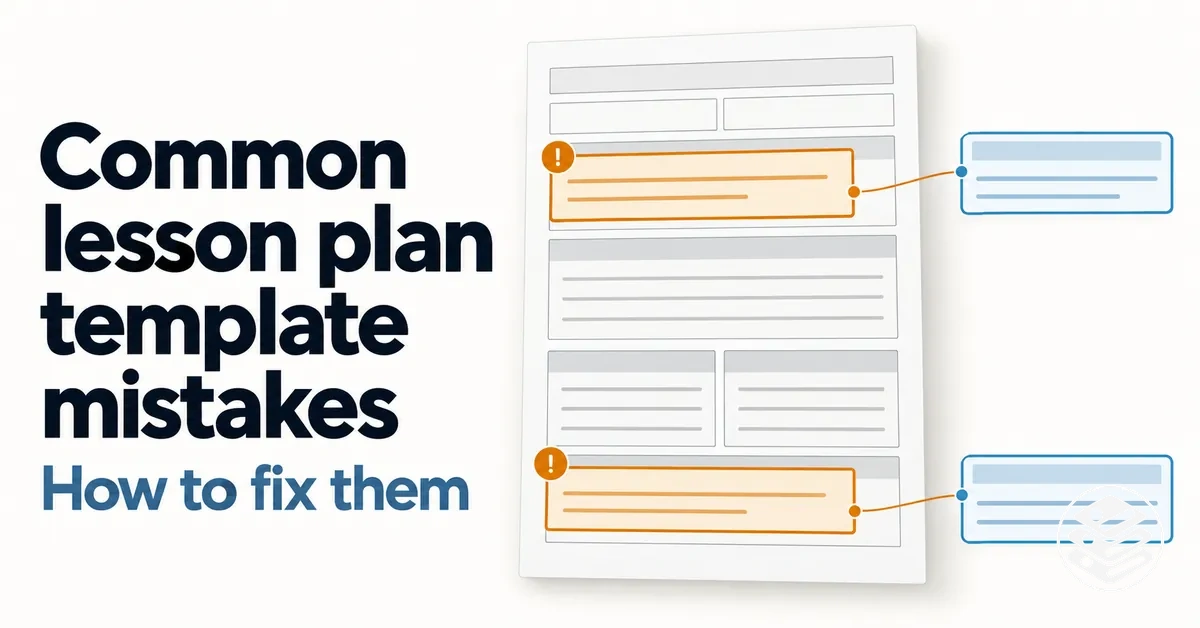
Diagnose the mistake before you edit
Match the visible problem to the planning relationship that has broken. The correction should target that relationship rather than rewrite the whole lesson plan.
Clarity
- Signal
- A field is blank, incomplete or ambiguous.
- Check
- Can another competent reader recover the intended action, task or necessary condition without guessing?
- Correction
- Add or clarify only the information needed for that field’s planning function.
Alignment
- Signal
- The objective, activity or assessment requires a materially different learner performance.
- Check
- Compare intended learning → practice demand → observable assessment evidence.
- Correction
- Revise the mismatched component so practice and evidence correspond to the intended learning.
Feasibility
- Signal
- The lesson is overloaded, poorly sequenced, or relies on an unsupported readiness or resource assumption.
- Check
- Check total demand, transitions, prerequisites, learner readiness and required resources under the planned conditions.
- Correction
- Prioritise, shorten or move lower-value work, restore prerequisite order, or adjust support and resources.
Review order: clarify information → check alignment → test feasibility → recheck the revised plan.
These categories describe planning defects, not teaching quality. Their classroom impact depends on the lesson goals, learner readiness, lesson time, available resources and implementation.
A lesson may be workable under one set of conditions but less feasible when timing, materials or transitions change. Likewise, objective–activity–assessment alignment breaks when the planned practice or evidence asks learners for a materially different performance from the intended learning.
Use the checks below to locate the defect before making cosmetic edits. The review starts with missing or unclear information because unresolved details can prevent the rest of the lesson plan from being interpreted reliably.
Table of Contents
Missing or Unclear Information in Lesson Plan Fields
A lesson plan field can be unusable because information is missing, incomplete, or ambiguous.
Missing information is absent, while unclear information is present but does not provide enough specificity to guide the intended teaching action.
An incomplete field provides some relevant detail but leaves information needed for that field’s function unresolved.
Correction starts by identifying which information state is present before adding or clarifying field content.
Specificity may clarify a teaching action or learner expectation, while timing and resources may establish conditions needed to carry it out.
The necessary detail therefore depends on the decision the field is intended to support rather than a universal requirement for every template.
The annotated example of missing or unclear information in lesson plan fields shows how a blank, partially specified, or vague entry can affect field usability.
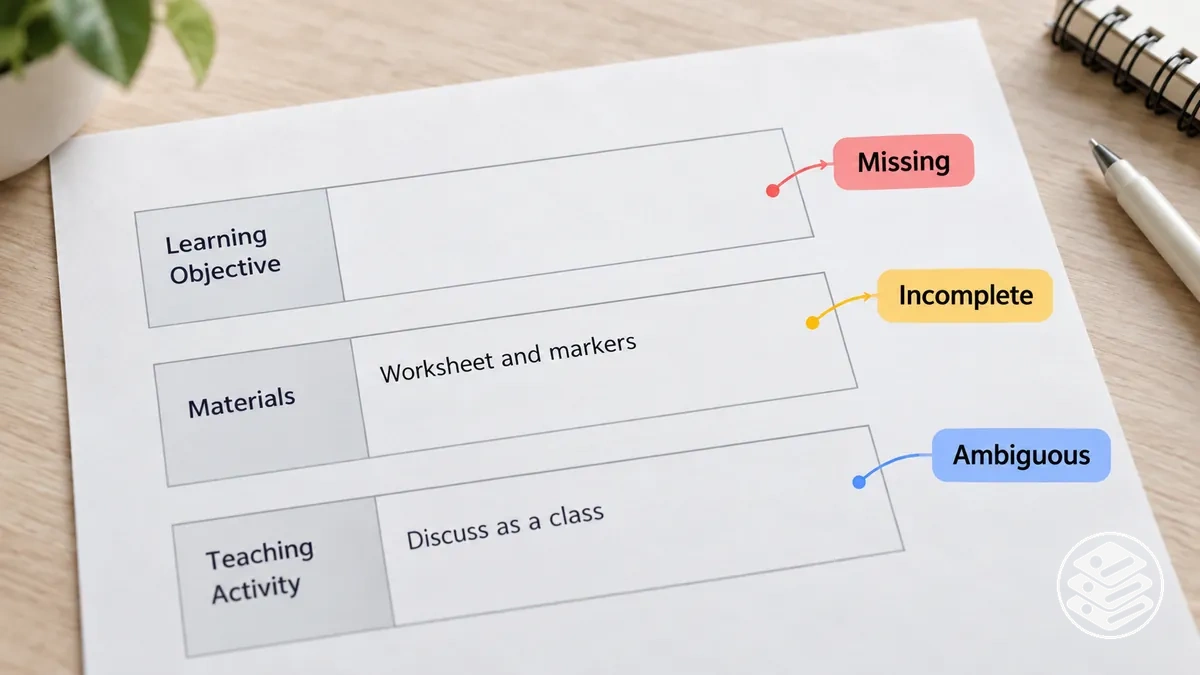
To recognise the error, check whether the lesson plan field contains the information its function requires and whether the wording supports a sufficiently clear interpretation.
The three information states below distinguish absence, incompleteness, and ambiguity without prescribing which fields every lesson plan template must contain.
- Missing: The lesson plan field is blank or omits information needed for its function, so the relevant planning decision cannot be made from that field.
- Incomplete: The field contains relevant information but leaves a necessary condition, such as timing, resources, or learner expectation, unresolved for the intended teaching action.
- Ambiguous: The field contains wording that permits materially different interpretations of the intended action, so the entry needs clarification before it can reliably guide implementation.
Missing Details That Make the Plan Incomplete
A plan is functionally incomplete when a missing detail removes information needed for a teaching or learning decision.
An absent learning target can leave the intended learning unclear, while an unspecified activity requirement can leave the teaching action or learner task underdefined.
Missing timing, resources, transitions, or evidence of learning can likewise create a practical gap when that information is necessary to carry out or evaluate the planned activity.
The appropriate correction is to supply the omitted information that supports the affected planning function.
Which omissions matter depends on the lesson's instructional purpose and required format, rather than a universal set of fields.
The image labels missing details according to the planning function they interrupt, showing how absent timing, resource, or learning-evidence information can leave a specific decision unresolved.
Functional completeness therefore means supplying the information required to use the incomplete lesson plan as intended, not filling every possible field.
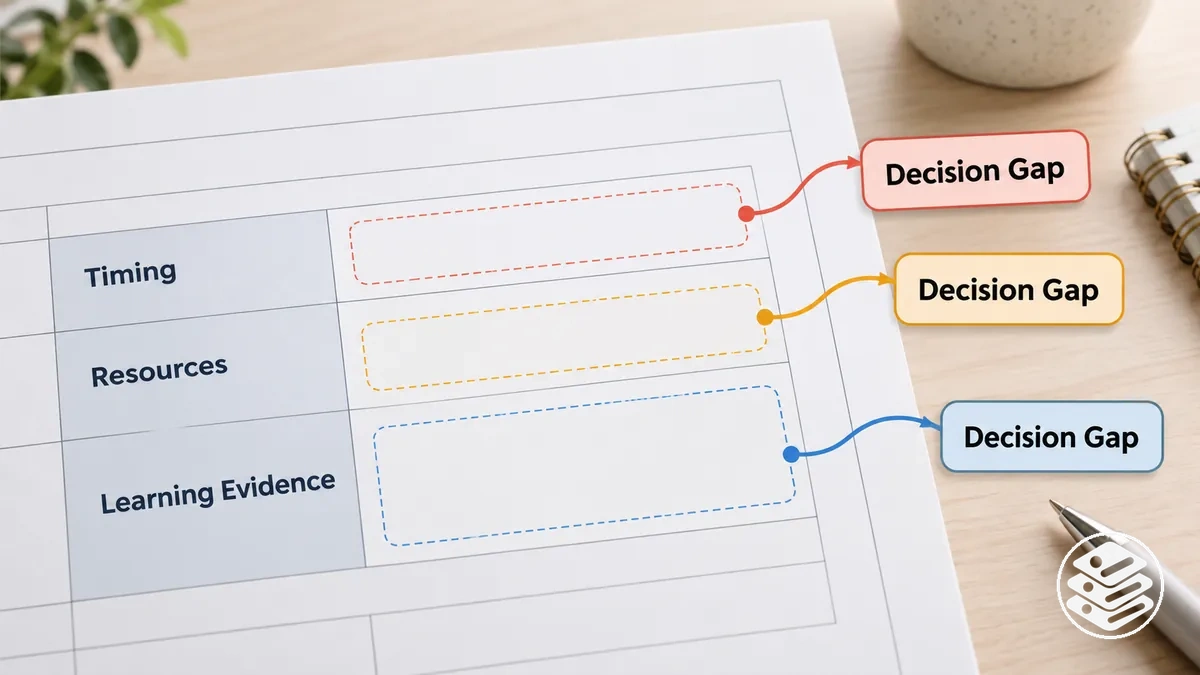
The following criteria filter a missing detail by its instructional consequence rather than by the number of fields in the lesson plan.
- Learning target: An omitted target leaves the intended learning outcome unspecified, limiting the ability to align the planned teaching action with that outcome.
- Activity requirement: Missing task requirements leave part of the intended activity undefined, so the teacher or learner may lack information needed to carry it out as planned.
- Timing: Missing timing leaves the duration or sequence point unspecified when that information is needed to organise lesson execution.
- Resources: An absent resource detail leaves required materials or equipment unidentified when the activity depends on them.
- Transition: A missing transition detail leaves the movement between relevant lesson activities unspecified when coordination or sequencing requires it.
- Evidence of learning: Omitted evidence criteria leave the plan without the information needed to determine what observable learner response will indicate the intended learning.
Vague Instructions That Leave Teaching Actions Unclear
A vague instruction can leave a teaching action or learner task unclear even when the lesson plan field contains text.
A broad label such as “group discussion” identifies an activity but does not specify what learners should discuss or produce.
Actionable wording makes the intended action recoverable by specifying the action and task, then adding a relevant condition, expected result, timing, grouping, or resources only when those details are needed for execution.
Operational clarity comes from making the action, task, relevant condition, and expected result explicit where each is necessary, rather than scripting every classroom move.
The examples illustrate operational clarity rather than an ideal wording style, with each pair showing what becomes explicit.
The appropriate level of specificity depends on the instructional context, and clarity is sufficient when another competent reader can infer the intended action without guessing at essential details.
Vague → actionable
- “Group discussion” → “In pairs, discuss two reasons the character changed their decision” → the learner task and grouping become explicit. These vague instructions and their clarified versions isolate the wording changes that make teaching actions recoverable. The graphic shows the same instruction in vague and clarified states so the action, task, and relevant condition can be distinguished visually.
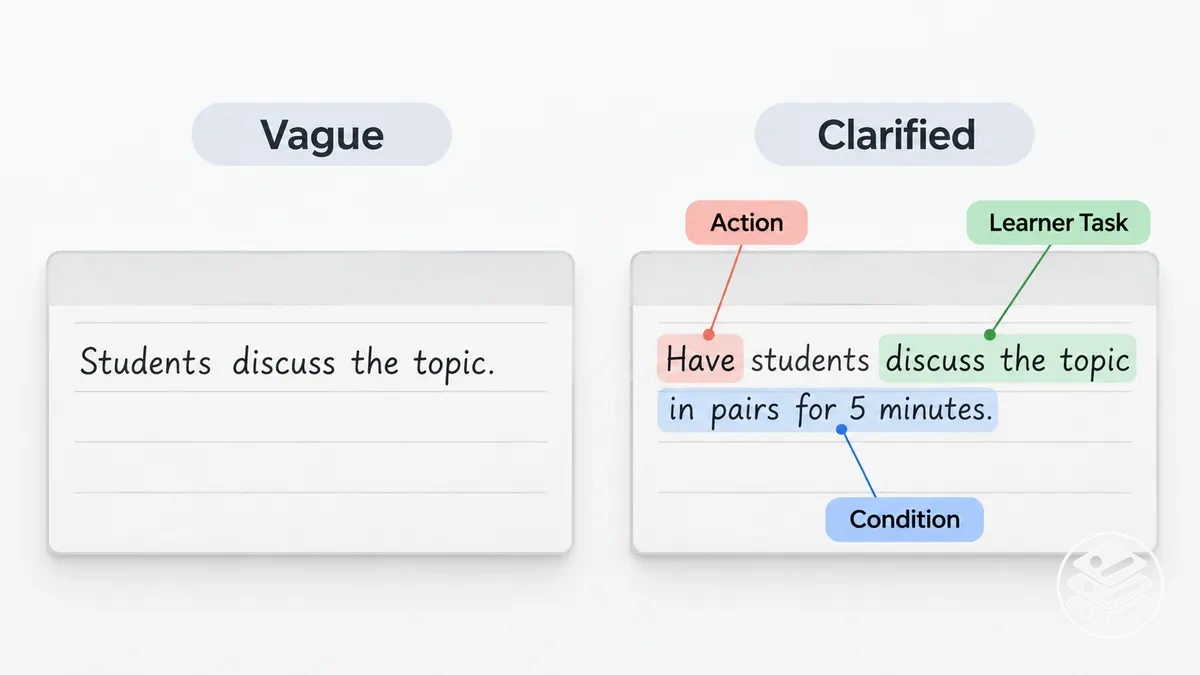
- “Review vocabulary” → “Learners sort the provided vocabulary cards into three topic groups” → the action, task object, grouping condition, and resources become explicit.
- “Write a response” → “Write one sentence stating the main idea after reading the passage” → the expected result and relevant condition become explicit.
Misalignment Between Learning Objectives, Activities and Assessment
Objective-activity-assessment alignment fails when the learning objective, planned activity, and assessment do not target the same intended learning.
The relationship must be checked across all three elements: the objective identifies the intended knowledge or skill, the activity provides practice with a relevant task demand, and the assessment elicits observable evidence that can support an inference about that intended learning.
The comparison therefore considers the intended knowledge or skill, the task demand placed on learners, the observable evidence elicited by the assessment, and the level of challenge across the three parts.
A planned activity aligns with a learning objective when its learner action practises the knowledge or skill represented by that objective, while the assessment aligns when its evidence task requires a corresponding performance.
If the practice demand and evidence demand differ materially from the objective, learner performance may not support the intended inference about that objective.
The table organizes intended learning, practice demand, and assessment evidence so matches and mismatches can be seen directly.
| Learning objective | Planned activity | Assessment evidence | Alignment implication |
|---|---|---|---|
| Compare two arguments using stated criteria | Learners compare two arguments and identify relevant similarities and differences | Learners submit a comparison that applies the stated criteria | Aligned: the activity practises and the assessment elicits learning evidence of the intended comparison skill. |
| Apply a procedure to solve a problem | Learners practise applying the procedure to example problems | Learners recall the steps of the procedure without applying them | Misaligned: the assessment evidence demonstrates recall rather than the intended application task demand. |
In the aligned example, the intended learning, practice task, and learning evidence require a corresponding performance; in the misaligned example, the assessment asks for recall rather than the application targeted by the learning objective.
The diagram isolates where the intended learning stops matching the planned task or evidence by highlighting one broken connection in the objective-activity-assessment chain.
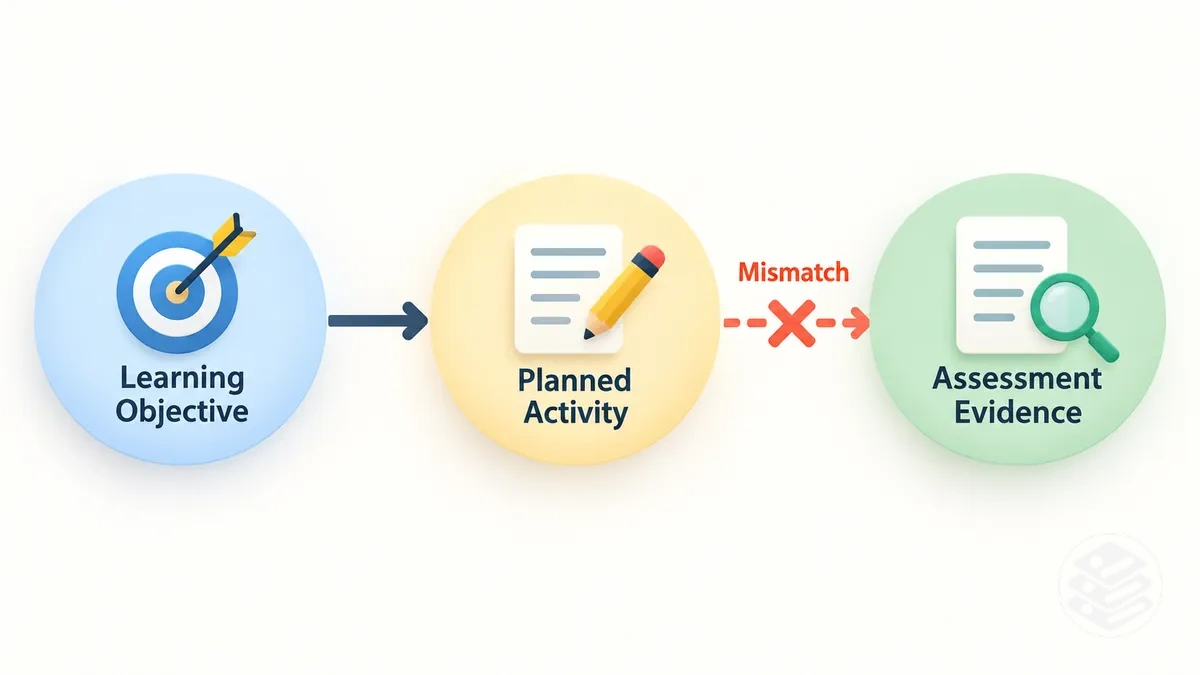 Curriculum-standard alignment is outside the main comparison here; alignment is a relationship among these lesson-plan parts rather than the mere presence of all three.
Objectives That Are Vague or Disconnected from Planned Activities
A learning objective can fail to guide a planned activity in two distinct ways: a vague objective may not specify the intended learning clearly enough for the required learner action to be identified, or a disconnected activity may require a materially different action from the stated objective.
The first problem is insufficient specificity about the intended knowledge or skill; the second is a mismatch between the objective's task demand and the activity task.
An activity can therefore address the same topic without actually practising the learning target described by the objective.
Correction begins by identifying which of these two connection problems is present.
Diagnosis compares the intended knowledge or skill, learner action, and cognitive or performance demand with what the planned activity actually requires.
The image compares what the learning objective asks learners to do with what the activity actually makes them do, making a demand mismatch visible.
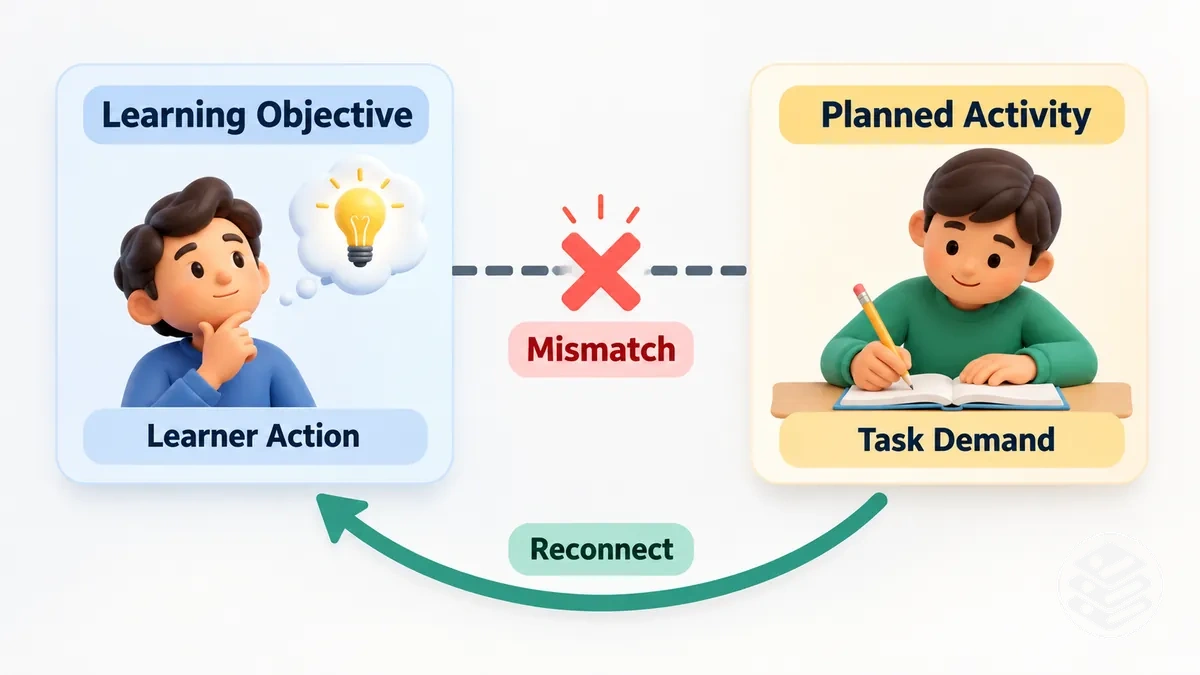 The examples compare instructional demand rather than surface topic similarity.
The correction is to reconnect the activity demand to the stated learning rather than rewriting objectives in general.
- Objective: “Compare two characters' responses to the same event.” Activity: Learners create a poster listing facts about each character. Mismatch: the planned activity requires identifying information but does not require the comparative learner action specified by the learning objective.
- Objective: “Explain how evaporation changes liquid water into water vapour.” Activity: Learners explain the change after observing an evaporation demonstration. Match: the activity practises the explanatory task demand represented by the objective.
- Objective: “Understand fractions.” Activity: Learners place fraction cards on a number line. Diagnostic issue: the activity requires a specific learner action, but the vague objective does not specify whether the intended learning is identifying, ordering, comparing, or representing fractions, so the objective-to-activity match cannot be established from the wording alone.
Assessments That Do Not Measure the Intended Learning Objective
Assessment evidence is misaligned when the evidence produced does not support a reasonable judgment about the intended learning in the learning objective.
The assessment must elicit an observable performance that corresponds closely enough to the objective's knowledge or skill and task demand for the response to provide relevant evidence of learning.
If an objective requires application but the assessment elicits only recall, the resulting evidence supports an interpretation about recall rather than the intended application performance.
Assessment format alone does not determine alignment; suitability depends on what the objective expects learners to demonstrate and what evidence the task produces.
Diagnosis compares the performance demanded by the learning objective with the evidence demanded by the assessment, including what learners must do, the performance level required, and the observable performance produced.
The image compares the performance demanded by the objective with the evidence demanded by the assessment, making a recall-versus-application mismatch visible.
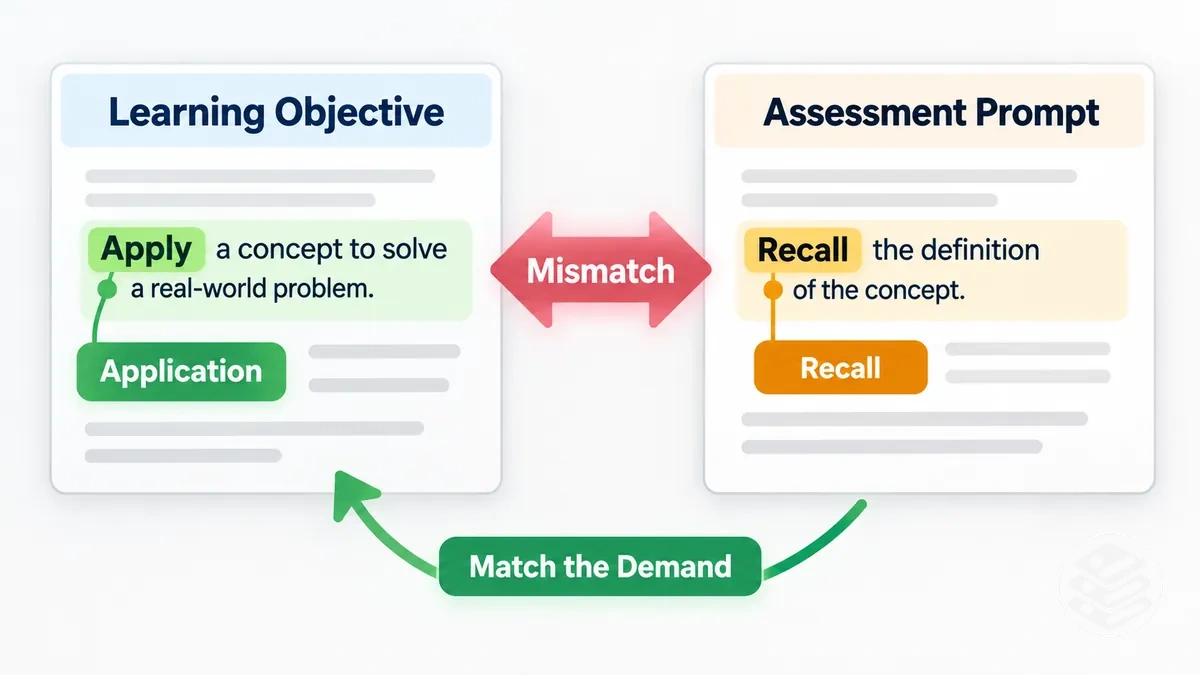 For example, if the intended learning is to apply a procedure to solve a problem but the assessment asks learners only to recall the procedure's steps, the assessment does not match the application demand.
The correction is to use an evidence task that requires the objective's intended performance rather than assuming a particular assessment format is inherently suitable.
- Objective expectation: Identify the knowledge or skill and learner performance required by the learning objective; if that demand differs from what is assessed, the assessment does not provide direct evidence of the intended performance.
- Assessment task: Check what the assessment actually asks learners to do and the performance level it requires; a mismatch means the task demand elicits a different learner action from the one required by the objective.
- Evidence produced: Check what the learner response can reasonably provide evidence of; if the observable performance does not correspond to the intended learning, the evidence does not support the intended interpretation of achievement.
Overloaded, Poorly Sequenced or Unrealistic Lesson Plans
Lesson plan feasibility becomes difficult to maintain when an overloaded lesson plan contains more goals or activities than the available conditions support, when the activity sequence lacks a coherent learning progression, or when the plan relies on unrealistic assumptions about learner readiness.
These are three distinct planning problems: overload concerns the amount of planned work, sequencing concerns the order and dependency of learning tasks, and assumptions concern whether learners have the readiness or support needed for those tasks.
Feasibility depends on conditions such as lesson time, task complexity, transitions, learner readiness, and available resources rather than a universal number of goals or activities.
A plan can therefore be feasible in one set of conditions and difficult to execute in another.
The three categories can coexist, but each requires a different check because its recognition cue and likely consequence differ.
At this level, the useful distinction is whether the main constraint concerns planning load, activity sequence, or realistic assumptions about learners and conditions.
Which feasibility problem is present?
- Overload: A recognition cue is that the planned goals and activities require more work than the available lesson time, transitions, task complexity, or resources reasonably support. The likely consequence is rushing, shortened activities, or incomplete planned work.
- Sequencing: A recognition cue is an activity sequence that asks learners to use knowledge or skills before relevant prerequisite learning has been established. The likely consequence is a gap in the learning progression that may leave later tasks harder to access or connect conceptually.
- Unrealistic assumptions: A recognition cue is that the plan assumes learner readiness, background knowledge, or resources that are not available under the planned conditions. The likely consequence is that an otherwise suitable task may become inaccessible or unproductive for the affected learners.
These categories can overlap without becoming interchangeable; an overpacked plan may also contain weak sequencing or unsupported assumptions.
Too Many Goals or Activities for the Available Lesson Time
An activity load is excessive when the combined demand of explanation, practice, transitions, checking, and closure exceeds what the available lesson time can realistically support.
Too many activities therefore means the planned demands cannot be completed while preserving the explanation, practice, transition time, learner processing time, and checking needed by the lesson design.
What counts as excessive depends on factors such as learner readiness, task complexity, activity purpose, and resources rather than a universal activity count or pacing ratio.
An overpacked lesson can create pressure to rush, shorten necessary practice, or reduce checking and closure.
Feasibility should be judged by comparing each activity's contribution to the learning objective with its total time demand, including costs that may be missed when only the activity itself is considered.
Estimated duration, transition time, and learner processing time can differ with the task and learners, so no universal timing threshold applies across lesson plans.
The criteria below estimate feasibility from learning value and total time demand without imposing universal timing rules.
The aim is to distinguish essential learning work from lower-priority additions that compete for the same lesson time.
- Activity purpose: Check whether the activity has a clear instructional function, such as explanation, practice, checking, or closure; an activity with little contribution to the intended learning can add avoidable load.
- Priority to the objective: Check how directly the activity supports the learning objective or necessary evidence of learning; essential work has higher priority when activities compete for limited time.
- Estimated duration: Consider the time the activity is expected to require under the planned conditions; an activity creates feasibility pressure when its time demand contributes to the combined plan exceeding available lesson time.
- Transition time: Include the time required to move between activities, groupings, materials, or task states; repeated or complex transitions can increase the total planning load beyond the duration of the activities themselves.
- Learner processing time: Allow for the time learners need to understand instructions, think, respond, practise, and complete the intended task; insufficient processing time can create pressure to rush work that is important to the objective.
Activities That Lack Logical Learning Progression
An activity sequence lacks logical progression when a task assumes prerequisite knowledge or a prerequisite skill that earlier work has not established or activated.
Each activity should build on what learners can already use and prepare them for the next relevant task demand.
Individually engaging or reasonable activities do not necessarily form a coherent learning progression when their task order leaves a missing step between what learners have practised and what they are expected to do next.
That missing dependency may create an abrupt jump that makes the next activity less accessible under the planned conditions.
An illustrative sequence can make these dependencies visible by showing how one activity prepares for the demand that follows; it is an example of dependency, not a mandatory pedagogical model.
For example, individually reasonable activities become less coherent if learners are asked for independent application before they have encountered the prerequisite skill or received the support that the application task assumes.
Appropriate ordering depends on the subject, learner readiness, task type, and instructional purpose.
The recognition cue is a missing prerequisite or an abrupt increase in task demand that prior work has not prepared learners to meet.
Illustrative dependency sequence
- Prerequisite activation: Learners retrieve or use the prerequisite knowledge or skill needed for the next task.
- Supported practice: Modelling or guided practice provides support for the new task demand where that support is needed.
- More independent application: Learners apply the relevant knowledge or skill with less support after the preceding work has prepared them for that demand.
- Checking: The lesson elicits evidence of learning that indicates whether learners can perform the intended task under the planned conditions.
Assumptions About Learner Readiness That Do Not Hold
A learner readiness assumption can make a planned activity unrealistic when it treats unverified background knowledge, prerequisite performance, language demand, task familiarity, independence, pace, or resource access as an established learner condition.
The problem is the unsupported assumption rather than a fixed characteristic of the learner.
Observable evidence from relevant prior work, current task performance, or confirmed access can support or challenge the assumed state, but one signal does not necessarily confirm readiness.
When the assumed condition is absent, the activity may require unplanned support or adjustment to remain feasible.
Readiness judgments should therefore connect the assumed state to observable evidence and then to its planning implication.
For example, if an activity assumes prior knowledge of a concept but relevant prerequisite performance indicates that the concept is not yet established, learners may need support that the plan did not allocate before they can complete the intended task.
Evidence can suggest whether a language demand, level of independence, task familiarity, or resource requirement is feasible under the current lesson conditions while preserving uncertainty about broader learner capability.
The corrective principle is to verify assumptions that materially affect the lesson rather than predict learner readiness from labels or unsupported expectations.
The scenarios below are evidence checks rather than learner labels; each pairs an assumption with an observable signal and a possible feasibility implication.
- Background knowledge: The plan assumes relevant prior knowledge is available. Performance on related prerequisite work can provide evidence for or challenge that assumption; if the required knowledge is not evident, the activity may require additional explanation or support before its main demand is feasible.
- Language demand and task familiarity: The plan assumes learners can interpret the task language and recognise what the activity requires. Observable responses to comparable instructions or tasks may indicate whether that assumption is supported; difficulty interpreting the demand may require clarification or additional task support.
- Independence: The plan assumes learners can complete the activity with the planned level of support. Prior performance on a relevant task may suggest whether that degree of independence is realistic, but it does not confirm performance in every context; evidence of continued support needs may require the planned support level to change.
- Resource access: The plan assumes required materials, devices, or other resources are available. Confirmed availability provides direct evidence for that condition; missing access may make the planned activity infeasible in its current form and require an alternative resource or task arrangement.
How to Review and Correct Lesson Plan Mistakes
A lesson plan review should identify and correct structural planning mistakes before cosmetic or low-impact edits.
Start with problems that affect information quality, alignment, feasibility, or a learner assumption because these can change whether the plan communicates and supports the intended lesson.
A signal may have more than one likely cause, so diagnose the relevant planning condition before choosing a corrective direction.
Wording or presentation refinements can follow once the underlying structure is coherent.
The review sequence moves from the information needed to interpret the plan toward relationships and conditions that determine whether it can operate as intended.
At each step, identify the signal, consider the likely mistake class, perform the relevant check, and revise only what the check indicates needs correction.
Structural checks come first because an earlier correction can change what later parts of the plan require.
Review path: signal → check → correction
- Clarify information quality: Signal: a field is blank, incomplete, or too vague to guide the intended action. Likely cause: missing detail or unclear wording. Check: identify the decision the field is meant to support and whether the necessary information is recoverable from its current wording. Corrective direction: add the missing detail or clarify the wording without adding information that does not serve that function.
- Check objective-activity-assessment alignment: Signal: the activity or assessment requires a different learner performance from the objective. Likely cause: misalignment among intended learning, practice, and evidence. Check: compare the objective's task demand with what learners do in the activity and what the assessment asks them to demonstrate. Corrective direction: revise the mismatched component so the activity and assessment correspond to the intended learning.
- Test time and sequence feasibility: Signal: planned work creates pressure to rush, or a later activity requires knowledge or skill that preceding work has not prepared learners to use. Likely cause: excessive activity load or an incoherent sequence. Check: compare the planned demands with available lesson time and inspect whether each activity prepares learners for the relevant next demand. Corrective direction: reduce or reprioritise lower-value demands, or revise the sequence where a prerequisite step is missing.
- Verify learner assumptions: Signal: an activity depends on background knowledge, language, independence, task familiarity, or resource access that has not been established. Likely cause: an unsupported learner assumption. Check: use relevant observable evidence, prior performance, or confirmed resource availability to determine whether the assumed condition is supported. Corrective direction: adjust the planned task or support when the evidence challenges an assumption that materially affects feasibility.
- Recheck the revised plan: Signal: a material correction has changed another component or planning condition. Likely cause: the revision has altered a dependency elsewhere in the plan. Check: review information quality, alignment, feasibility, and relevant learner assumptions again in light of the change. Corrective direction: resolve any new inconsistency before treating the correction as complete.
For example, if an assessment asks learners to apply a procedure while the objective specifies only recalling its steps, correcting that structural mismatch may also change which practice activity is needed, removing the need for separate cosmetic edits to the activity.
Broader pre-teaching verification belongs outside this troubleshooting sequence; after any material correction, recheck the revised lesson plan to confirm that the change has not introduced another inconsistency.
Clarify Missing or Vague Information Before Refining the Plan
An unclear lesson plan field should be corrected for missing information or vague information before lower-priority wording refinements are made.
First identify the field function, because that function determines which required detail is necessary for the intended teaching action.
A focused clarification is sufficient when it makes the action recoverable for execution without changing unrelated parts of the plan.
For example, changing “Discuss the text” to “In pairs, identify two reasons for the character’s decision” adds the learner task and grouping needed to make that teaching action materially clearer without rewriting the plan.
The method below moves from the field’s purpose to its current information gap, the minimum clarification needed, and verification by another reader.
After the local clarification, broader template completion can be handled separately; here, verify whether another reader can recover the intended action without guessing at an essential detail.
The amount of required detail depends on the field function and the information needed for reliable execution.
Keep the correction proportional by adding only the detail needed for reliable execution.
- Identify the field function: Determine what teaching action, learner task, condition, or other planning decision the field is intended to communicate.
- Locate the missing or ambiguous information: Identify the specific information that is absent or the vague wording that prevents the intended action from being recovered reliably.
- Add the minimum actionable detail: Clarify the entry with the required detail needed for execution, such as the learner action, task object, grouping, timing, or resource when that information is necessary for the field function.
- Verify the intended action: Check whether another reader could recover the intended teaching action from the revised field without guessing at an essential detail; if not, clarify the unresolved information and verify again.
Reconnect Objectives, Activities and Assessment
Repair alignment by returning to the intended learning and checking whether the planned activity practises that learning and the assessment elicits corresponding evidence.
Start with the learning objective and identify its task demand and expected learner action.
Then compare that demand with the practice task and evidence task rather than assuming that shared subject matter means the three parts match.
A mismatch exists when one element requires a materially different performance from the intended learning.
The method follows the relationship among intended learning, activity practice, and assessment evidence rather than a generic writing sequence.
When one element breaks that relationship, make the smallest useful revision by simplifying, replacing, or reframing that element instead of changing all three.
For example, if the learning objective requires learners to apply a procedure and the activity practises application but the assessment asks only for recall of the steps, revising the assessment to require application reconnects the evidence task to the intended learning.
Finish with a consistency check across the learning objective, activity practice, and assessment evidence.
- Identify the intended learning: State the knowledge or skill represented by the learning objective and identify the task demand or learner action it requires.
- Compare the activity demand: Check whether the activity practice requires learners to practise the intended learning; if the learner action differs materially, identify that connection as the mismatch.
- Compare the assessment evidence: Check whether the assessment elicits an observable performance that corresponds to the intended learning and whether its evidence task matches the relevant task demand.
- Revise and recheck: Revise the mismatched element by simplifying, replacing, or reframing it as appropriate, then recheck whether the learning objective, activity practice, and assessment evidence now require consistent learner performance.
Reduce and Resequence Activities to Fit the Lesson
Correct an overloaded lesson by prioritising each planned activity according to how directly its activity purpose supports the learning objective, then remove or compress lower-value demands.
Consider both evidence value and time cost so essential practice or checking is not displaced by work with a weaker contribution to the intended learning.
The decision may be to keep, shorten, move, or remove an activity according to its learning value and the constraints of the lesson.
This reduces overload without relying on a fixed activity count.
The ordered method balances learning value with realistic time and dependency rather than imposing a universal pace.
Estimate each activity's time cost with relevant transition and processing demands, then check whether a prerequisite requires one task to precede another.
Keep high-value activities where feasible, shorten or compress demands that can retain their purpose with less load, move activities when their position breaks prerequisite order, and remove lower-value work when it competes with more necessary learning.
Resequence the remaining activities so the planned progression reflects both dependency and the available lesson length.
- Rank activities by objective value: For each planned activity, identify its activity purpose and evidence value, then rank how directly it supports the learning objective. Keep activities that provide necessary learning practice or evidence before lower-priority additions.
- Estimate realistic time: Estimate the time cost of each planned activity under the expected lesson conditions, including relevant transition and learner processing time rather than counting only the main task.
- Remove or compress low-value demands: Shorten an activity when its purpose can be retained with less demand, or remove it when its contribution is lower than competing work needed for the learning objective. The appropriate decision remains conditional on the activity purpose and available lesson time.
- Resequence by prerequisites: Move activities when necessary so a prerequisite is established or activated before a later task requires learners to use it.
- Recheck feasibility: Review the revised sequence against the available lesson length, transitions, learner processing needs, and intended evidence of learning. If the combined demands still exceed the workable conditions, repeat the keep, shorten, move, or remove decisions while protecting the activities most relevant to the learning objective.
Pacing remains conditional on learner needs, task complexity, transitions, and lesson length, so the method does not prescribe an exact pacing formula.
The final feasibility check is whether the revised activity sequence can accommodate its necessary learning work, transitions, and processing demands within the available lesson under the planned conditions.
Check Assumptions Against Learners' Actual Readiness
A learner-readiness assumption should be retained only when relevant learner readiness evidence supports it strongly enough for the current lesson.
Check observable information such as prior work, prerequisite performance, language demand, task familiarity, resource access, and observed independence before the plan relies on the assumed learner condition.
Evidence can support or challenge an assumption, but a single observation does not confirm readiness across tasks or contexts.
When evidence is incomplete, treat the readiness judgment as provisional rather than substituting labels or demographic characteristics for evidence.
The criteria below connect each relevant evidence source to a provisional readiness judgment and an immediate planning adjustment.
Include only signals that can affect the current lesson, and distinguish a supported assumption from an unsupported one by whether the available evidence is relevant to the demand being planned.
Where evidence suggests a support need but remains incomplete, adjust only the affected task, support, or sequence rather than making a broader judgment about the learner.
Make a proportionate support or sequence change only when the available evidence justifies that planning adjustment.
Evidence → planning adjustment
- Prior work and prerequisite performance: Check whether relevant prior work shows the knowledge or skill required by the planned task. Consistent prerequisite performance can support the assumption for that demand, while missing or conflicting evidence may indicate a need to activate, review, or support the prerequisite before relying on it.
- Language demand: Check whether available learner responses indicate that the language required to understand or complete the task is accessible under the planned conditions. Difficulty with the relevant language demand suggests that instructions, vocabulary support, or task presentation may need adjustment, but it does not confirm a broader limitation in learner readiness.
- Task familiarity: Check whether learners have relevant experience with the task type or its expected procedure. Familiar performance can support an assumption that less procedural guidance is needed, while limited evidence of familiarity may indicate a need for clearer modelling or instructions for that task.
- Resource access: Confirm whether the materials, devices, or other resources required by the activity are actually available to the learners who need them. Confirmed access supports that planning assumption; unavailable access indicates a need to change the resource or task arrangement before implementation.
- Observed independence: Check relevant observations of how much support learners required on comparable work. Prior independent performance may support a plan with similar support conditions, while evidence of continued support needs may indicate a need to adjust scaffolding or sequence; one observation alone does not confirm independence across contexts.