Lesson planning becomes unnecessarily time-consuming when preparation is repeatedly spent rebuilding structure, polishing detail that does not serve a requirement or instructional decision, or reconsidering choices because the learning priority is unclear. A well-fitted lesson plan template helps mainly by reducing repeated setup; it does not replace lesson-specific judgement and can add work when its fields, required detail, or formatting do not fit the task.
Diagnose the delay before changing the planning process
Use the work consuming the session—not a universal minute threshold—to decide whether the time is mainly recurring process work, a planning decision problem, format friction, or legitimate lesson-specific preparation.
Repeated setup
Signal
Recurring fields, prompts, layout, or routines are recreated across plans.
Interpretation
The same process work is recurring before lesson-specific planning begins.
Template role
A suitable reusable structure can retain these stable elements and reduce recreation.
Low-impact detail
Signal
Time is repeatedly spent rewriting, polishing, or expanding detail.
Interpretation
Check whether the extra specificity supports lesson readiness, an instructional decision, or a requirement.
Direction
Reduce optional detail that has little planning use; retain detail that is required or instructionally useful.
Unresolved priorities
Signal
Activities, materials, explanations, or sequencing are repeatedly searched for or reconsidered.
Interpretation
An unclear learning priority can leave too many options plausible.
Direction
Use the intended learning outcome as the criterion for accepting, rejecting, or revisiting options.
Format friction
Signal
Information is duplicated, moved between fields, or repeatedly reformatted.
Interpretation
The format may not match the information or decisions the lesson requires.
Template role
Simplify or change optional structure that causes recurring friction; retain and accommodate required fields.
Lesson-specific complexity
Signal
Extra work is concentrated on a new, complex, or context-specific lesson and does not recur across comparable plans.
Interpretation
The additional time is more consistent with necessary preparation than with a recurring process bottleneck.
Template role
A template may reduce routine setup, but objectives, activities, assessment, sequencing, and adjustments still require teacher judgement.
Decision rule
Recurring work with little instructional or required value is the strongest candidate for standardising, simplifying, or removing. One-off work that supports lesson readiness, complexity, or a requirement is more likely to be necessary preparation.
A long planning session is not automatically inefficient. New or complex lessons, required documentation, and limited reusable structure can justify additional preparation, so there is no universal minute benchmark; judge the session by what the work accomplishes and whether the same low-value process repeats across comparable plans.
The sections below separate recurring bottlenecks from necessary preparation and show how to test whether a template reduces repeated work or introduces new friction.
Table of Contents⌄
The Main Causes of Excessive Lesson Planning Time
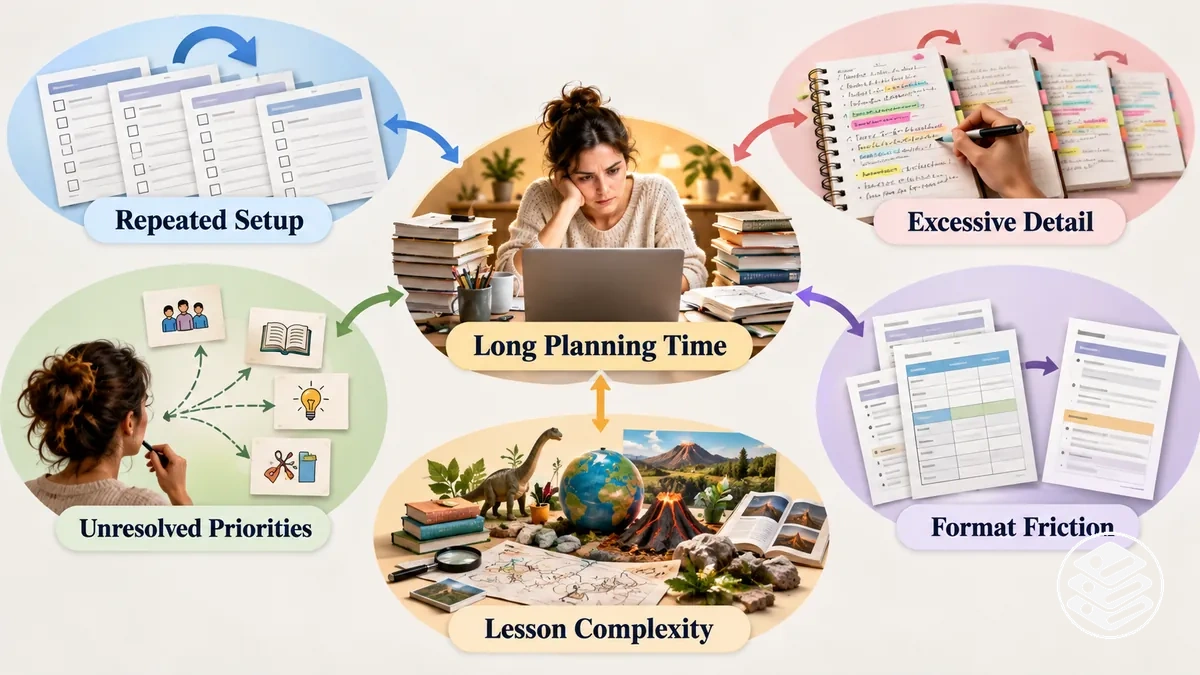
The causes of excessive lesson planning time are contributing mechanisms rather than one universal explanation.
Repeated setup increases preparation by recreating recurring work, unnecessary detail adds work that may not increase instructional value, unclear learning priorities leave more choices unresolved, and decision overload increases the planning decisions that must be made.
How much each mechanism contributes depends on the lesson, teacher context, and requirements.
The diagram groups these distinct mechanisms rather than ranking their importance or implying that every teacher experiences them equally.
Context-specific requirements, including required documentation, can intensify preparation burden when they add necessary planning work or interact with these contributing factors.
Such requirements are modifiers rather than universal causes because their effect depends on what a particular lesson and teaching context require.
The relevant distinction is whether planning time expands through repeated or unresolved planning work, or through preparation that the context genuinely requires.
Starting From Scratch and Repeating the Same Setup
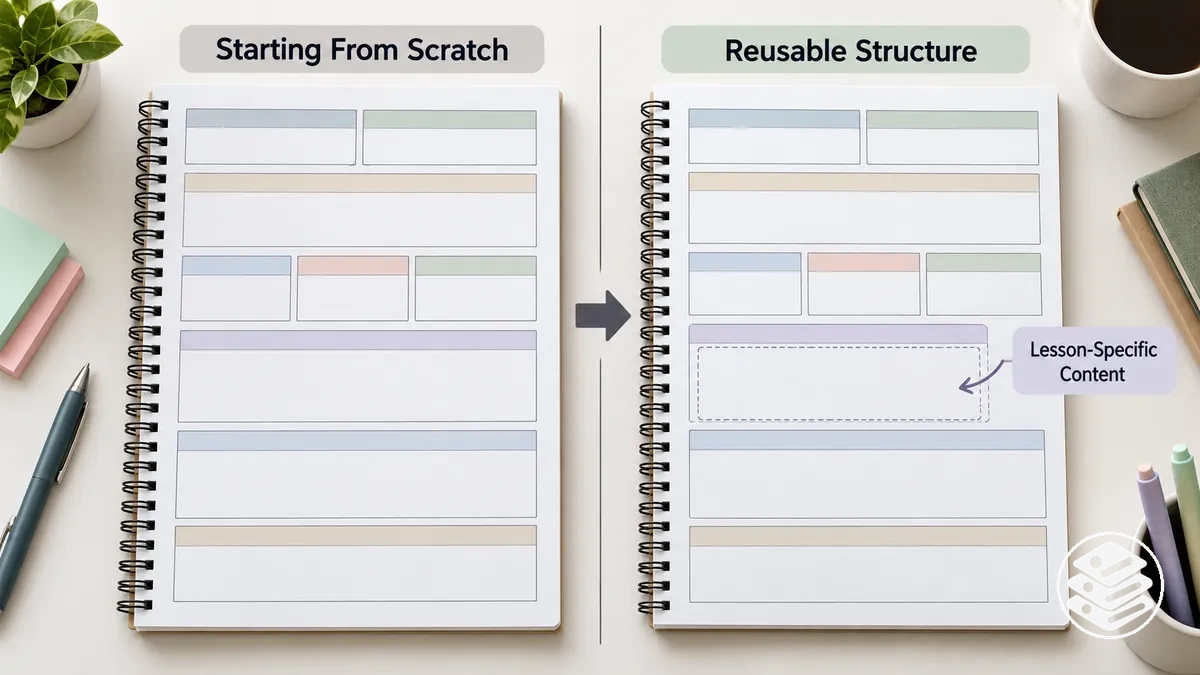
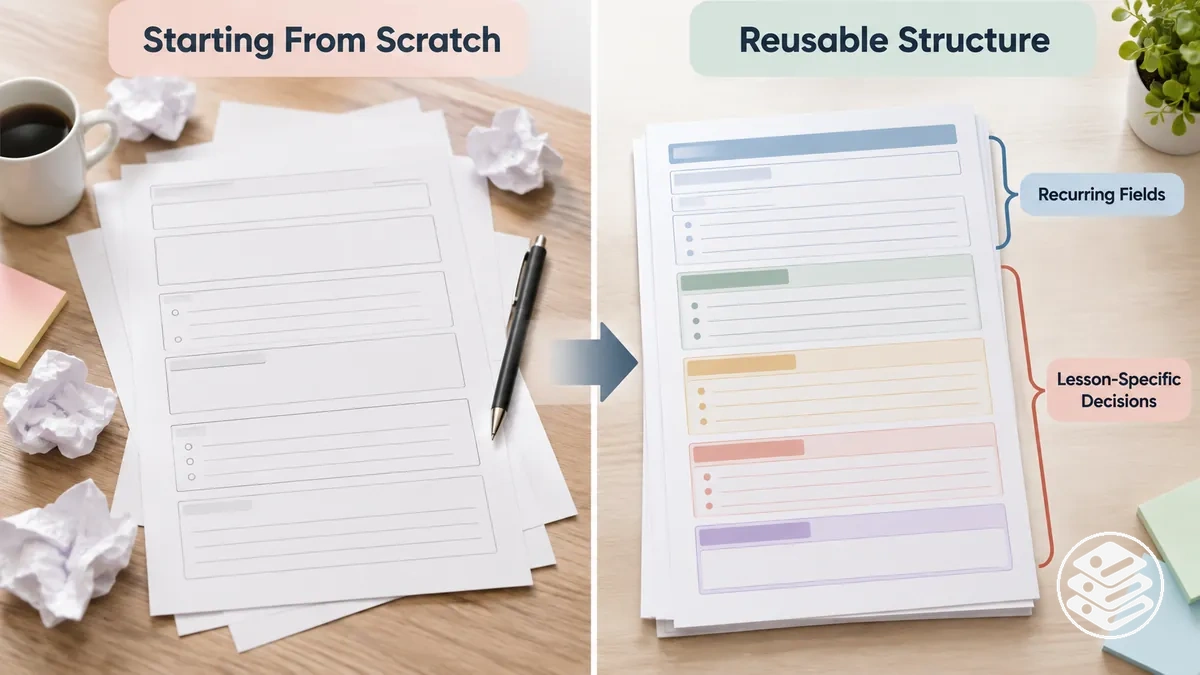
Starting from scratch creates repeated setup when recurring fields, routines, prompts, and formatting have to be recreated before lesson-specific planning begins.
Reusing stable structure avoids rebuilding those recurring elements, although the effect on preparation time depends on how much of the structure is genuinely reusable and how much the lesson requires adaptation.
Recurring fields, routine prompts, familiar activity structures, and consistent formatting can remain part of a reusable structure when they serve the same function across lessons.
Lesson-specific content, learning choices, activities, and sequencing still require judgement, so reuse changes the amount of setup work rather than removing substantive planning decisions.
The corrective principle is to reuse recurring structure where appropriate while leaving lesson-specific decisions open for adaptation.
Overplanning Low-Impact Details
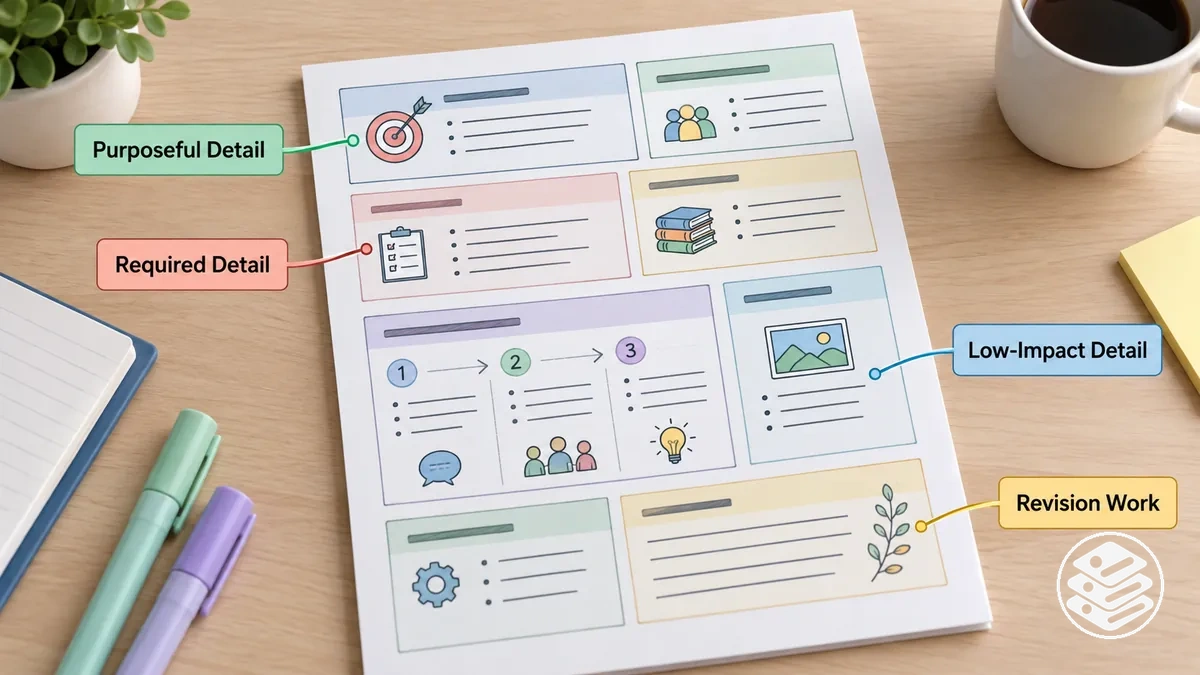
Overplanning occurs when low-impact details add writing, rewriting, or polishing without materially improving lesson readiness, meeting a requirement, or supporting an instructional decision.
This revision work may increase planning time when the added specificity has limited instructional purpose in the current lesson, so the comparison is based on instructional usefulness and requirement status rather than minimalism.
Required detail or additional specificity is justified when it supports an instructional purpose, satisfies accountability or documentation requirements, or helps prepare for a novel or complex lesson.
The same level of detail can be low-impact when it mainly polishes wording or formatting that will not affect later decisions, while likely reuse and teacher experience can make comparable detail more useful in another context.
More detail can therefore be appropriate in one context and excessive in another; time-related overplanning is only one part of the wider category of avoidable lesson planning mistakes.
Unclear Learning Priorities and Too Many Planning Decisions
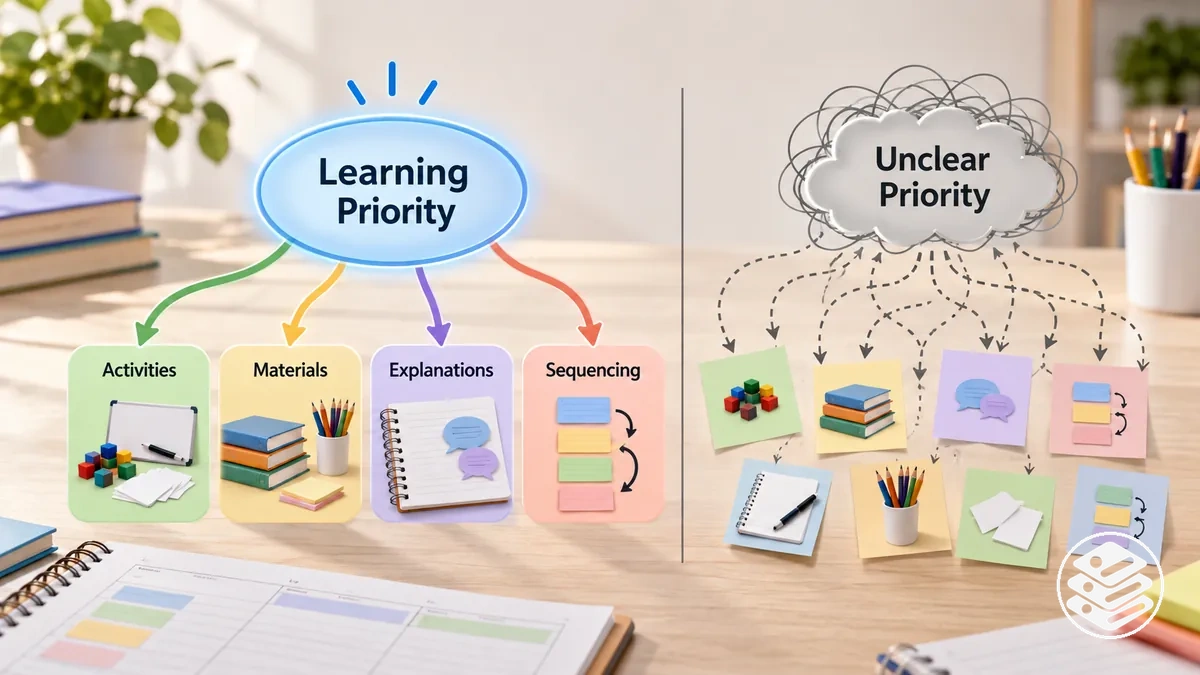
Planning choices need stable learning priorities to filter which activities, materials, explanations, and sequencing options support the intended learning.
When the learning outcome is unclear, more options can remain plausible, increasing decision overload and prompting additional searching or reworking because there is no stable criterion for what deserves emphasis.
This can increase planning time, although the extent depends on lesson complexity and teacher context.
The diagram shows how priority clarity can filter later planning decisions rather than determine every choice.
An explicit learning outcome can act as a criterion for accepting, rejecting, or revisiting planning options according to whether they serve the intended learning.
For example, when two activities address different purposes, the stated learning priority can identify which one is relevant to the lesson and which would add another decision without supporting the intended emphasis.
The same filtering applies to materials, explanations, and sequencing, narrowing choice load while leaving lesson-specific judgement intact.
How to Identify Which Planning Tasks Are Causing the Delay
Identify the delay by observing which planning tasks consume time and whether the same work pattern recurs across lesson plans, rather than comparing total planning time with a universal minute threshold.
A recurring bottleneck points to repeated process work, while a one-off demand may instead reflect legitimate lesson-specific complexity.
Similar planning times can therefore arise from different underlying patterns.
The diagram separates the shared symptom of a long planning session from several possible bottlenecks and the observations used to distinguish them.
The relevant signal is the work consuming the session, while the check asks whether that work recurs and what function it serves.
Recreating the same setup across plans suggests repeated setup, whereas repeated revision of detail requires checking whether the detail serves a requirement or instructional use.
Continued searching or changing activities can be consistent with unresolved priorities, while duplicated entry or reformatting can indicate format friction when the planning format does not fit the work.
Preparation concentrated on the novelty or complexity of one lesson is more consistent with lesson-specific complexity when the same demand does not recur across comparable plans.
Planning bottlenecks: signals, checks, and interpretations
Signal
Possible Cause
Check
Interpretation
Recurring fields, prompts, or setup work are created again across plans.
Repeated setup
Check whether substantially the same setup work appears in multiple lesson plans.
A recurring pattern points to setup work as a possible planning bottleneck.
Time is repeatedly spent expanding, rewriting, or polishing planning detail.
Excessive detail
Check whether the revised detail supports a requirement, lesson readiness, or an instructional decision.
Revision with limited instructional or required use is consistent with excessive detail; necessary detail is not.
Activities, materials, explanations, or sequencing are repeatedly searched for or reconsidered.
Unresolved priorities
Check whether a clear learning priority provides a stable criterion for accepting or rejecting options.
Repeated choices without a stable criterion suggest unresolved priorities are contributing to the delay.
Information is duplicated, moved between fields, or repeatedly reformatted.
Format friction
Check whether the same reformatting or duplicated entry recurs because the planning format does not fit the information being recorded.
A recurring mismatch between the task and format points to format friction as a possible bottleneck.
Extra preparation is concentrated on a new, complex, or context-specific lesson.
Lesson-specific complexity
Check whether the additional work is largely absent from more familiar or comparable lessons.
A one-off demand tied to lesson novelty or complexity is more consistent with legitimate preparation than a recurring process bottleneck.
The interpretation should therefore follow the recurring work pattern, not duration alone.
Two plans can take similar total time while one is slowed by repeated setup or format friction and the other requires additional preparation because of lesson-specific complexity, so the differentiating check matters more than the shared symptom.
How Templates Reduce Repeated Planning Work
Lesson plan templates can reduce repeated planning work when they preserve reusable structure, recurring fields, and useful prompts that would otherwise require the same setup again.
This standardisation reduces recreation while leaving objectives, activities, assessment choices, and other lesson-specific adaptation open to teacher judgement.
The comparison concerns repeated preparation work rather than teaching quality or an automatic reduction in preparation time.
Starting from scratch requires recurring structure and information to be set up again, whereas a suitable planning template retains those reusable elements for the next plan.
Recurring prompts and fields can standardise where repeated information is recorded, reducing recreation when those elements fit the planning task.
Repeated decisions about layout or where recurring information belongs can therefore be reduced, while the content of objectives, activities, assessment, and adjustments still requires teacher judgement.
The table compares repeated preparation work across setup, recurring information, reusable fields, and lesson-specific adaptation without treating reduced task repetition as a measure of teaching quality.
What reusable structure changes—and what still requires teacher judgement
Planning Task
Starting From Scratch
Using Reusable Structure
What Still Requires Judgement
Setup
Recurring sections and layout are established for each plan.
Stable structure is already available when it fits the task.
Whether the structure suits the lesson and needs adjustment.
Recurring information
Repeated information must be entered into newly established locations.
Recurring fields provide consistent locations for information that belongs in each plan.
Which information is relevant and accurate for the specific lesson.
Recurring prompts or fields
Common planning prompts or fields must be established or reconsidered.
Useful prompts and reusable fields remain available across plans.
How each prompt applies and whether a field is necessary for the lesson.
Lesson-specific adaptation
Both recurring structure and lesson-specific content require preparation.
Recurring structure is retained while lesson-specific areas remain open for adaptation.
Objectives, activities, assessment choices, sequencing, and necessary adjustments.
The practical time benefit depends on fit: reusable structure can reduce repeated setup when its fields and prompts correspond to work that genuinely recurs.
Redundant fields or poorly matched structure can create extra work instead, so a template should standardise repetition without adding unnecessary requirements.
Lesson-specific decisions remain dependent on teacher judgement rather than the template itself.
How to Balance Lesson Detail With Planning Time
Lesson detail is justified when it serves an instructional need, requirement, or decision strongly enough to warrant the added planning time.
The appropriate level of detail therefore changes with novelty, lesson complexity, required documentation, reuse value, flexibility needs, and the consequence of leaving information unspecified.
These are decision conditions rather than fixed thresholds, so they do not establish a universal preparation-time limit.
Extra detail earns its preparation cost when a relevant condition makes greater planning specificity useful; when that condition is absent, a lighter level of detail may be sufficient.
What changes the useful level of detail
Required documentation
Detail is justified when a required record, accountability process, or planning requirement calls for specific information; detail beyond that requirement has a higher planning cost without serving the documentation need.
Novelty or lesson complexity
A new or complex lesson can justify more detail when additional preparation helps clarify activities, sequencing, materials, assessment, or likely adjustments.
Consequence of omission
Detail matters more when leaving an item unspecified could affect lesson readiness or a later instructional decision; lower-consequence information can often remain less specific.
Reuse value
Detail can justify more planning time when the information is likely to remain useful across future lessons or adaptations; one-off specificity has less reuse value.
Flexibility
Less detail can be appropriate when the plan needs room for adaptation during teaching, while more specificity can be useful where an element needs to be established before the lesson.
Familiarity
A familiar repeat lesson can require less written detail when the necessary decisions are already understood, whereas unfamiliar preparation may justify greater specificity.
A familiar repeat lesson may therefore need less preparation detail, while a new or complex lesson may justify more because more decisions need to be established before teaching.
This planning time is teacher preparation time, not classroom time allocated to activities; decisions about activity duration belong to lesson-time allocation rather than to the amount of planning detail.
When Lesson Plan Templates Add Extra Work
A lesson plan template can add extra work when irrelevant fields, excessive detail, duplicated entry, poor fit, or reformatting create planning tasks that do not support the lesson's actual needs.
This template friction does not mean templates are generally inefficient, because the same requirement may be optional in one planning context and required in another.
Before changing the planning approach, check whether the friction comes from an optional template feature, a required constraint, or a mismatch between the format and the lesson.
Treat each symptom as a clue rather than proof: connect it to a likely cause, verify whether the work is unnecessary, duplicated, required, or caused by poor fit, and then choose a corrective direction. The table applies that diagnostic sequence.
The table organises the main sources of template friction on that basis.
Template friction: symptoms, checks, and corrective directions
Symptom
Likely Cause
Check
Corrective Direction
Irrelevant fields repeatedly require attention even though they do not support the lesson.
The lesson plan template contains fields that do not match the current planning task.
Check whether each field is optional or required and whether completing it informs a planning decision or satisfies a requirement.
If the field is optional and serves no current planning need, simplify its use; retain required fields and handle them according to the applicable requirement.
Planning requires excessive detail beyond what appears necessary for the lesson.
The format may require more specificity than the planning task itself needs.
Check which details support lesson readiness or a formal requirement and which are optional additions.
Reduce optional detail that does not serve the planning task, while retaining detail that is required or instructionally useful.
The same information is entered more than once.
Duplicated entry may reflect overlapping fields or information already recorded elsewhere.
Check whether each repeated entry serves a distinct requirement or whether the same information is being recorded redundantly.
Where duplication is optional, use one appropriate location; where separate records are required, accommodate the constraint rather than deleting required information.
The template repeatedly needs adaptation to represent the lesson.
Poor fit between the planning format and the lesson needs may be creating extra work.
Check whether recurring adjustments are needed because the template structure does not match the information or decisions the lesson requires.
If the format is optional, use a structure that better fits the planning task; if it is required, keep the constraint and limit adaptations to what is necessary.
Information must be repeatedly moved, reformatted, or reorganised.
Unnecessary reformatting may indicate a mismatch between the template structure and the way planning information is used.
Check whether the formatting work is required for a defined purpose or simply recurs because information does not fit the available fields.
Reduce optional formatting work where possible, while retaining formatting that is required for the relevant planning or documentation purpose.
An optional format that repeatedly creates irrelevant fields or reformatting can be simplified or changed when the constraint is genuinely optional, whereas a required field must be retained or accommodated even when it adds preparation work.
The corrective direction therefore depends on whether the source of friction is optional or required, not on one frustrating experience with a template.