
Lesson Plan Template Readiness Checklist Before Teaching
A lesson plan is ready to teach when no material blocker remains in objective–activity–assessment alignment, practical feasibility, evidence of learning, or necessary contingency preparation, so the intended learning can be taught and checked in the actual class conditions. Readiness is a pre-teaching verification judgment, not a requirement to make every detail final.
Lesson plan readiness decision check
Classify each readiness area by the consequence of any remaining gap. Use Fix before teaching for a local correction that leaves the core lesson workable, and Core blocker when the lesson objective, evidence, or feasibility requires substantive replanning.
Readiness depends on the lesson purpose, classroom conditions, available class time, resources, and relevant contingencies. The same plan can therefore be workable in one teaching context and need revision in another without changing the underlying verification principle.
Broader template fundamentals belong to the lesson plan template overview; this checklist focuses on material gaps that affect whether the intended learning can be taught and checked.
Table of Contents
Check Learning Objectives, Activities, and Assessment for Alignment
A learning objective, learning activities, and assessment evidence are aligned when they serve the same intended learning.
The learning objective establishes the expectation, the activities support the corresponding learning demand, and the assessment evidence provides a relevant basis for checking that expectation.
For readiness, the three elements should function as one coherent instructional chain rather than as separate completed fields.
A mismatch occurs when an activity or planned evidence does not support the learning objective it is meant to address.
Having the expected fields or essential template components present does not by itself establish functional alignment.
The following three checks organize the objective-to-activity-to-evidence relationship; if a material mismatch leaves the intended learning unsupported or without relevant evidence, the lesson plan requires revision before teaching.

- Learning objective ↔ intended learning: the objective should express the learning the lesson is intended to address; a conflicting expectation indicates an alignment gap that requires revision.
- Learning activity ↔ objective: the activity should support practice or engagement relevant to the objective; an activity aimed at a different learning demand indicates a mismatch.
- Assessment evidence ↔ objective: the planned evidence should provide information relevant to the objective; unrelated evidence leaves readiness unresolved and requires revision.
Learning Objectives Are Clear and Checkable
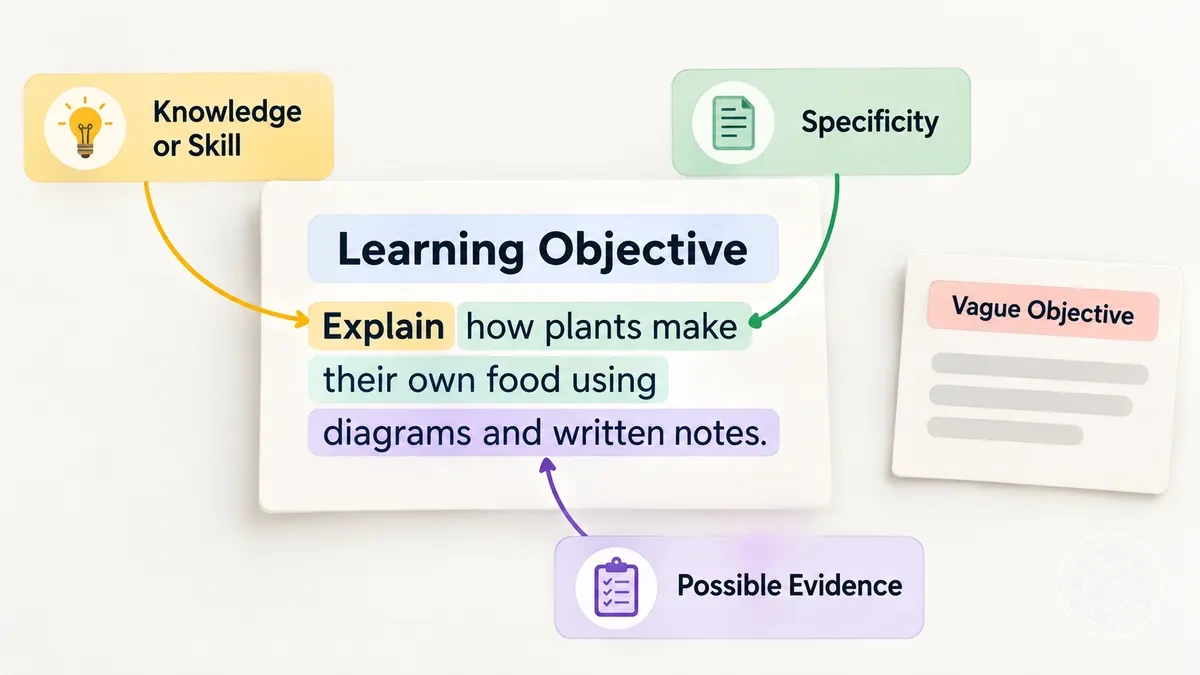
A learning objective is ready for use when it states the intended learning clearly and can be checked through relevant evidence.
It should identify the knowledge or skill learners are expected to develop with enough specificity to guide teaching.
Checkability does not require every learning objective to use numeric measures; relevant evidence can also show progress in qualitative knowledge or skill.
A clear, specific objective supports interpretation of that evidence, while vague wording leaves ambiguity that weakens later activity and evidence decisions.
Activities Directly Support the Learning Objectives
A learning activity supports a learning objective when learners practice, apply, explore, or demonstrate the intended learning.
The activity's learning demand should require learners to work with the knowledge or skill represented by the objective.
Objective alignment depends on what learners actually do, not whether an activity is merely engaging or related to the same topic.
An aligned activity requires the intended learning, while a topic-related activity may involve the subject without materially advancing the learning objective; activities with that mismatch require revision before teaching.

Planned Checks Can Provide Evidence of the Intended Learning
A planned check is useful when it can reveal evidence of learning relevant to the intended learning.
A check for understanding should produce an observable response or product that can indicate knowledge, skill, misconception, or progress and support interpretation.
Task completion alone does not show whether the intended learning is evident. Finishing an activity records completion, while explaining a relevant idea can provide interpretable evidence.
A planned check may be informal or ungraded, but it should still provide relevant evidence; an evidence gap requires revision before teaching.

Check Lesson Sequence, Timing, and Resource Readiness
A lesson plan is practically feasible when its activity sequence can operate within the available class time and required resources are ready when needed.
Dependencies between activities should support a workable flow rather than create avoidable delays or gaps.
Timing should account for the planned activities and realistic transitions under the relevant classroom conditions.
Materials, access, and other resources must be available and usable for the activities that depend on them.
Setup, transitions, access requirements, and classroom overhead can create a feasibility gap even when the written lesson plan appears complete.
These conditions affect available class time and whether materials or resources can be used as planned.
The following checklist tests feasibility across sequence, timing, and resources without redesigning the lesson.

- Sequence: Check that the activity sequence respects necessary dependencies and allows workable transitions; unresolved dependencies or transition demands create a readiness gap.
- Timing: Check that planned activities, setup, transitions, and closure can reasonably fit within the available class time; an unrealistic timing demand requires adjustment before teaching.
- Resources: Check that required materials, technology, and access are available and functional when needed; missing or unusable resources create a feasibility gap.
Activities Follow a Workable Teaching Sequence
An activity sequence is workable when each later activity receives the prerequisite preparation, modelling, practice, or transition it depends on.
The activity order should create a coherent flow in which the next task does not assume knowledge or action that has not yet occurred.

A dependency gap exists when a later activity requires preparation that an earlier activity or transition has not provided.
Here, sequence means lesson-activity order and dependency, not teaching learners to sequence events as a literacy skill.
A broken prerequisite or transition dependency should be revised before class.
Planned Timing Fits the Available Class Time
Planned timing is feasible when instruction, student work, transitions, checking, and closure can reasonably fit within the available class time.
Each activity duration should be considered as part of the total planned demand rather than in isolation.
Setup, transitions, and other classroom overhead reduce the class time available for planned activities, while a buffer or cut-point can provide a conditional response when estimates vary.
These are planning considerations rather than fixed timing rules; a plan requiring more time than the class can reasonably provide needs adjustment.
- Instruction and student work: Check whether their combined activity duration fits the available class time without assuming unrealistically fast completion.
- Transitions: Allow for the transitions required between activities; overlooked transition demands can make planned timing overrun.
- Setup or cleanup: Account for setup or cleanup when the lesson requires them; omitted overhead reduces the time available for planned work.
- Checking and closure: Confirm that checking and closure still have workable time within the total planned demand; otherwise, the timing needs adjustment.
- Buffer or cut-point: Where uncertainty is material, identify a reasonable buffer or cut-point appropriate to the lesson rather than applying a universal allowance.
Materials and Resources Are Ready for Use
Materials and resources are ready when their availability, accessibility, quantity, preparation, and functionality meet the needs of the planned activity.
A resource being present is insufficient if learners or the teacher cannot access or use it when required.
Relevant checks may include copies, permissions, device access, files, links, or physical materials, depending on what the activity requires.
Each required resource should be usable at the point of instruction; a missing critical resource or access condition creates a readiness gap.
- Availability: Confirm each essential resource will be available when the planned activity requires it.
- Access: Confirm required materials, files, links, devices, or spaces are accessible to the people who need them.
- Quantity: Where quantity matters, confirm there are sufficient copies, materials, or devices for the planned classroom use.
- Preparation: Confirm required materials, files, or equipment are prepared for use rather than merely present.
- Functionality: Check that required technology, files, links, or equipment function in the intended classroom environment.
- Permissions: Where access depends on permissions, confirm the required authorisation or account access is available before instruction.
Check Flexibility for Timing and Unexpected Lesson Changes
A useful contingency protects the lesson objective when a foreseeable disruption could make the original plan unworkable.
A time change, unavailable materials, technology problem, or ordinary classroom disruption may require a proportionate fallback.
The alternative should preserve the intended learning rather than simply keep learners occupied.
Readiness therefore depends on having a workable response where a foreseeable change could obstruct the lesson objective.
Contingency planning should focus on realistic changes that materially affect time, materials, technology, or another necessary lesson condition.
The adequacy of a fallback depends on the affected lesson function and whether the alternative still supports the intended learning.
Contingencies should preserve instructional purpose without attempting to plan for every imaginable event.
- Time-related change: If available lesson time changes, verify that a proportionate fallback exists and still supports the lesson objective.
- Materials-related disruption: If essential materials become unavailable, check whether an appropriate alternative can support the same intended learning.
- Technology-related disruption: If required technology becomes unusable or inaccessible, confirm whether a feasible alternative preserves the instructional purpose.
- Ordinary classroom disruption: If a foreseeable classroom condition interrupts the planned activity, verify that the contingency keeps the essential learning workable without requiring a response for every minor inconvenience.
The Lesson Can Be Shortened or Extended Without Losing Its Objective
A lesson can be shortened or extended when the essential learning objective and evidence needed to judge progress remain intact.
The learning objective and usable evidence are non-negotiable; the adjustable element is the activity load around them.
Optional practice, depth, enrichment, or extension may change according to the available time and lesson design.
A cut-point should remove adjustable activity before essential learning or its evidence, while an extension should add useful depth without changing the objective.
- Shortening: Preserve the essential learning objective and enough evidence to judge progress; shorten optional practice, enrichment, or other non-essential activity where the lesson design permits.
- Extending: Preserve the same learning objective and evidence requirement; extend the lesson with relevant practice, depth, or enrichment rather than adding activity unrelated to the intended learning.
Alternatives Are Available if Materials or Technology Cannot Be Used
A fallback is suitable when it preserves the instructional function of an unavailable resource or technology dependency.
The alternative does not need to reproduce the original tool exactly if it keeps the required learning purpose feasible.
An alternative may change timing, delivery, accessibility, or the evidence learners can provide, so those effects should be checked for readiness.
If the substitute cannot preserve the required instructional function or usable evidence, an essential dependency without a feasible alternative remains a material blocker.
- Unavailable physical material: Identify its instructional function and use an alternative only if that function remains feasible without an unworkable change to timing or evidence.
- Unavailable technology: Identify the function the technology serves and confirm that the fallback preserves that function, while accounting for any material change in timing, delivery, accessibility, or evidence.
- Inaccessible digital resource: Identify the learning function of the file, link, or digital resource and verify that the alternative preserves that function and still permits appropriate evidence of learning.
Decide Whether the Lesson Is Ready to Teach or Needs Revision
A lesson plan is ready to teach when no material blocker remains in alignment, feasibility, evidence, or necessary contingency preparation.
Specific fixable gaps indicate a need for limited revision rather than rejection of the whole plan.
Substantial replanning is required when a core alignment or feasibility problem makes the intended learning unworkable.
The diagnosis therefore has three states: ready to teach, needs limited revision, or needs replanning.
The distinction depends on the consequence of the remaining gap, not the number of imperfections.
A missing detail that can be corrected without changing the lesson's core design suggests targeted revision, while an objective-activity mismatch or infeasible lesson structure may constitute a material blocker requiring replanning.
Several small gaps may also become material when their combined effect undermines usable evidence, feasibility, or the lesson objective.
Readiness should therefore be interpreted in the context of the planned lesson and classroom conditions.
| Readiness state | Typical condition | Interpretation | Next planning action |
|---|---|---|---|
| Ready to teach | No material blocker remains in core alignment, feasibility, evidence, or necessary contingency preparation. | The remaining details do not prevent the intended learning from being taught and checked. | Proceed with the lesson while retaining normal professional judgment during teaching. |
| Needs limited revision | A specific fixable gap remains, but the core objective and lesson design are workable. | The gap affects readiness without requiring the lesson to be substantially redesigned. | Correct the affected element before teaching, then verify that the relevant condition is workable. |
| Needs replanning | A core mismatch or infeasible condition prevents the intended learning from being taught or meaningfully checked. | The problem is a material blocker rather than a local preparation gap. | Rework the affected objective, activity, evidence, sequence, or feasibility condition before class. |
For example, one missing preparation detail that can be corrected before class suggests revision, while an activity that cannot address the learning objective suggests replanning.
Several individually minor gaps may also justify replanning if their combined consequence creates a material blocker.
The final readiness decision should follow the size and consequence of the remaining gap rather than a numeric score.