
Essential Lesson Plan Template Sections and Their Purpose
A lesson plan template usually needs sections for lesson details and context, prior knowledge, learning objectives, materials and resources, teaching and learning activities, differentiation or learner support, assessment evidence, and post-lesson reflection. There is no universal fixed section count: labels and grouping vary, but the functions should work together so objectives guide activities and assessment, learner context informs support, and reflection informs future planning.
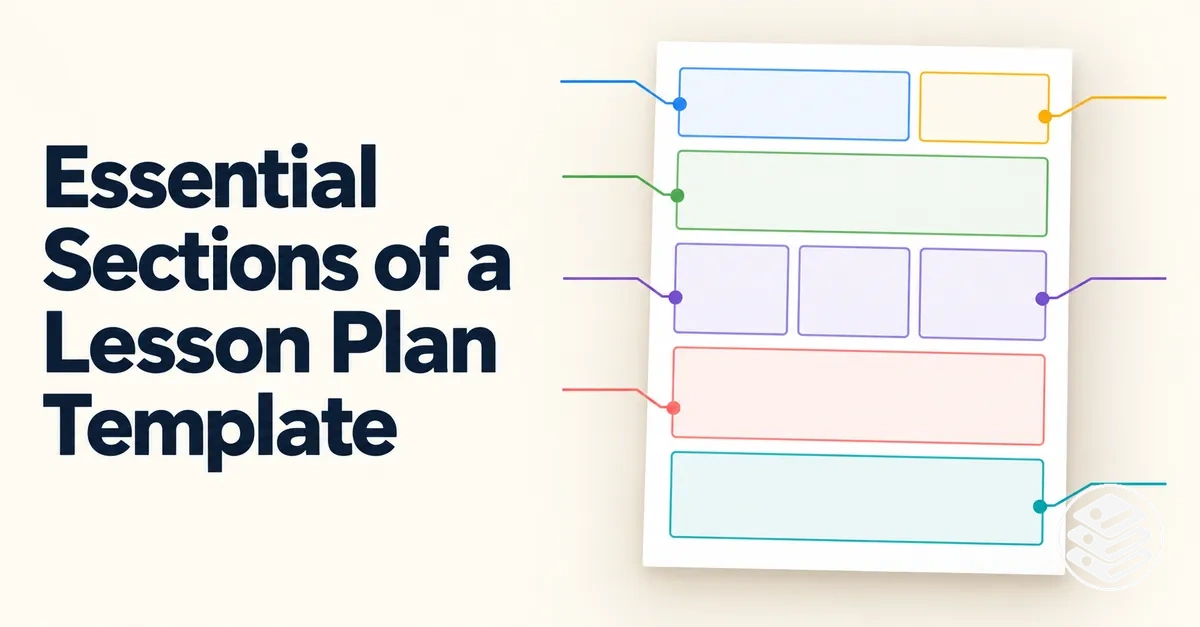
At a glance: the essential lesson-plan sections
Use this map to see what each field records and the planning decision it supports. Templates may combine or rename fields, but these functions remain distinct.
Define context and direction
- Lesson details and context
- Records the subject or topic, learner group, date and duration so the rest of the plan can be interpreted in its teaching context.
- Prior knowledge
- Records relevant knowledge, skills, experiences or misconceptions; distinguish observed evidence from teacher assumption.
- Learning objectives
- States the intended knowledge or skill and provides the reference point for aligned activities and assessment evidence.
Organise teaching and learning
- Materials and resources
- Identifies what is needed and the readiness conditions that matter, such as access, preparation, availability, quantity or compatibility.
- Teaching and learning activities
- States what the teacher or learners will do and why the action supports the learning objective.
- Differentiation and learner support
- Connects a learner need or access condition to a specific adjustment and its effect on participation or evidence of learning.
Evaluate and improve
- Assessment
- Identifies evidence of learning, when it will be collected, what would indicate progress or attainment, and whether the evidence fits the objective.
- Post-lesson reflection
- Separates observation, evidence, interpretation and a specific revision so one lesson can inform future planning without overclaiming cause.
Coherence check
Learning objective → required learner performance → activity opportunity → assessment evidence. Prior knowledge, materials and differentiation should support access to that same intended learning.
The sections below explain what each field records, what decision it supports, and how it connects to the rest of the lesson plan.
Table of Contents
Sections That Define the Lesson Context and Direction
Lesson context and direction fields establish three related kinds of information: what the lesson is about, the learner group's starting point, and the intended learning.
Prior knowledge records information relevant to the starting point, while learning objectives identify the intended learning that later activities and assessment need to address.
These functions are parallel parts of planning rather than a compulsory sequence.
Lesson context frames planning decisions by identifying the teaching situation, while prior knowledge indicates the existing knowledge, experiences, or misconceptions that may affect those decisions.
The image groups the lesson details, prior-knowledge, and learning-objectives fields to show how separate fields contribute different information to one lesson direction.

These parallel information functions can be distinguished without treating them as steps:
- Lesson context: identifies what the lesson concerns and situates it for a particular learner group and teaching context.
- Learner starting point: records relevant prior knowledge so later planning can account for what learners already know or may misunderstand.
- Intended learning: frames what learners are expected to learn, giving later activities and assessment a defined direction.
Incomplete or vague information in these fields can make later activity and assessment choices less clearly connected to the lesson's context, starting point, or intended learning.
Templates may use different labels or group these fields differently, but the underlying functions remain comparable and collectively establish direction before instructional choices are made.
Lesson Details and Context
The lesson-details field records identifying and situational information that makes a planned lesson interpretable in context.
- Subject or topic
- Identifies the lesson focus.
- Learner group
- Identifies the class, year level or learner context for which the lesson is planned.
- Date
- Places the lesson in its planned teaching period or sequence.
- Duration
- States the time available and therefore constrains the feasible scope of the lesson.
The annotated example labels these core identifying fields so their values can be interpreted together rather than as isolated entries.
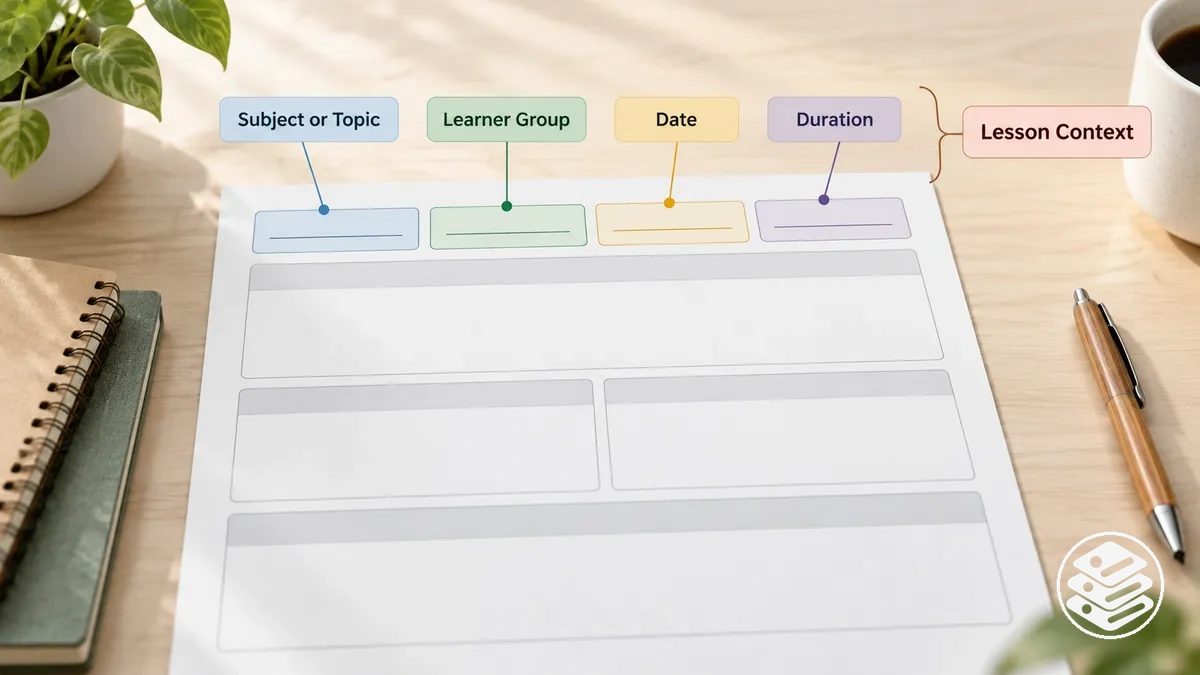
For example, an activity entry without a learner group or duration can be ambiguous because its suitability and feasible scope cannot be interpreted from those details alone.
Recording the relevant lesson details provides the context needed to interpret later planning entries.
Prior Knowledge and Starting Point
Prior knowledge records the learner's relevant starting point before the planned lesson, including existing knowledge, skills, experiences, or misconceptions connected to the new learning.
The field describes what learners appear to bring into the lesson rather than the activity used to activate or assess that knowledge.
When the starting state is inferred rather than evidenced, it should be treated as an assumption rather than a confirmed learner state.
Relevant existing knowledge can indicate where explanation may begin, while an existing skill can inform which planned activities may be suitable at the lesson entry point.
Experiences can provide background for interpreting new ideas, whereas misconceptions can indicate where clarification may be needed.
The annotated example labels these kinds of starting information and distinguishes evidence from teacher assumption so the prior-knowledge entry can be interpreted with appropriate confidence.
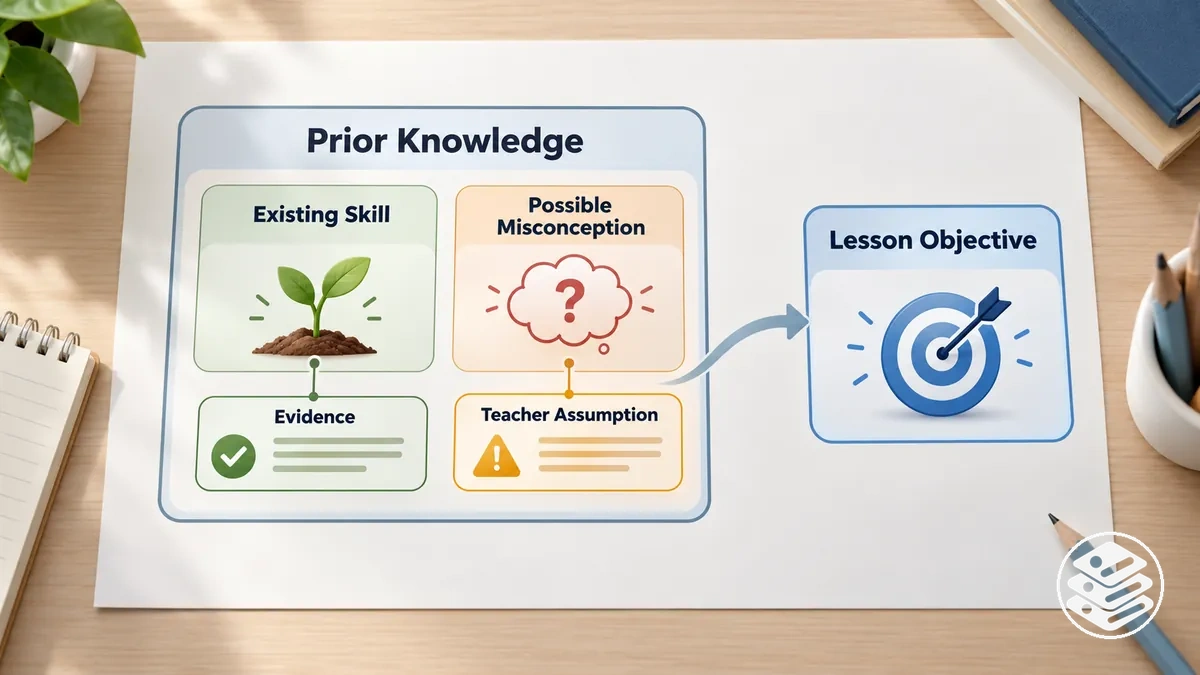
For example, work from a previous lesson may provide evidence that learners can use a relevant skill, while expecting the same skill without observed work or another check remains an assumption.
Prior knowledge records that starting information; a warm-up or assessment used to activate or check it is a separate activity.
Learning Objectives
A learning objective states the intended learning for the lesson by describing the knowledge or skill learners are expected to develop.
The objective field provides a reference point for selecting activities and assessment that support that intended learning rather than guaranteeing that learners will achieve it.
A useful learning objective describes learning that can be connected to observable evidence, with a scope appropriate to the lesson context.
The Association of American Medical Colleges distinguishes learning objectives from activity descriptions and states that objectives should describe what participants should be able to know or do as a result of a learning experience.
The annotated example shows the objective field connected to observable evidence, activities, and assessment so the intended learning remains the central reference point.
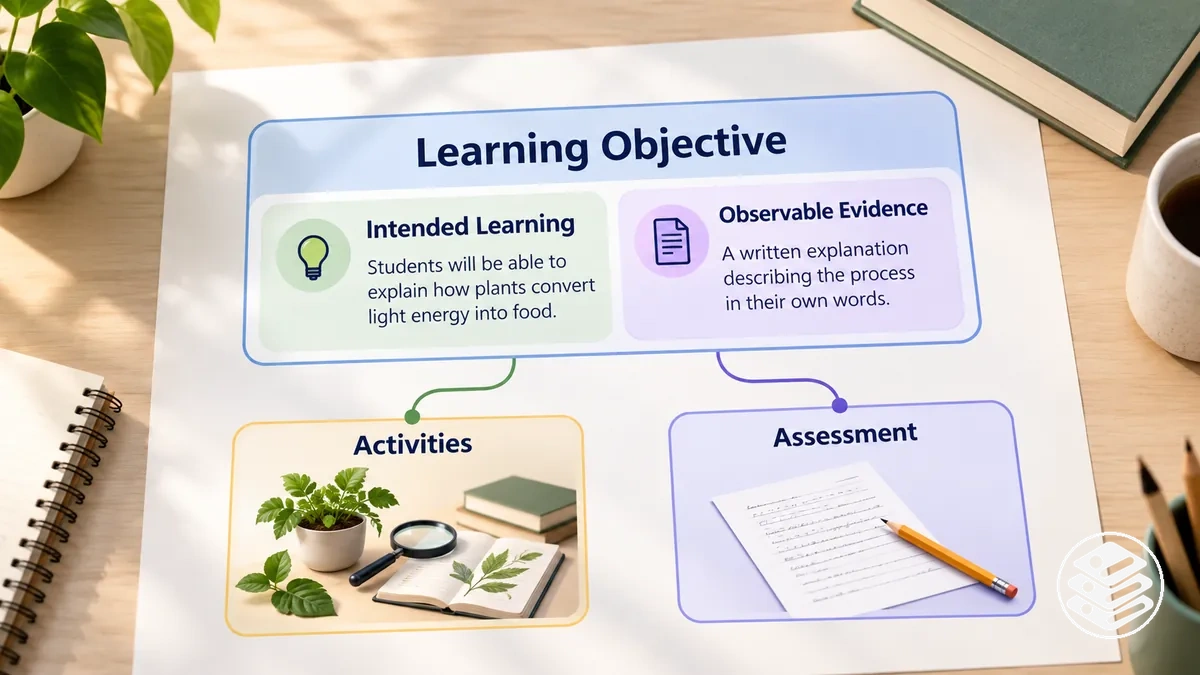
The learning objective therefore identifies the intended knowledge or skill, while observable evidence indicates what could demonstrate that learning and informs the relationship with activities and assessment.
Detailed guidance on how to write learning objectives belongs to the objective-writing process rather than the function of this field.
Sections That Organise Teaching and Learning
Teaching-and-learning organisation fields convert intended learning into the practical instructional conditions and learner experiences planned for the lesson.
Materials and resources establish what needs to be available, while teaching activities, learning activities, and learner support describe how learners can engage with the intended knowledge or skill.
These functions remain accountable to the learning objective without forming a mandatory sequence.
Materials and resources can enable or constrain execution because an activity may depend on particular equipment, texts, digital access, physical space, or prepared materials.
Their suitability depends on the learning objective, learner needs, and teaching context.
The diagram organises resources, activities, and support as parallel functions connected to the learning objective rather than as sequential steps.
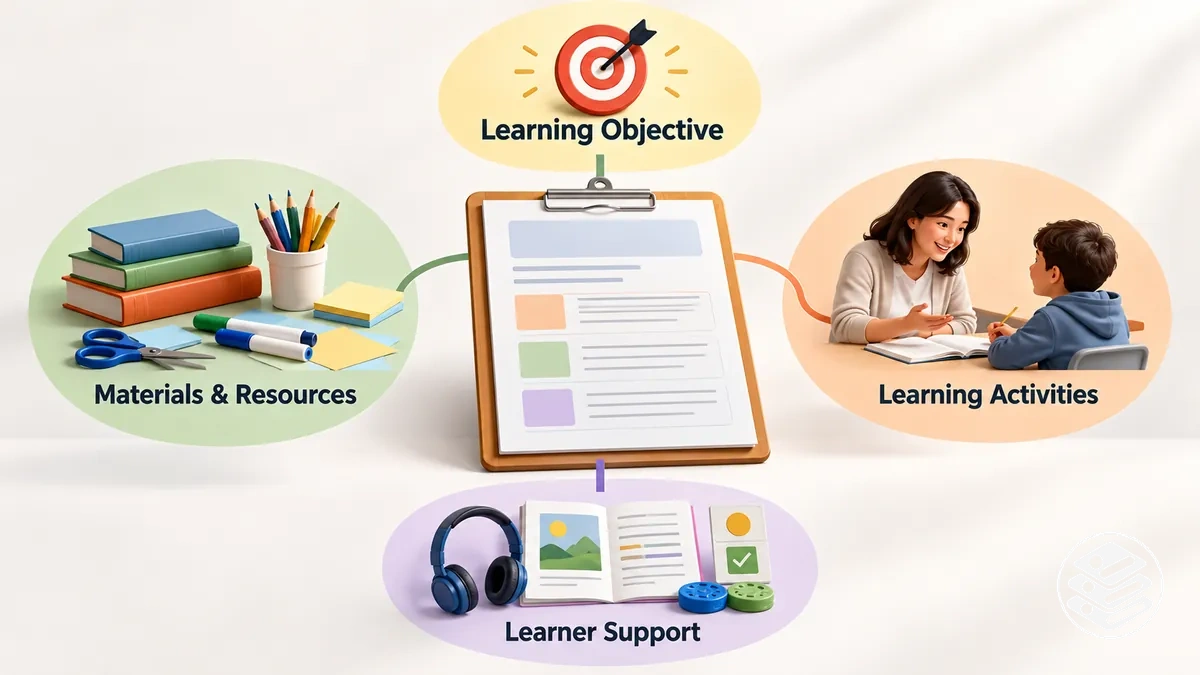
- Resources: specify the materials and resources that need to be available or prepared for the planned learning experience.
- Activities: describe teaching activities and learning activities selected to support participation in learning related to the objective.
- Learner support: records differentiation or other support considerations that provide for relevant learner needs and access to the planned activities.
Teaching activities and learning activities organise the instructional experience, while learner support and differentiation provide for relevant learner needs or access requirements.
The suitability of a particular activity or adjustment depends on the learners, context, and learning objective.
Together, these instructional choices organise execution while keeping the planned teaching and learning accountable to the intended learning.
Materials and Resources
The materials-and-resources field identifies the materials, resources, equipment, texts, digital resources, and handouts that a planned activity needs to be carried out as intended.
A useful entry records not only the resource but also any condition that affects its readiness, such as access, preparation, availability, quantity, or compatibility.
These conditions make resource entries actionable: quantity depends on how the material will be used, access determines whether learners can reach a text or digital resource, and preparation identifies what needs to be ready before the activity.
Compatibility matters when a planned activity depends on particular equipment or a digital environment.
The annotated example shows how a physical or digital resource can be recorded with an access or quantity note, a preparation condition, and the planned activity it supports.
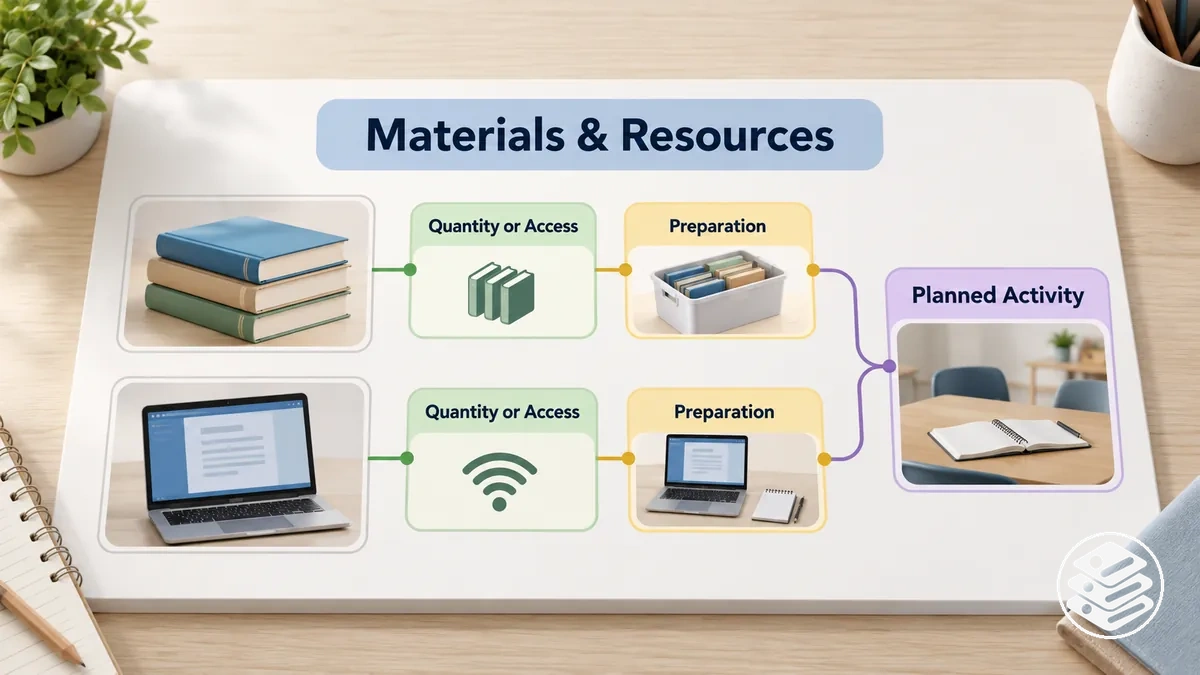
For example, naming a handout records the resource, while noting that it needs preparation and must be available to the learners using it records the conditions that make the handout usable for the planned activity.
Materials and resources are ready for execution when the relevant resource and its practical access, preparation, availability, quantity, or compatibility conditions have been identified.
Teaching and Learning Activities
The teaching-and-learning-activities field records the teaching activities and learning activities planned to support the learning objective.
- Action
- State what the teacher or learners will actually do—for example, model or clarify a task, compare examples, explain a choice, or apply a concept.
- Instructional function
- State why that action supports the learning objective rather than treating engagement as the purpose by itself.
- Evidence
- Identify what the learner response can reveal about current understanding or the next instructional need; participation alone is not evidence that the intended learning has been demonstrated.
Whether a particular activity is appropriate depends on its purpose, the learners, and the lesson context rather than on engagement alone.
For example, asking learners to compare two examples and explain the relevant difference has a defined learner action and can provide evidence related to an objective that requires distinguishing between concepts.
An unrelated activity may involve active participation but does not become instructionally aligned unless its function supports the intended learning.
Differentiation and Learner Support
The differentiation-and-learner-support field records a planned adjustment when a learner need or condition affects access to the intended learning, participation in the task, or an appropriate way to demonstrate learning.
The adjustment should respond to the identified need while keeping the learning objective visible unless the plan genuinely requires a different outcome.
Condition
Identify the learner need, task demand, learning environment or access condition that affects participation or evidence of learning.
Adjustment
Choose a specific change to access, process support, task demand or response mode that addresses that condition.
Implication
State how the adjustment supports participation or valid evidence while keeping the learning objective visible where the intended outcome remains the same.
For example, when a learner can demonstrate the intended knowledge but a particular response mode creates an access barrier, the plan may provide another suitable response mode while retaining the same learning objective.
In that case, the recorded differentiation identifies the condition, the planned support provision, and its implication for access to the task or evidence of learning.
Sections That Evaluate Learning and the Lesson
Assessment and reflection fields evaluate different objects within a lesson plan.
Assessment records evidence of learning related to the learning objective and can indicate learner progress or attainment, while reflection evaluates observations about lesson effectiveness and teaching choices.
The two fields therefore support different interpretations rather than serving the same purpose.
The distinction is clearest when each field is considered by what it evaluates, when its information is typically recorded, and the decision that information can support.
| Field | What It Evaluates | Typical Timing | Decision It Supports |
|---|---|---|---|
| Assessment | Evidence of learning in relation to the learning objective, including evidence relevant to learner progress or attainment | During or after relevant learning activities | Interpret what learners currently demonstrate and identify whether further learning or checking may be needed |
| Post-Lesson Reflection | Observations about lesson effectiveness and teaching choices | After the lesson | Inform revision of future planning or teaching choices |
Assessment closes the learner-evidence loop by connecting evidence of learning to decisions about learner progress, whereas reflection closes a lesson-planning loop by using teacher observation to inform revision.
Reflection does not replace assessment evidence, and assessment does not by itself establish whether a teaching choice was effective.
Assessment and Evidence of Learning
The assessment field identifies the evidence of learning used to judge progress toward or attainment of the learning objective.
Assessment evidence should relate to the knowledge or skill being assessed, because participation in an activity alone does not necessarily indicate that the intended learning has been demonstrated.
A meaningful assessment entry makes the evidence source, timing, success indication, and fit with the learning objective explicit.
These criteria describe what information will be collected and how it can support an interpretation of progress or a next instructional need; they are not a sequence of assessment steps.
- Evidence source: identifies the learner response, product, performance, or other observable evidence from which the assessed knowledge or skill can be interpreted.
- Timing: identifies when the evidence will be collected in relation to the relevant learning, so its interpretation has a clear instructional context.
- Success indication: states what features of the evidence would indicate progress toward or attainment of the stated objective without treating limited evidence as definitive proof.
- Fit with objective: checks that the evidence actually represents the knowledge or skill named in the learning objective rather than participation in an activity alone.
Together, these details make assessment information usable for interpreting learner progress and deciding whether further instruction, practice, or evidence may be needed.
Detailed decisions about how to include assessment information belong to the assessment-planning process.
Post-Lesson Reflection
Post-lesson reflection records evidence-informed observations about what occurred during the lesson, including learner response, activity effectiveness, pacing, and resources that affected delivery.
The reflection field separates what was observed from the interpretation of why it occurred, so a single lesson event can inform future planning without being treated as a general teaching rule.
Observation
Record what happened during the lesson, such as learner response, pacing, activity effectiveness or a resource issue.
Evidence
Connect the observation to learner work, completion patterns or another relevant source rather than relying on impression alone.
Interpretation
State what the evidence may suggest while keeping the explanation qualified when the cause is not established.
Revision
Identify a specific change to pacing, resources or a teaching choice that can be tested in future planning.
A planned adjustment should respond to the recorded lesson evidence rather than to an unsupported assumption about why the lesson unfolded as it did.
Alignment Between Learning Objectives, Activities, and Assessment
Alignment means that the learning objective, teaching and learning activities, and assessment evidence describe the same intended learning from different functional angles.
The learning objective identifies the intended learning, the activities provide an opportunity for the required learner performance, and the assessment elicits evidence related to that performance.
Coherence is stronger when these relations remain consistent rather than asking learners to practise or demonstrate something materially different from the objective.
The alignment chain begins by identifying the learner performance required by the learning objective and checking whether the planned activity provides a genuine opportunity to perform it.
If the objective requires learners to compare concepts, for example, an aligned activity gives learners an opportunity to make and explain comparisons rather than only recall definitions.
Prior knowledge, materials, and differentiation should support access to that opportunity without contradicting the intended performance.
Assessment evidence then needs to represent the learner performance that the activity was intended to develop or elicit.
Evidence aligned with the objective supports an interpretation of progress or attainment, while evidence of a different performance creates a mismatch and weakens that interpretation.
The table maps one learning intention across the objective, required performance, activity opportunity, assessment evidence, and resulting alignment implication.
| Learning Objective | Required Learner Performance | Activity Opportunity | Assessment Evidence | Alignment Implication |
|---|---|---|---|---|
| Compare two concepts using relevant differences | Identify and explain meaningful differences | Compare examples and explain the distinctions | Learner comparison showing identified differences and explanation | The activity and evidence address the performance required by the objective |
| Compare two concepts using relevant differences | Identify and explain meaningful differences | Memorise definitions without making comparisons | Recall of definitions only | The activity and evidence do not adequately represent the required comparison performance |
Alignment therefore provides a coherence test across intended learning, learner performance, activity opportunity, and assessment evidence; it does not guarantee that learning will occur.
Checking materials, prior knowledge, differentiation, timing, and other practical conditions before teaching belongs to the separate readiness-checking context.