
Adapting Lesson Plan Templates for Mixed-Ability Learners
Adapt a mixed-ability lesson plan by keeping a shared learning goal where it remains appropriate, then vary support, challenge, grouping or response conditions only where current evidence shows a task-specific learner need. Tie each adjustment to the lesson stage where it is needed and record the condition, action, expected evidence and review cue so the adaptation can be maintained, reduced, deepened or changed.
Plan the smallest useful mixed-ability adaptation
Use current learner evidence to decide what needs to change, where it needs to change, and how you will know whether the change helped. Do not adapt a lesson simply because learners have different labels or profiles.
- Read the evidence. Identify what the learner can access and complete now, where support is required, or where current performance indicates readiness for greater challenge.
- Locate the lesson stage and task demand. Pinpoint whether the relevant demand is language, response mode, independence, complexity, participation or another feature of the current task.
- Choose the smallest relevant change. Use a targeted scaffold for an access barrier, deeper demand for demonstrated readiness, or flexible grouping when the arrangement itself serves a clear support or participation function.
- Protect the learning purpose. Keep the shared learning goal where it remains appropriate and check that each variation can still produce interpretable evidence of the intended learning.
- Record and review. Note the condition, teacher or peer action, expected evidence and review cue; then retain, reduce, deepen or change the adaptation according to the observed response.
- Access barrier
- Targeted support: modelling, a worked example, prompt, vocabulary support, guided practice, visual cue or another scaffold matched to the barrier.
- Readiness for deeper demand
- Meaningful extension: increase reasoning, complexity, independence, transfer or justification rather than simply adding more work.
- Participation or support arrangement
- Flexible grouping: use pairs, groups, individual work or whole-class work only when the arrangement has a clear task function.
- No demonstrated task-specific need
- Keep the planned task: do not add an adjustment by default; continue using checks for learning to see whether a need emerges.
Record in the template: planning field → learner condition → adaptation/action → expected evidence → review cue.
Readiness may reflect relevant prior knowledge, while access and support may respond to language, independence or other barriers within a particular lesson stage. A learner might need vocabulary support during modelling but work independently during practice, while another learner is ready for a deeper application of the same goal; checks for learning provide the evidence for deciding what changes next.
Table of Contents
Identify Learner Readiness and Support Needs for This Lesson
Identify only learner differences that current evidence shows are relevant to the task being planned, because learner readiness can change by task and lesson stage.
Start with what learners already know, what they can currently access and complete independently, and where prompts or other support appear necessary.
Classroom evidence and assessment evidence should inform a planning response only when they indicate a current access, support or challenge need.
Treat incomplete evidence as a planning signal rather than as a fixed learner classification.

The criteria below connect observable evidence with the learner condition that matters for this lesson and its likely planning implication.
Focus on evidence that can change access, support or challenge; assumptions or permanent labels do not establish a lesson-specific need.
- Prior knowledge: recent work, questioning or assessment evidence that shows relevant knowledge is present or missing can indicate whether the planned task is accessible as written or needs preparation or support.
- Task independence: evidence that a learner completes comparable tasks independently, or relies on prompts to begin or continue, suggests whether the lesson plan should preserve independence or provide targeted support.
- Language demand: if the task requires vocabulary, instructions or classroom language that current evidence suggests may restrict access, the planning implication is to support that language demand without changing unrelated parts of the lesson.
- Literacy demand: when reading, writing or comprehension demands create a barrier to demonstrating the intended learning, the lesson plan should address that specific access need rather than infer a broader ability level.
- Pace: observed pace matters when the time required to process instructions or complete the current type of task affects participation; the relevant response is an adjustment to that lesson condition, not a permanent pace label.
- Recent classroom or assessment evidence: patterns in recent responses, work samples or observations can suggest a current support need or readiness for greater challenge when the evidence relates directly to the learning being planned.
For example, a learner may need vocabulary support while accessing teacher modelling but then complete the practice task independently and show readiness for a more demanding application later in the lesson.
The support need therefore applies to the stage where the language demand affects access, while the later evidence can justify greater challenge at a different stage.
Planning should respond to those demonstrated conditions rather than assume that the learner requires the same adjustment throughout the lesson.
This filters learner variation into the needs that actually require a change to the lesson plan.
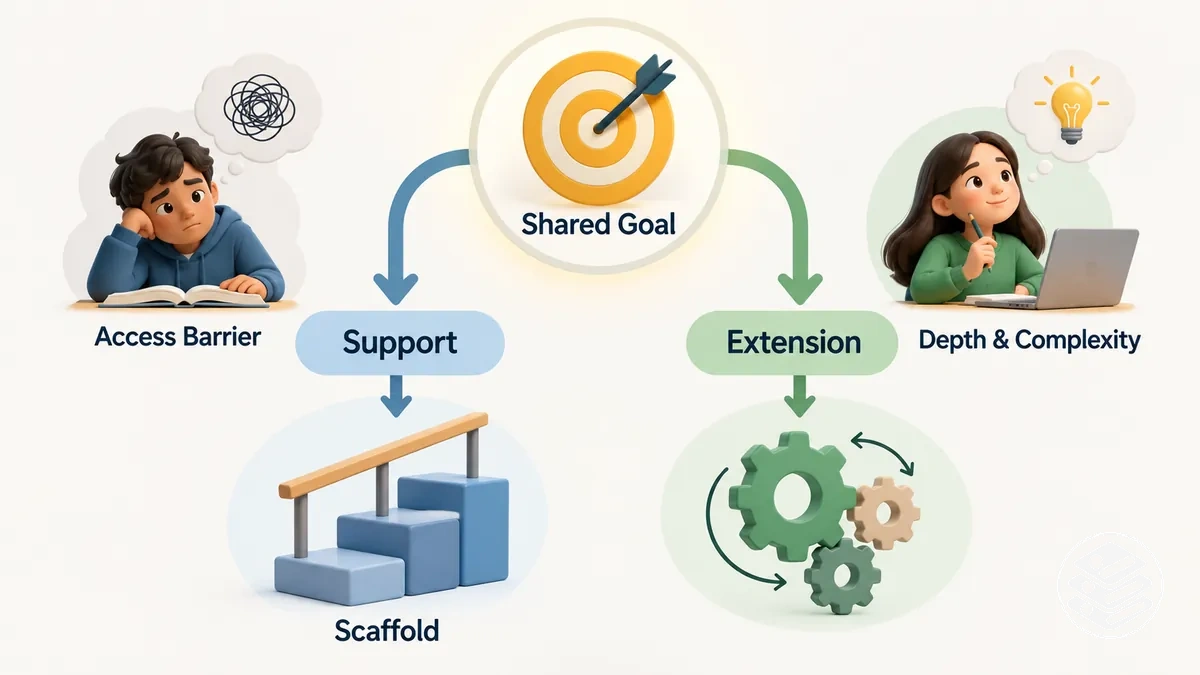
Distinguish Support Needs from Extension Needs
A support need indicates an access barrier to the intended learning and calls for a scaffold that preserves the core task demand.
An extension need indicates readiness for greater depth, complexity, independence or transfer while preserving the same shared learning goal.
Evidence from the current task should determine whether either adjustment is warranted rather than assigning learners to fixed categories.
| Need type | Evidence or condition | Appropriate adjustment | Risk if misapplied |
|---|---|---|---|
| Support | An access barrier prevents the learner from participating in or demonstrating the intended learning under the current task conditions. | Use a targeted scaffold that addresses the barrier while preserving the shared learning goal and its core demand. | Lowering the intended learning rather than addressing the access barrier can change what the learner is expected to learn. |
| Extension | Current evidence indicates readiness to work with greater depth, complexity, independence or transfer within the intended learning. | Deepen the task demand through richer reasoning, application, transfer or independence rather than simply increasing the amount of work. | Adding volume without deeper demand can increase workload without providing meaningful extension. |
For the same shared learning goal, a learner who understands the concept but cannot yet access key task language may need a vocabulary scaffold, while a learner who can already apply the concept independently may be ready to transfer it to a less familiar context.
The first adjustment addresses an access barrier; the second deepens the demand without substituting a separate learning goal.
The planning decision is therefore based on the demonstrated condition in the current task and the purpose the adjustment must serve.
Match Learner Differences to Specific Lesson Stages
Attach each adjustment to the lesson stage where the relevant learner need creates a barrier or challenge, rather than adapting the whole lesson by default.
Entry, modelling, guided practice, independent work and review require an adjustment only when the task demand at that stage creates a specific need.
The sequence below connects the adaptation point to the smallest useful response while keeping the shared lesson purpose intact.
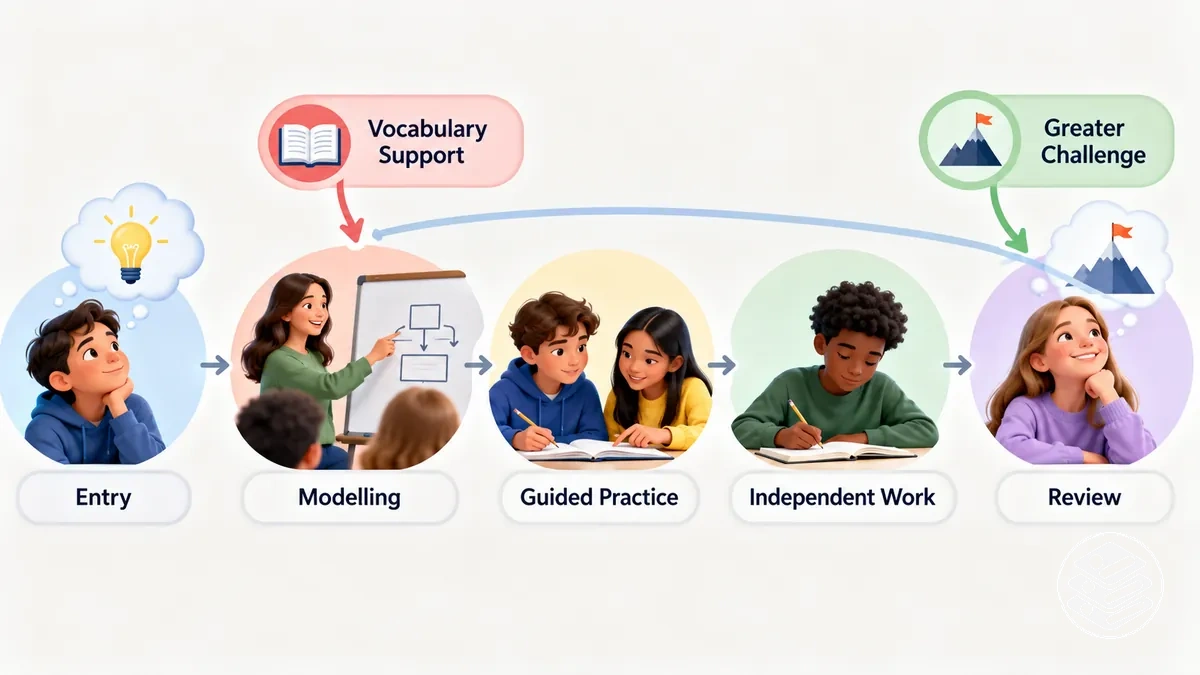
- Locate the lesson stage: identify where the learner need affects participation or the expected evidence, using only stages that exist in the lesson.
- Identify the barrier or challenge: determine which task demand at that stage creates an access barrier or indicates readiness for greater challenge.
- Select the adjustment: choose the smallest useful support or extension that responds to that local need without applying the adjustment to unrelated stages.
- Verify the shared purpose: check that the adjustment still enables participation in, or appropriate challenge within, the intended learning before moving on.
For example, a learner may need vocabulary support during modelling when unfamiliar language creates an access barrier, yet complete independent work without that support once the task language is understood.
A challenge may likewise emerge only at a later stage if the learner is ready to work with greater independence or apply the learning in a less familiar context.
The adjustment therefore belongs at the stage where evidence indicates the need, not automatically at entry, guided practice, independent work and review.
This keeps stage-specific lesson adaptation selective rather than turning an identified learner need into a fixed pathway through the lesson.
Adapt Activities Within One Shared Lesson
Adapt one planned activity by changing access, support or challenge where the task demand creates a relevant learner need, while keeping a shared learning goal where that goal remains appropriate.
A prompt, additional modelling or a different response mode can change access, while complexity or independence can provide greater challenge.
These task variations can remain part of one coherent lesson when each adjustment is tied to the intended learning rather than creating a separate task purpose.
Use the following sequence to connect the activity, learner condition and adjustment to the expected evidence.
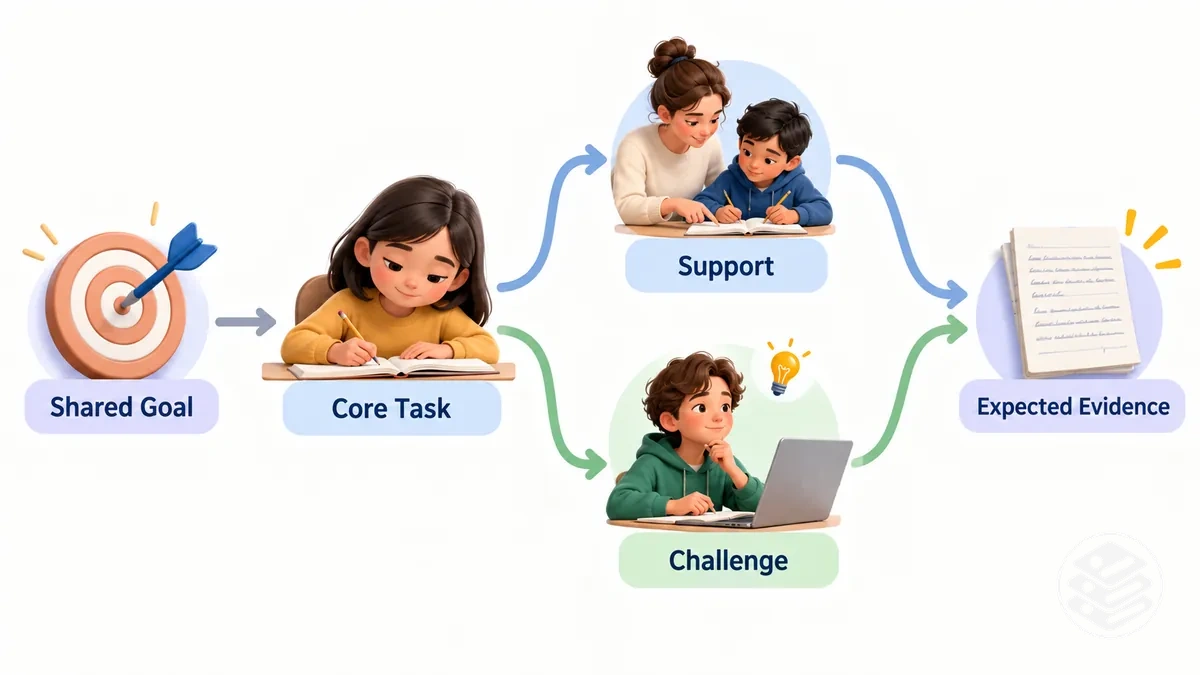
- Define the shared learning goal: state the intended learning that the activity is meant to develop or demonstrate, and identify where that goal can appropriately remain common across task variations.
- Identify the task demand: locate the feature that affects participation or challenge, such as language, required independence, response mode or complexity.
- Adjust access, support or challenge: select a change that responds to the learner condition, such as a prompt or modelling for access and support, or greater complexity or independence for challenge.
- Choose grouping when relevant: use individual, paired or group participation only when the grouping arrangement helps deliver the required adjustment without changing the task purpose.
- Check the expected evidence: verify that each task variation can still produce interpretable evidence of the intended learning, rather than showing only that the learner completed a different version of the activity.
The task demand determines which feature of an activity may need to change, while the expected evidence determines whether the resulting variation still serves the intended learning.
For example, changing the response mode may improve access when the original mode creates a barrier, whereas increasing complexity may be appropriate when current evidence supports greater challenge; neither change is necessary when the task already fits the learner condition.
When documenting these decisions, adapt planned learning activities within the broader lesson-plan format after identifying the task-level adjustment.
This keeps the implementation record connected to the activity without expanding this section into objective writing, curriculum alignment or assessment design.
For example, a shared activity might ask learners to explain how evidence supports a conclusion.
A supported pathway could provide a prompt or brief modelling when the response process creates an access barrier, while an extended pathway could require greater independence or application of the same reasoning in a less familiar context.
The pathways differ in support or challenge, but the teacher still checks whether the resulting responses provide expected evidence of the intended learning.
If a variation no longer produces interpretable evidence for that purpose, the activity adjustment needs to be reconsidered.
Add Scaffolding Where Learners Need More Access Support
A scaffold is temporary instructional support selected to help a learner access a task that they cannot yet complete independently.
It addresses a specific access barrier through support such as modelling, a worked example, a prompt, vocabulary support, guided practice or a visual cue.
The scaffold can be reduced when learner performance shows that the same level of support is no longer needed.
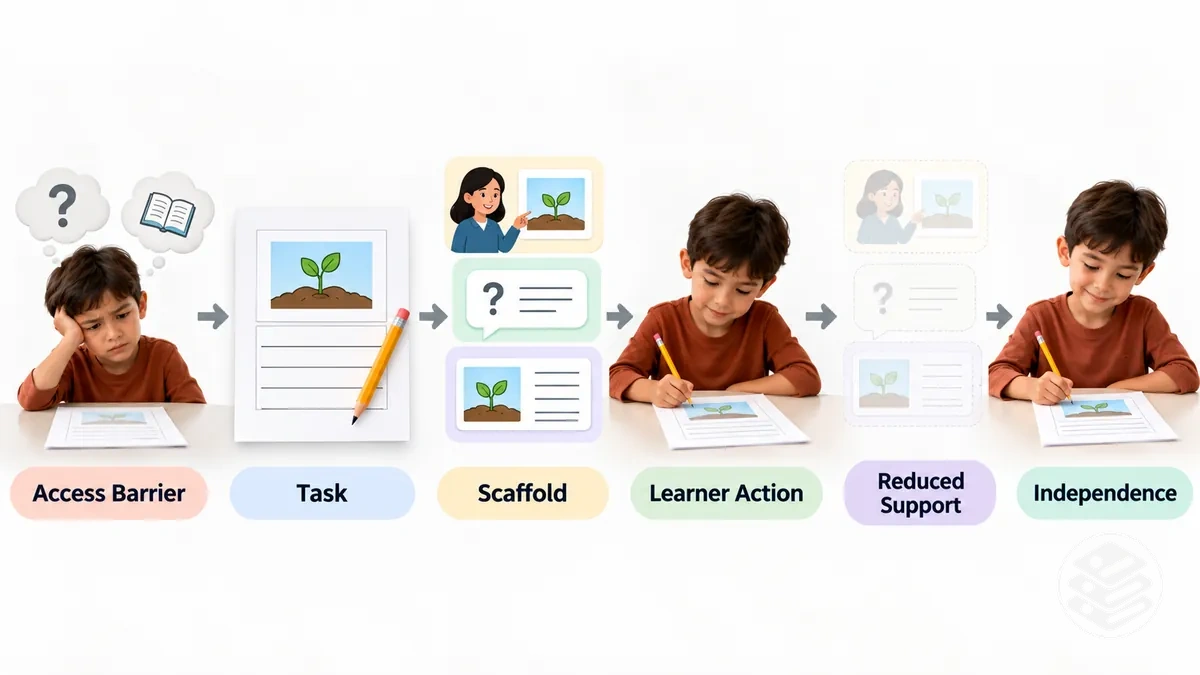
Match the scaffold to the barrier that affects participation in the current task, then observe what the learner can do with that support and with less support.
The relevant check is observable learner action: whether the learner can perform more of the task independently while still engaging with the intended learning.
Reduction does not follow a fixed timetable; it depends on evidence that less guidance is appropriate.
If the learning objective itself needs to change, treat that as a separate planning decision rather than assuming scaffolding requires a lower learning demand.
- Modelling: use a demonstration when the access barrier is uncertainty about how to perform a process or apply a procedure, then check whether the learner can perform the relevant action with less demonstration.
- Worked example: provide a completed or partially completed example when the learner needs a concrete representation of how the task is structured, then check whether the learner can apply that structure more independently.
- Prompt: use a targeted cue when the learner can continue the task with guidance at a specific point, then reduce the prompt when the learner begins that action without the same cue.
- Vocabulary support: provide relevant words or meanings when language demand creates an access barrier to the task, then check whether the learner can use or interpret the necessary vocabulary with less support.
- Guided practice: provide supported opportunities to perform the task when the learner needs guidance while applying the process, then check performance as that guidance is reduced.
- Visual cue: use a diagram, sequence cue or other relevant visual representation when it helps the learner access task information or order, then check whether the same cue remains necessary for independent performance.
For example, before scaffolding, a learner may understand the intended concept but be unable to begin an explanation because the task's language demand creates an access barrier.
A vocabulary support and brief prompt can provide access to the same explanation task; if later responses show that the learner can begin and develop the explanation without the prompt, that support can be reduced while the intended learning remains the same where appropriate.
Keep a Shared Learning Goal While Varying Task Challenge
Task challenge can vary while learners work towards a shared learning goal when that goal is genuinely appropriate for them.
Start with a baseline success criterion that identifies what evidence would demonstrate the intended learning, then vary the demand rather than simply increasing the quantity of work.
The relevant challenge variable may be reasoning, complexity, independence or transfer, depending on what creates a meaningful deeper demand for the task.
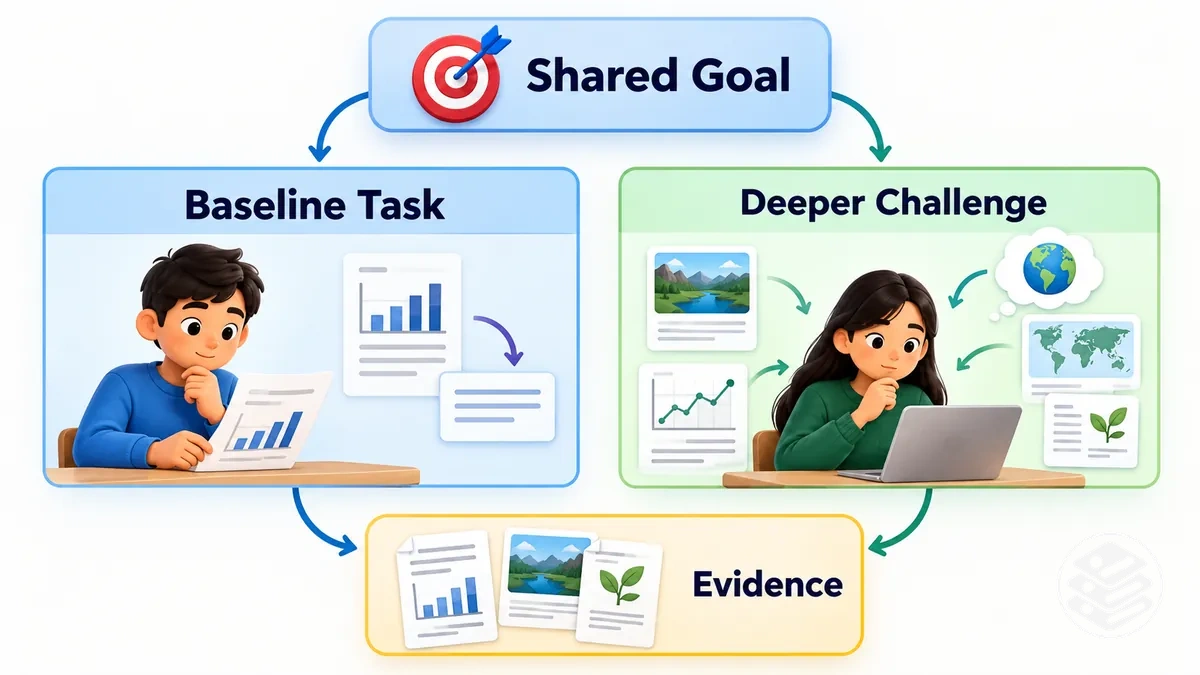
For example, a baseline task might ask learners to use given evidence to justify a conclusion, while a deeper version asks learners to select relevant evidence independently and transfer the same reasoning to an unfamiliar context.
The shared learning goal and baseline success criterion remain connected to both versions, but the second task increases independence and transfer rather than adding more questions.
Evidence of deeper learning would therefore come from how the learner handles the extended demand, such as selecting evidence and applying the reasoning in the new context, rather than from completing a greater volume of work.
A shared objective remains appropriate only when it continues to represent the intended learning for the learners concerned; if the objective itself needs to change, that becomes a separate planning decision.
In that case, adjust learning objectives as a distinct planning task rather than treating the change as another form of task challenge.
Use Flexible Grouping to Match the Task and Support Need
Flexible grouping is a task-specific method for arranging learners according to the task purpose and current learner need rather than assigning a permanent ranking.
The grouping choice can change between pairs, mixed-readiness groups, similar-need groups, individual work and whole-class work as the activity changes.
Each arrangement should have a clear support or participation function connected to the current task.
- Pairs: may fit when the task purpose requires focused peer interaction, rehearsal or reciprocal support and both learners have a meaningful role in producing evidence of learning.
- Mixed-readiness groups: may fit when different perspectives or forms of peer interaction support the activity and the grouping allows each learner to participate in the intended learning rather than assigning a fixed status.
- Similar-need groups: may fit when several learners need the same targeted explanation, modelling or support for a specific task demand; the grouping remains provisional and can change when that need changes.
- Individual work: may fit when the task requires independent performance or when the teacher needs evidence of what a learner can do without peer support.
- Whole-class work: may fit when learners need a common explanation, model, discussion or shared task launch before other grouping arrangements become useful.
Choose the grouping arrangement by connecting the task purpose and observed learner need to the teacher or peer support role, then consider what evidence of learning the arrangement is expected to make possible; participation alone does not establish that the grouping supported learning.
For example, a lesson might begin with whole-class modelling, move to similar-need groups for targeted support during guided work, and then use individual work when the task changes to demonstrating independent performance.
Regrouping therefore follows changes in the task and learner need rather than turning one temporary grouping choice into a fixed pathway.
Record Mixed-Ability Adaptations in the Lesson Plan Template
- Planning field
- Use the existing activity, grouping, check-for-learning or other lesson-plan field that is closest to the action.
- Learner condition
- State the observable task-specific barrier, challenge or participation need that triggers the decision, rather than a fixed ability label.
- Adaptation
- Name the targeted support, extension or grouping decision clearly enough to distinguish it from a vague instruction to “provide support”.
- Implementation cue
- Record what the teacher or peer should do when the condition occurs.
- Evidence and review cue
- State what learner response to observe and what evidence would justify maintaining, reducing, deepening or changing the adaptation.
Keep the note concise, avoid unnecessary sensitive learner information, and record it once in the most relevant existing field rather than duplicating the same differentiation note across the template.
If a required format provides limited or inflexible fields, record the smallest actionable note that fits the relevant field without redesigning the template; changing the format itself is a separate task when you need to adjust a rigid lesson planning format.
For example: Activity — vocabulary support when unfamiliar task language restricts access; teacher previews the key terms before independent work and observes whether the learner can begin and explain the task without the same prompt.
This worked note connects the planning field, learner need, support, teacher action and evidence to observe without turning the lesson plan into a full learner profile or separate support plan.
Document Support, Extension and Grouping Decisions
An adaptation decision note should preserve the learner need, the reason for the decision, the condition that triggers it, the implementation cue and the review cue needed during teaching.
Record whether the decision concerns support, extension or a grouping decision, and connect it to the task condition that makes the adjustment relevant.
Keep each cue concise enough to identify what to apply and what learner response should prompt a review, fade or change.
- Learner need and reason: specify the task-related barrier or challenge that explains why support, extension or a grouping decision is being recorded, without using a fixed learner label as the reason.
- Planned adaptation: record the support, extension or grouping decision clearly enough to distinguish the intended adjustment from a general instruction to provide help.
- Condition: state the trigger or task condition under which the adaptation should be applied, so the decision is connected to an observable teaching situation.
- Implementation cue: specify the teacher or peer action required when the condition occurs, such as providing a prompt, increasing task independence or changing the grouping arrangement.
- Review cue: note the learner response or evidence that should prompt the teacher to review, fade, maintain or change the adaptation rather than treating it as permanent.
For example, “provide support as needed” is too vague because it does not identify the learner need, trigger or teacher action.
A more actionable note is: “When unfamiliar task vocabulary prevents the learner from starting independently, provide the key vocabulary prompt; review the support when the learner can begin and explain the task without the same prompt.” The second note connects the reason and condition to an implementation cue and review cue without using a fixed learner label.
Record only the detail needed to apply the decision during teaching rather than unnecessary personal history or sensitive information.
Record How Checks for Learning Will Vary by Learner Need
A check for learning may vary in access or response support according to learner need while still eliciting expected evidence relevant to the shared learning goal.
A prompt, response mode, support level or timing adjustment should therefore be recorded together with the condition that makes it necessary.
If an adjustment changes the learning demand or what the check actually elicits, record that limitation rather than assuming the evidence remains directly interpretable against the same goal.
For each variation, connect the learner condition to the changed check, the expected evidence and the possible instructional response.
Distinguish an access change that helps a learner demonstrate the intended learning from a change that alters the construct or demand being checked.
The criteria below keep that distinction explicit so the resulting learning evidence can inform an appropriate next step.
- Prompt: record the learner condition that triggers a prompt, what the prompt supports and what expected evidence should still come from the learner; if the prompt supplies part of the knowledge or reasoning being checked, note that limitation when interpreting the response.
- Response mode: change the response mode when the original mode creates an access barrier that is separate from the intended learning; record what evidence the alternative mode should elicit and whether changing the mode also changes what is being checked.
- Support level: specify the amount or type of response support used under the relevant learner condition and identify which part of the expected evidence should remain independently observable; the instructional response can then reflect what the learner demonstrated with that support.
- Timing: vary timing when a timing condition affects access to the check, provided timing is not itself part of the intended learning demand; record the expected evidence and any limitation created when timing is part of what the check is intended to assess.
- Instructional response: note the next adjustment that the observed evidence may inform, such as maintaining, reducing or changing support or providing greater challenge, without treating one check for learning as proof of mastery.
For example, learners working towards the same learning intention might explain their reasoning independently, while a learner whose access is restricted by the response process receives a brief prompt or appropriate response support; the note should identify the support used and the reasoning the learner is still expected to demonstrate.
If the prompt supplies reasoning that the check was intended to elicit independently, the resulting evidence should be recorded as supported rather than treated as equivalent independent evidence.
Broader decisions about how to plan assessment for different learner needs belong to assessment planning rather than this lesson-level documentation.
Here, record only the check condition, expected evidence and instructional response needed for this lesson.
Review Which Adaptations Worked for Different Learners
An adaptation review should evaluate a planned adaptation against the observed response and evidence of learning, including whether it supported access, participation, independence or an appropriate challenge level.
Task completion or apparent engagement alone does not establish that the adaptation supported the intended learning.
Use the review evidence to interpret what the learner demonstrated and whether the adaptation may need to be retained, reduced, replaced or investigated further.
- Access: check whether the planned adaptation enabled the learner to access the relevant task demand and whether the observed response provides evidence that the identified barrier was addressed.
- Participation: check whether the learner participated in the intended learning activity, while distinguishing participation from evidence of learning rather than treating engagement alone as an outcome.
- Evidence of learning: identify what the learner's response indicates about the intended learning and whether the evidence is sufficiently clear to support an interpretation; mixed or limited evidence may warrant further observation.
- Independence: check whether the learner completed relevant parts of the task with less, similar or greater support dependence than anticipated, and use that evidence when considering whether support should change.
- Challenge level: check whether the learner's response indicates that the task provided an appropriate opportunity for depth, complexity, independence or transfer, rather than inferring challenge from task completion alone.
- Grouping effectiveness: check whether the grouping arrangement supported the intended participation or learning function and whether the resulting evidence justifies retaining or changing that arrangement.
Interpret the checklist by connecting the planned adaptation to the observed response, then to the evidence of learning and the next adjustment.
A single observation may suggest that an adaptation should change, but the conclusion should remain conditional on the quality and consistency of the available evidence.
Retain an adaptation when the evidence supports its continued purpose, reduce or replace it when learner response indicates a different level or type of adjustment may be appropriate, and investigate further when the evidence is mixed or insufficient.
For example, a learner may use a planned prompt, participate in the task and produce evidence of the intended learning with less prompting as the lesson progresses.
That pattern may support reducing the prompt next time while continuing to observe whether independence is maintained; if the evidence instead remains dependent on the same prompt, retaining or changing the support may be more appropriate.
If the learner completes the task but the response does not provide clear evidence of the intended learning, completion alone does not justify retaining the adaptation as effective.
The next adjustment should therefore follow the strongest interpretation supported by the observed evidence rather than a single sign of participation or completion.
Check Whether Scaffolds Can Be Reduced as Learners Gain Independence
Reduce a scaffold when the learner maintains access and sufficiently accurate learner performance with reduced support, then observe the effect before reducing further.
Increased independence with a lighter prompt, model or vocabulary aid can suggest that the current level of guidance is no longer necessary for that part of the task.
The reduction condition should therefore be based on observed performance rather than the amount of time the scaffold has been in place.
If access and sufficiently accurate performance are maintained with less support
Reduce one support element and observe the learner again before fading further.
If access or performance deteriorates after support is reduced
Restore or adjust the support instead of continuing to fade it simply because time has passed.
Example: if a learner uses both a model and a vocabulary aid, keep the vocabulary aid while withdrawing part of the model. Reduce support further only when the intended task remains accessible and the relevant performance remains sufficiently accurate with greater independence.
Check That Extensions Add Depth Rather Than Extra Workload
A useful extension increases depth by changing the cognitive or conceptual demand rather than simply increasing workload through extra items or repetition.
The changed demand may involve greater reasoning, complexity, transfer, independence or justification when that dimension fits the intended learning.
The extension should still produce evidence of deeper thinking that remains connected to the shared learning goal.
- Reasoning: check whether the extension requires the learner to develop, connect or evaluate reasoning rather than repeat the same reasoning across more items.
- Complexity: check whether the task demand introduces relevant relationships, constraints or information that require more complex thinking without disconnecting the task from the shared learning goal.
- Transfer: check whether the learner must apply the intended learning in an unfamiliar context or situation rather than complete additional versions of a familiar task.
- Independence: check whether the extension requires the learner to make relevant decisions, select an approach or apply the learning with less guidance when greater independence is an appropriate source of challenge.
- Justification: check whether the learner must explain or defend a conclusion using relevant evidence or reasoning, so the resulting response can show deeper thinking rather than greater quantity alone.
For example, asking a learner to complete more questions that use the same familiar reasoning increases workload but may leave the underlying demand unchanged.
A deeper extension could instead ask the learner to apply the same concept in an unfamiliar context, select an approach independently and justify the conclusion, creating evidence of transfer, independence and reasoning without relying on extra volume.
The appropriate dimension depends on the lesson purpose, so the extension remains a meaningful deeper challenge only when its changed demand still fits the shared learning goal.
Check Whether Grouping Supported Participation and Learning
A grouping arrangement is useful only when it serves the intended task purpose and supports meaningful participation, contribution and learning evidence for the learners involved.
Judge the grouping against the participation and collaboration it was intended to enable, rather than interpreting quietness or orderliness as evidence that it worked.
Observed contributions and learner responses should show whether the group functioning supported the intended learning conditions.
- Not enough evidence
- The group finishes the task, appears orderly, or one learner produces most of the reasoning while others depend on that learner.
- Stronger evidence
- Learners make meaningful contributions and their responses provide evidence connected to the intended learning and the purpose of the grouping.
- Planning decision
- Keep the arrangement when it serves its task purpose; change or regroup when dependency or uneven participation limits contribution or learning evidence.
Mixed-Ability Lesson Plan Adaptation Example
In this mixed-ability lesson-plan example, the shared learning goal is for learners to explain a conclusion using relevant evidence.
Learner variation matters where some learners need support to access task language, while others are ready for greater reasoning, transfer or independence within the same goal.
The lesson therefore adapts selected stages according to learner need while keeping the expected evidence connected to the common lesson purpose.
| Lesson stage or task | Learner need or condition | Support or extension | Grouping or check | Review note |
|---|---|---|---|---|
| Teacher modelling | Unfamiliar task language restricts access to the explanation. | Support with key vocabulary and a model of how evidence can be connected to a conclusion. | Whole-class modelling followed by a check for learning that asks learners to identify the evidence they would use. | Observe whether the learner can identify relevant evidence with less language support before reducing the scaffold. |
| Guided practice | Some learners can identify evidence but still need a prompt to explain its relevance. | Support with a targeted reasoning prompt while preserving the same explanation task. | Use purposeful pairs where peer interaction supports contribution, then check what each learner can explain. | Review whether the prompt and grouping supported participation without creating dependency on the peer or prompt. |
| Independent task | Some learners are ready to apply the shared learning goal with greater independence or transfer. | Extension requires selecting relevant evidence independently and applying the reasoning in a less familiar context. | Individual work provides a check for learning through each learner's explanation and evidence selection. | Observe whether the extended demand produces evidence of deeper reasoning while remaining aligned with the shared learning goal. |
| Lesson review | The teacher needs evidence about whether the planned adaptations should continue or change. | Retain, reduce or change support and extension according to the observed learner response. | Review participation and learning evidence from the earlier grouping and individual work. | Record the next adjustment where the evidence suggests that support, challenge or grouping should change in a later lesson. |
The adaptation at each lesson stage responds to a specific condition rather than creating a separate lesson purpose.
Support addresses an access or reasoning barrier, extension changes the demand through independence or transfer, and grouping is used only where it serves participation or the task purpose.
Each check for learning keeps the expected evidence visible so the teacher can distinguish task completion from evidence related to the shared learning goal.
The review note then connects the planned adjustment and observed response to a possible next adjustment.
This example is representative rather than a universal model because the relevant learner need and useful adaptation can change with the subject, task and available evidence.
The coherent planning principle is to keep the relationship explicit between learner need, adaptation, expected evidence and review while preserving the common lesson purpose where that purpose remains appropriate.