Lesson Plans vs Unit Plans: Differences in Scope, Structure, and Use
A lesson plan specifies the objectives, activities, timing, and assessment for one lesson or similarly narrow teaching session; a unit plan coordinates a connected sequence of lessons toward broader learning outcomes. Use the lesson plan for immediate execution, the unit plan for progression and continuity, and both together when you need sequence-level direction plus day-to-day teaching detail.
Lesson plan vs unit plan at a glance
The defining difference is planning scale, not a universal number of days or a fixed set of fields.
Lesson plan
Scope
One lesson or similarly narrow instructional episode
Primary job
Guide immediate teaching and learning activity
Detail
Specific objectives, activities, timing, resources, and assessment for that lesson
Sequence-level organisation of content, objectives, pacing, resources, and assessment
Pacing
Across the lesson sequence
What they share: both can include objectives, content, activities, resources, pacing, assessment, curriculum alignment, and adjustments.
Use both when: you need the unit plan to preserve sequence-level coherence and lesson plans to support day-to-day execution.
A lesson plan and a unit plan are therefore complementary planning tools. The same planning component can appear in both, but its granularity and instructional function change with the planning horizon.
Table of Contents⌄
How Lesson Plans and Unit Plans Differ in Scope and Timeframe
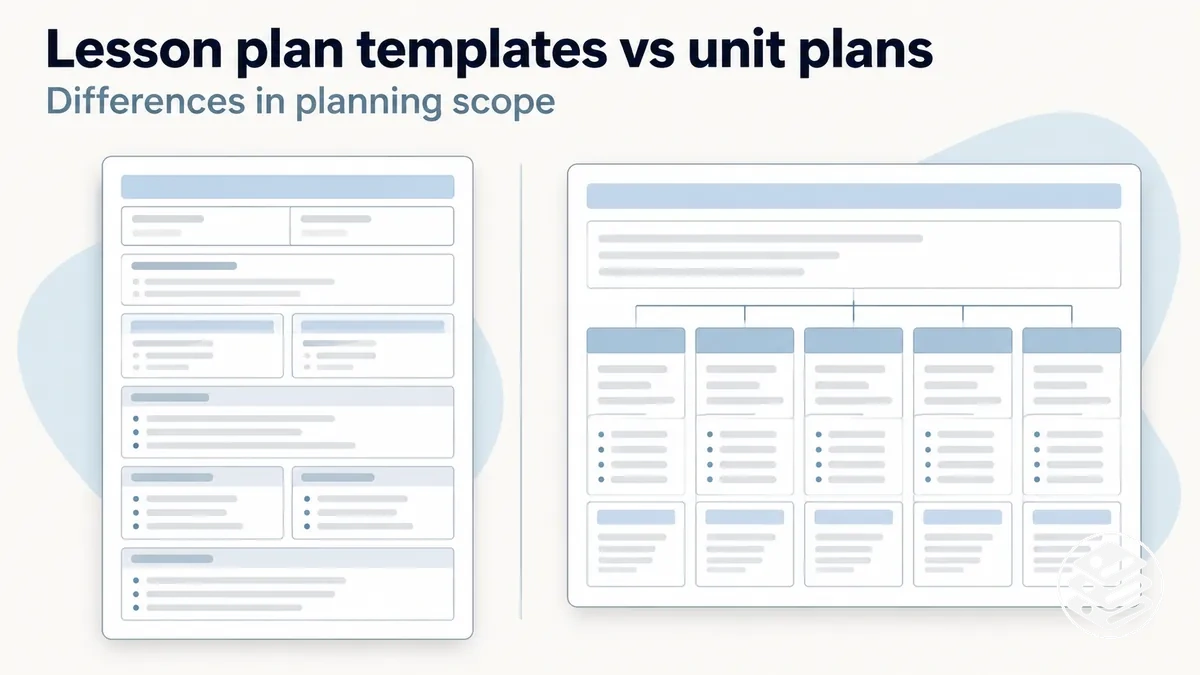
A lesson plan usually covers one instructional episode, such as a class period, while a unit plan spans a connected series of lessons directed toward broader learning outcomes.
Their planning horizons are therefore different: the lesson plan is narrower and more detailed for immediate execution, while the unit plan is broader and sequence-oriented for coordinating progression and pacing.
The comparison is clearest when the same dimensions of scope and timeframe are applied to both planning levels.
The image shows the difference in instructional span, while the table compares planning horizon, lesson coverage, instructional detail, pacing, and flexibility.
Dimension
Lesson Plan
Unit Plan
Planning Implication
Planning horizon
One instructional episode or similarly narrow teaching span
Connected instructional span across multiple lessons
The unit plan coordinates how individual lessons contribute to broader learning outcomes
Instructional detail
Detailed activities, timing, and immediate teaching actions
Sequence-level organisation of content, outcomes, and progression
Detail shifts from individual-lesson execution to coordination across the lesson sequence
Pacing function
Organises pacing within the immediate lesson
Coordinates pacing and progression across multiple lessons
The relevant pacing scale expands with the planning horizon
Day-to-day flexibility
Allows immediate lesson details to be adjusted to the current teaching situation
Allows individual lessons to be adjusted while maintaining the broader sequence
Adjustments occur at different levels of the instructional plan
The defining distinction is the scale of instruction covered, not a universal number of days, lessons, or weeks. Scope determines what each plan must coordinate.
A lesson often corresponds to one teaching session, while a unit extends across multiple related lessons. Exact timeframes vary with the subject, year level, timetable, curriculum, and school context, so a multi-week unit is an illustrative planning horizon rather than a prescribed duration.
How Individual Lesson Plans Fit Within a Unit Sequence
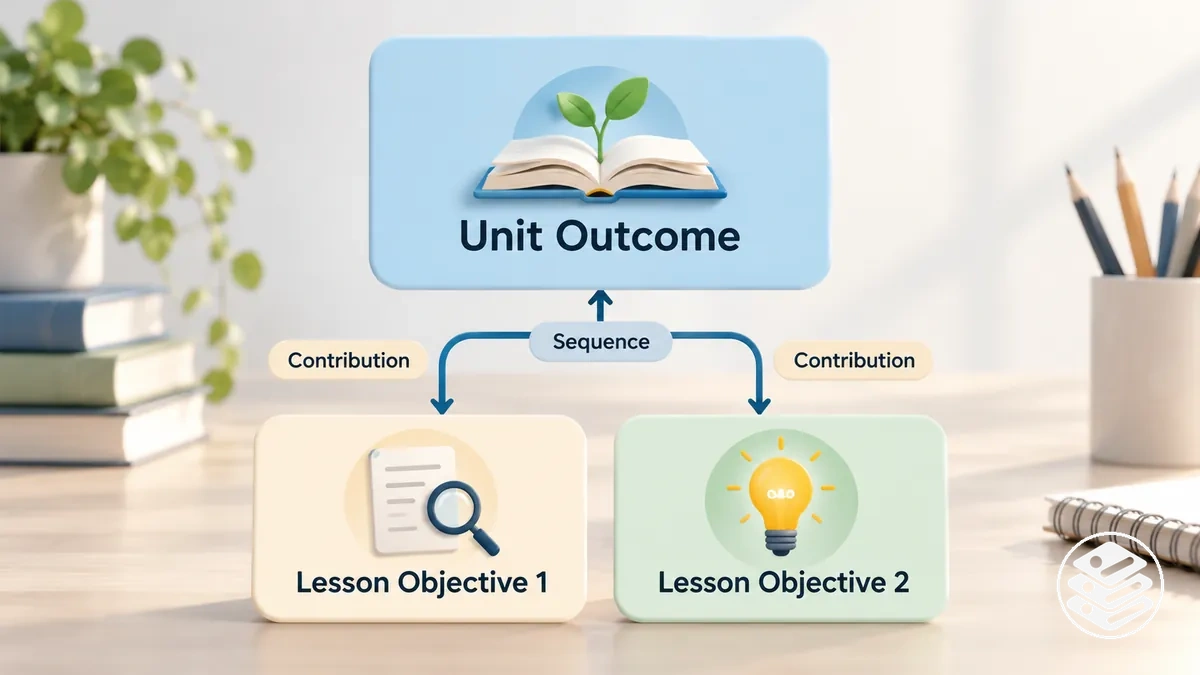
An individual lesson plan should contribute a defined step toward the broader unit outcome rather than operate as an isolated activity.
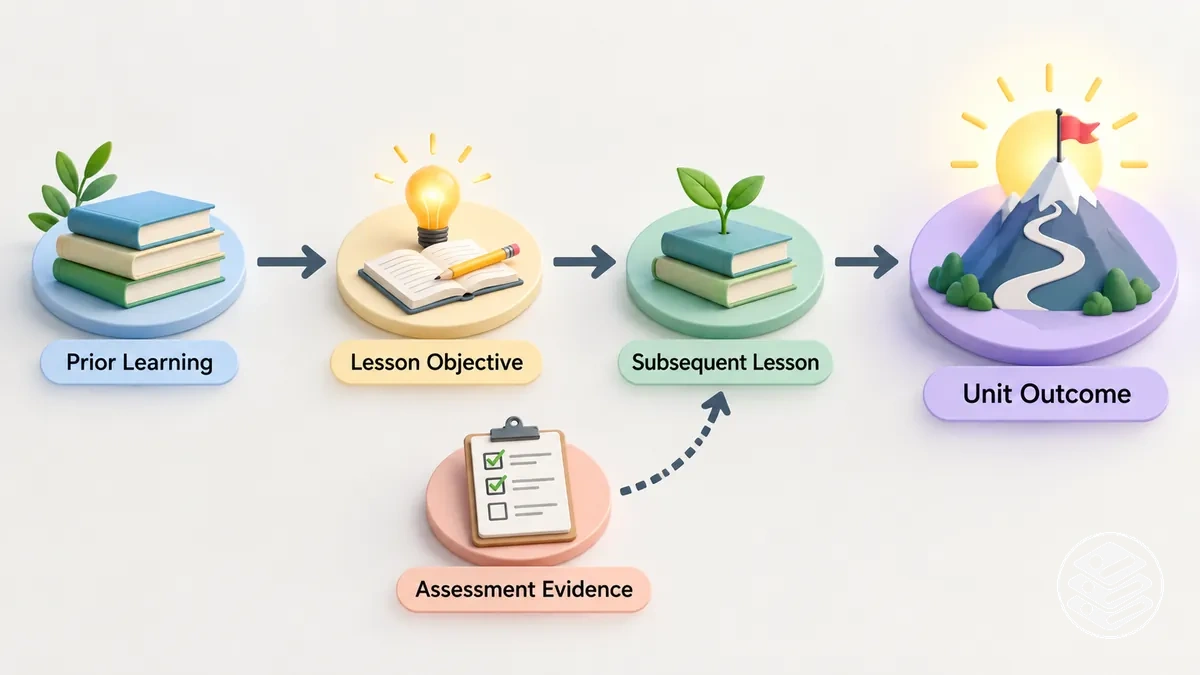
Its lesson objective builds on relevant prior learning and prepares learners for a subsequent lesson within the unit sequence, while the activity and assessment evidence support that specific contribution.
The planning relationship can be organised as a five-part sequence that connects the unit outcome to each lesson's contribution and allows later pacing to respond to evidence.
The exact lesson sequence can vary by subject, learners, timetable, and curriculum.
Establish the unit outcome that gives the lesson sequence its broader instructional direction.
Identify the learning progression so each lesson can build on relevant prior learning and prepare for what follows.
Assign each individual lesson plan a specific contribution by connecting its lesson objective to an appropriate activity within that progression.
Gather assessment evidence from the lesson to identify what learners demonstrated in relation to the lesson objective.
Use that evidence to adjust a subsequent lesson when needed, such as its pacing, activity, or immediate objective, while retaining the broader unit direction.
For example, a unit outcome might require learners to explain a concept using supporting evidence, with one lesson developing the required background knowledge and a later lesson applying it to an explanation.
If assessment evidence from the earlier lesson indicates that important prior learning needs further attention, the subsequent lesson can devote more time or use a different activity to address that knowledge before moving forward.
The lesson objective and pacing can therefore change in response to evidence without requiring the broader unit outcome to change.
This keeps individual lesson plans connected through progression while allowing instructional decisions to respond to what occurs during the sequence.
How Lesson and Unit Plan Components Differ in Level of Detail
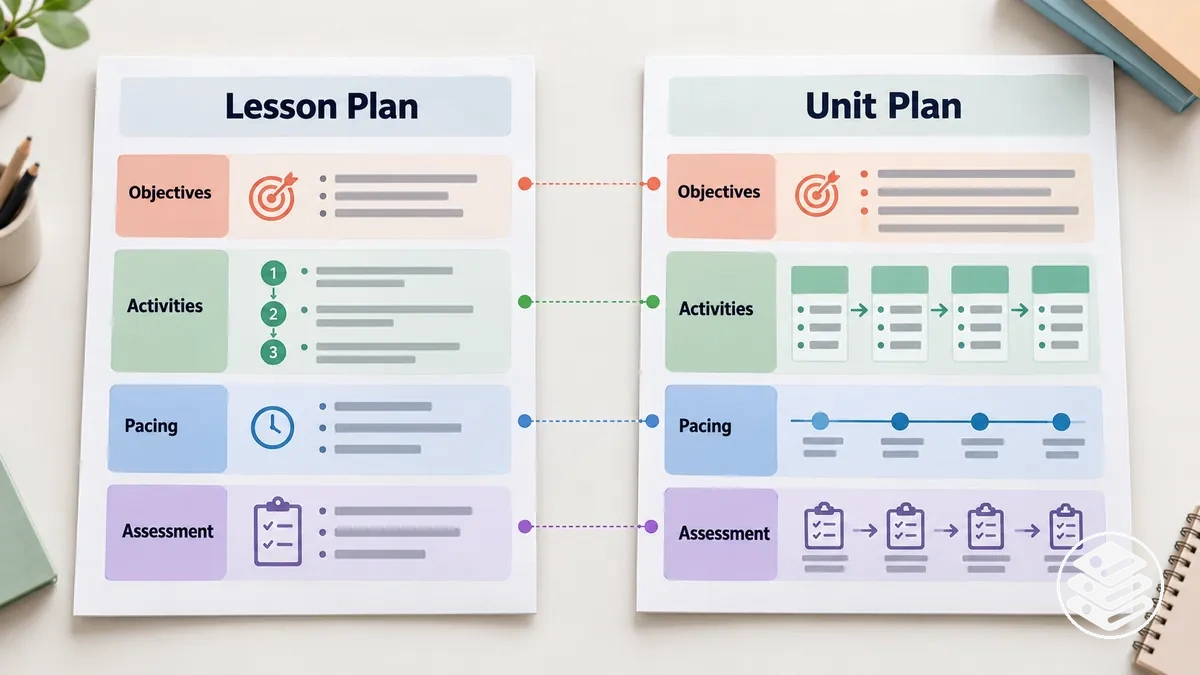
Lesson plan components and unit plan components can use similar planning categories, but they express those categories at different levels of detail.
A lesson plan specifies immediate instructional elements for one lesson, while a unit plan groups or sequences related elements across multiple lessons toward broader unit outcomes.
The comparison below shows how shared objectives, content, activities, resources, pacing, assessment, and adjustments change in specificity according to their planning purpose.
The image makes the difference in granularity visible, while the table compares the instructional function and implication of each component.
Component
Lesson Plan Detail
Unit Plan Detail
Why the Difference Matters
Objectives
Specifies the learning objective addressed within the individual lesson
Summarises or sequences broader unit outcomes across related lessons
Connects immediate instructional intent with the wider direction of the unit
Content/topics
Identifies the specific content or topic addressed during the lesson
Groups and sequences related content or topics across the unit
Distinguishes what is taught now from how content develops across the sequence
Activities
Specifies the teaching and learning activities used during the lesson
Maps or summarises activities across multiple lessons where useful
Supports immediate execution at lesson level and continuity at unit level
Resources
Records resources needed for the immediate lesson activities
Identifies resources required across the broader sequence
Separates lesson-specific preparation from resources needed across multiple lessons
Pacing
Specifies how instructional time is allocated within the lesson
Coordinates pacing and progression across the lesson sequence
Keeps timing decisions appropriate to the planning horizon being managed
Assessment
Records assessment evidence gathered in relation to the lesson objective
Coordinates assessment across the unit, including evidence gathered at different points in the sequence
Distinguishes immediate evidence of learning from assessment considered across the broader unit
Adjustments
Records changes to immediate instruction in response to the lesson context or evidence
Accounts for changes to later lessons, sequence, or pacing when evidence indicates they are needed
Allows instructional decisions to operate at either the individual-lesson or broader sequence level
The main difference is granularity, not whether a planning component exists. Lesson-level objectives, activities, resources, pacing, assessment, and adjustments support immediate instructional decisions; their unit-level counterparts organise continuity and relationships across multiple lessons.
Component names and counts vary by school, curriculum, and planning system, so no list of five, seven, or another number of fields is universal. Compare each field by its function and level of detail rather than assuming every lesson plan or unit plan follows the same structure.
How Objectives, Curriculum, and Assessment Align at Lesson and Unit Levels
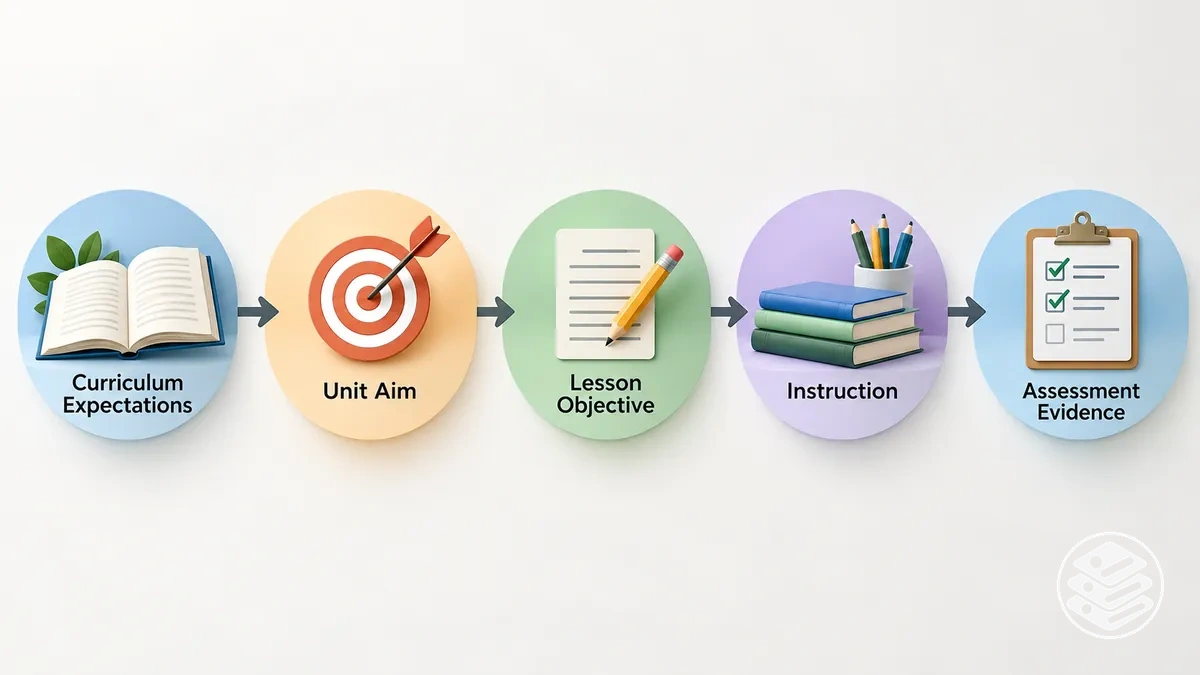
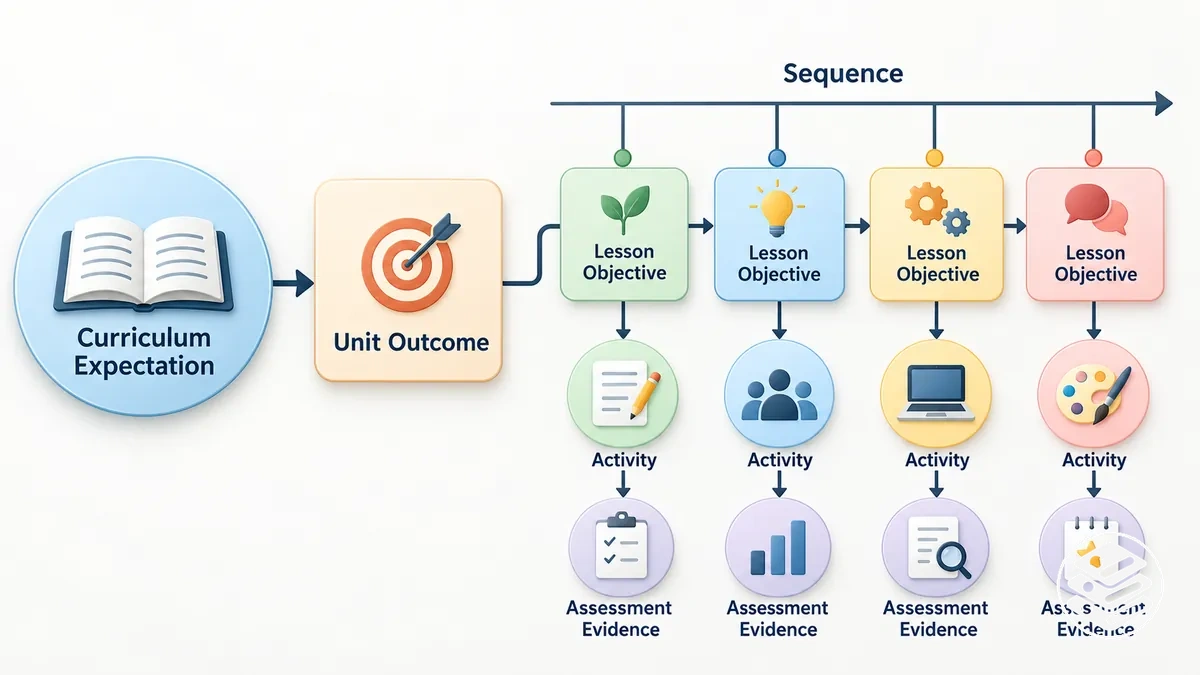
Alignment across lesson and unit plans connects curriculum expectations, unit outcomes, lesson objectives, instructional activity, and assessment evidence so that each planning level serves a related instructional purpose.
Curriculum expectations inform the broader unit outcomes, and those unit outcomes guide the more specific lesson objectives addressed through instructional activity.
In concise form, the relationship is curriculum expectation → unit outcome → lesson objective → instruction → evidence.
At the lesson level, assessment evidence provides immediate information about what learners demonstrated in relation to the current lesson objective and instructional activity, while evidence gathered across multiple lessons can contribute to a broader judgement about progress toward the unit outcome.
The terminology and documentation used for this alignment can differ according to the curriculum framework, school requirements, and planning system.
The underlying relationship remains one of instructional coherence: intended learning guides instruction, and assessment evidence is considered at the lesson or unit level according to the planning purpose.
Learning Objectives at Lesson and Unit Levels
A unit-level objective expresses a broader learning objective or unit outcome across a sequence, while a lesson-level objective specifies the learning contribution expected from an individual lesson.
When the lesson belongs to that unit, its objective contributes to the broader outcome rather than functioning as an isolated target.
Compare the two levels through scope, timeframe, measurability, and dependency. Both can describe observable learning, but evidence is interpreted at the planning scale each objective represents.
Scope: A unit-level objective expresses learning across a broader sequence; a lesson-level objective specifies the contribution of an individual lesson.
Timeframe: A unit-level objective extends across the relevant unit sequence; a lesson-level objective applies to the instructional timeframe of its lesson.
Measurability: Progress toward either objective level can be evaluated with relevant assessment evidence; lesson evidence addresses the immediate objective, while evidence across the sequence can inform progress toward the broader unit outcome.
Dependency: When a lesson is part of a unit, its lesson objective contributes to the broader unit outcome and supports progression through the sequence.
For example, a unit outcome could ask learners to compare how evidence supports different explanations, while a contributing lesson objective could ask them to identify evidence supporting two explanations in a specific text.
This paired example shows how a measurable lesson contribution can advance the broader outcome without duplicating its full scope.
Curriculum Alignment Across Individual Lessons and the Wider Unit
Curriculum alignment operates at two connected scales: a unit plan maps a broader curriculum expectation to a unit outcome across a sequence, while each lesson plan connects its lesson objective, instructional activity, and assessment evidence to the relevant part of that mapped intent.
The distinction is one of scale and contribution rather than separate alignment systems.
At unit level, curriculum alignment distributes the curriculum expectation across the sequence so that the unit outcome provides a coherent direction for the lessons.
At lesson level, the lesson objective aligns with the relevant part of that unit outcome, while the instructional activity supports that objective and assessment evidence indicates what learning was demonstrated in relation to it.
This creates coherence from curriculum expectation to unit outcome to lesson objective, activity, and evidence without requiring curriculum wording to be repeated mechanically in every planning field.
For example, a curriculum expectation concerning analysis of evidence could be represented by a unit outcome developed across several lessons, with one lesson focusing on identifying relevant evidence and a subsequent lesson applying that evidence to an explanation.
The exact terminology and mapping practice can depend on the curriculum framework and school requirements, but alignment remains coherent when each lesson contributes to the mapped unit outcome.
Assessment Evidence Within Lessons and Across the Unit
Assessment evidence serves different planning decisions according to its scope, timing, and instructional use.
Assessment evidence at two planning scales
Lesson level
Scope
The current lesson objective and what learners demonstrate within or soon after that lesson
Use
Inform a near-term instructional decision, such as whether to reteach, practise, or adjust the next lesson
Possible evidence
Diagnostic or formative checks linked to the immediate objective
Unit level
Scope
Progress toward the broader unit outcome across the relevant sequence
Use
Judge broader progress and adjust sequence-level pacing or later instruction
Possible evidence
Accumulated formative evidence and, where appropriate, a culminating or summative assessment
Key boundary: diagnostic, formative, and summative functions are not exclusive to one planning level, and no single result should be treated as proof of learning.
For example, an in-lesson formative check might indicate that learners need further practice with a concept, which can inform the instructional decision for the next lesson.
Evidence accumulated across subsequent lessons, together with an appropriate culminating assessment where used, can then contribute to a broader judgement about progress toward the unit outcome.
When Teachers Need a Lesson Plan, a Unit Plan, or Both
The appropriate planning level depends on the planning scale, the instructional detail needed for execution, the need to coordinate a multi-lesson progression, and any local school requirements.
A lesson plan fits an immediate teaching-session need, a unit plan supports unit-level coherence across a sequence, and both can be used together when strategic planning and day-to-day execution are required.
The decision can be made by matching the current planning need to its main condition and implication.
Use a lesson plan when the immediate need is one teaching session with specific activities, timing, and instructional detail.
Use a unit plan when the need is to coordinate a multi-lesson progression, broader outcomes, pacing, and continuity across a sequence.
Use both when you need sequence-level coherence and day-to-day execution detail; the unit plan provides broader direction and lesson plans support immediate teaching decisions.
Follow local requirements when a school or system specifies the planning documents or fields that must be used.
A standalone lesson may require only lesson-level detail, whereas a connected multi-lesson unit benefits from unit-level coordination; using both preserves the link between sequence-level intent and immediate teaching decisions. School requirements, subject conventions, teacher experience, and instructional context can still determine which documents are required or useful, so neither planning level is mandatory everywhere.